In 2025, Israel remains at the center of several major conflicts in the Middle East. With regional tensions escalating—especially following its military operations against Iran—understanding Israel’s goals is more crucial than ever. This article presents a comprehensive, neutral overview of what Israel wants based on the latest developments.
Eliminating Iran’s Nuclear and Missile Capabilities
One of Israel’s foremost objectives is to prevent Iran from acquiring nuclear weapons and expanding its long-range missile program. This priority has driven military operations such as “Operation Rising Lion,” which targeted Iranian nuclear sites (like Natanz), missile depots, and senior military figures. Israel views these efforts as a matter of national survival.
According to Israeli officials, the short-term goal is to disrupt Iran’s enrichment capacity and missile readiness. The long-term vision is to delay or permanently degrade Iran’s ability to rebuild these capabilities. While tactical successes have been claimed, many analysts point out the difficulty of destroying a dispersed, clandestine nuclear infrastructure solely through military strikes.
Pressuring Iran’s Regime
While regime change is not an officially declared goal, Israeli rhetoric and strategy suggest that it sees the Iranian government as a core source of regional instability. Prime Minister Netanyahu has encouraged Iranian citizens to rise against what he describes as an “evil and oppressive” regime. Although there is no official Israeli policy aimed at removing Iran’s Supreme Leader, the indirect goal appears to be weakening the regime’s grip through external and internal pressure.
Israel’s message to the Iranian public reflects a broader strategy: to isolate Iran internationally and create conditions for internal dissent. However, such efforts remain politically sensitive and face strong international scrutiny.
Maintaining Military Pressure over Diplomacy
Israel is not currently prioritizing diplomacy in its dealings with Iran. Following Iran’s withdrawal from nuclear talks in early 2025, Israeli officials reiterated that their military campaign is far from over. The focus is firmly on achieving strategic deterrence and degrading Iran’s capabilities rather than rushing into ceasefire negotiations or diplomatic settlements.
This stance reflects Israel’s belief that military pressure, not negotiation, is the most effective tool for preventing Iran from becoming a nuclear state. As a result, Israel is willing to bear short-term international criticism and regional instability in pursuit of its long-term security objectives.
Controlling and Demilitarizing Gaza
Parallel to its Iran strategy, Israel is intensifying efforts to dismantle Hamas’s control in Gaza. This includes the construction and enforcement of security corridors such as the Philadelphi and Morag corridors. These physical barriers are designed to fragment Gaza, limit Hamas’s mobility, and enable targeted military operations.
Israel has made it clear that it does not support the creation of a Palestinian state. Its current government is firmly opposed to the two-state solution, and sees the complete demilitarization of Gaza as a prerequisite for any long-term peace or stability.
Securing Strategic Regional Buffers
Israel’s security doctrine includes maintaining buffer zones in conflict-prone regions such as southern Syria and the Lebanon border. These areas have historically served as transit routes for weapons smuggling and as launching pads for militant activity. By controlling or influencing these regions, Israel aims to preempt threats from Hezbollah and Iranian proxy forces.
Regular airstrikes and intelligence operations in Syria and Lebanon reflect this proactive strategy. While critics argue that such actions contribute to regional destabilization, Israel insists that these are necessary defensive measures.
Rejecting the Two-State Solution
The current Israeli leadership has repeatedly stated its opposition to the creation of a Palestinian state. It argues that such a state would serve as a base for extremism and terrorism, undermining Israel’s security. This position has been a major sticking point in international negotiations and continues to draw global criticism.
Despite international pressure, Israel remains steadfast in its belief that territorial concessions and sovereignty for the Palestinians would compromise its strategic depth and national safety.
Conclusion
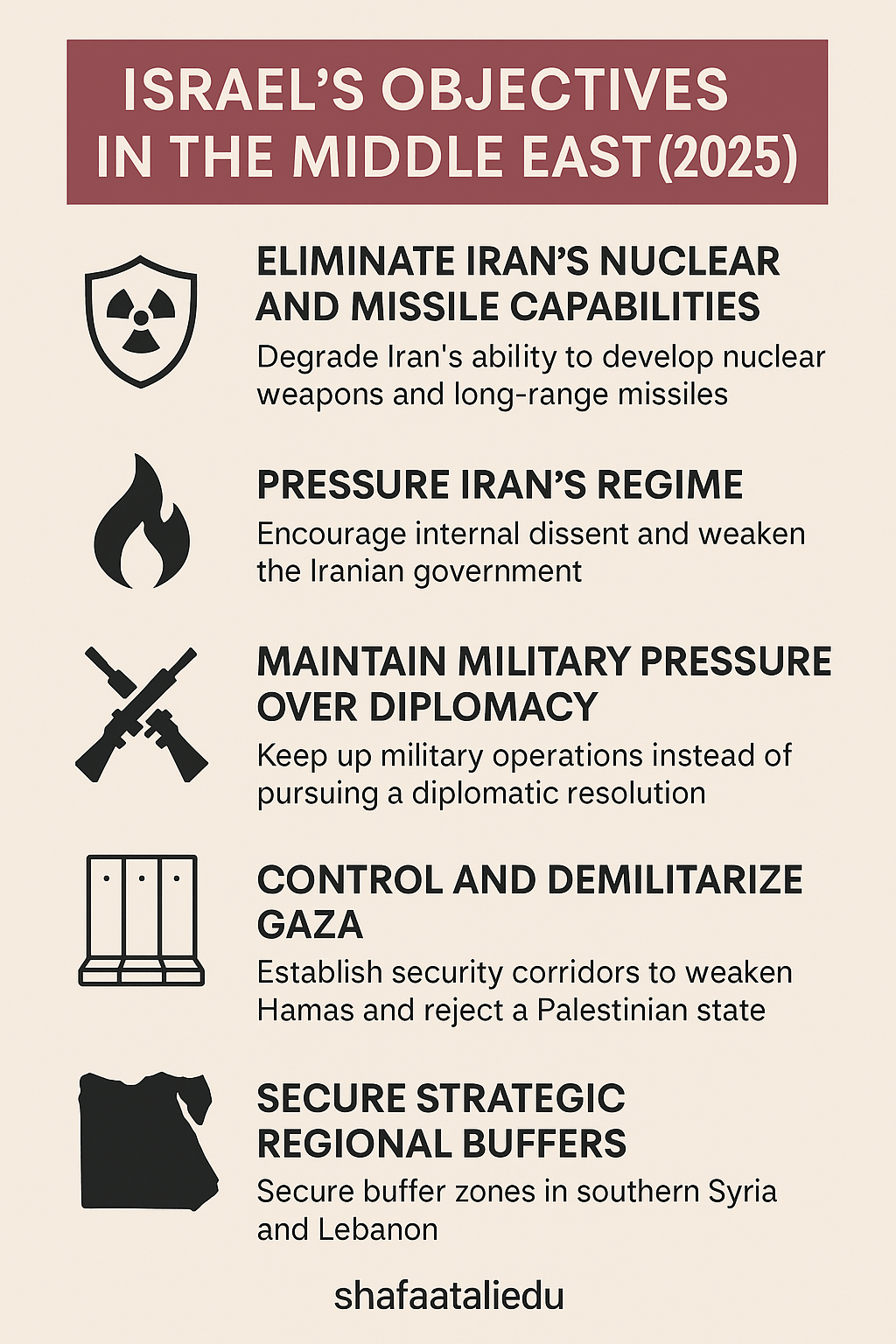
Israel’s current strategy in the Middle East is shaped by a combination of military assertiveness and long-standing security concerns. Its objectives in 2025 can be summarized as follows:
- Prevent Iran from becoming a nuclear power
- Pressure the Iranian regime without formally seeking regime change
- Maintain military operations over diplomatic talks
- Control and demilitarize Gaza while opposing a Palestinian state
- Secure buffer zones in Syria and along the Lebanon border
While Israel argues that these measures are essential for its survival, critics warn of the long-term risks: prolonged conflict, humanitarian crises, and regional instability. Nevertheless, as of mid-2025, Israel shows no sign of changing its current course, remaining focused on deterrence, strategic dominance, and national security above all else.

Leave a comment