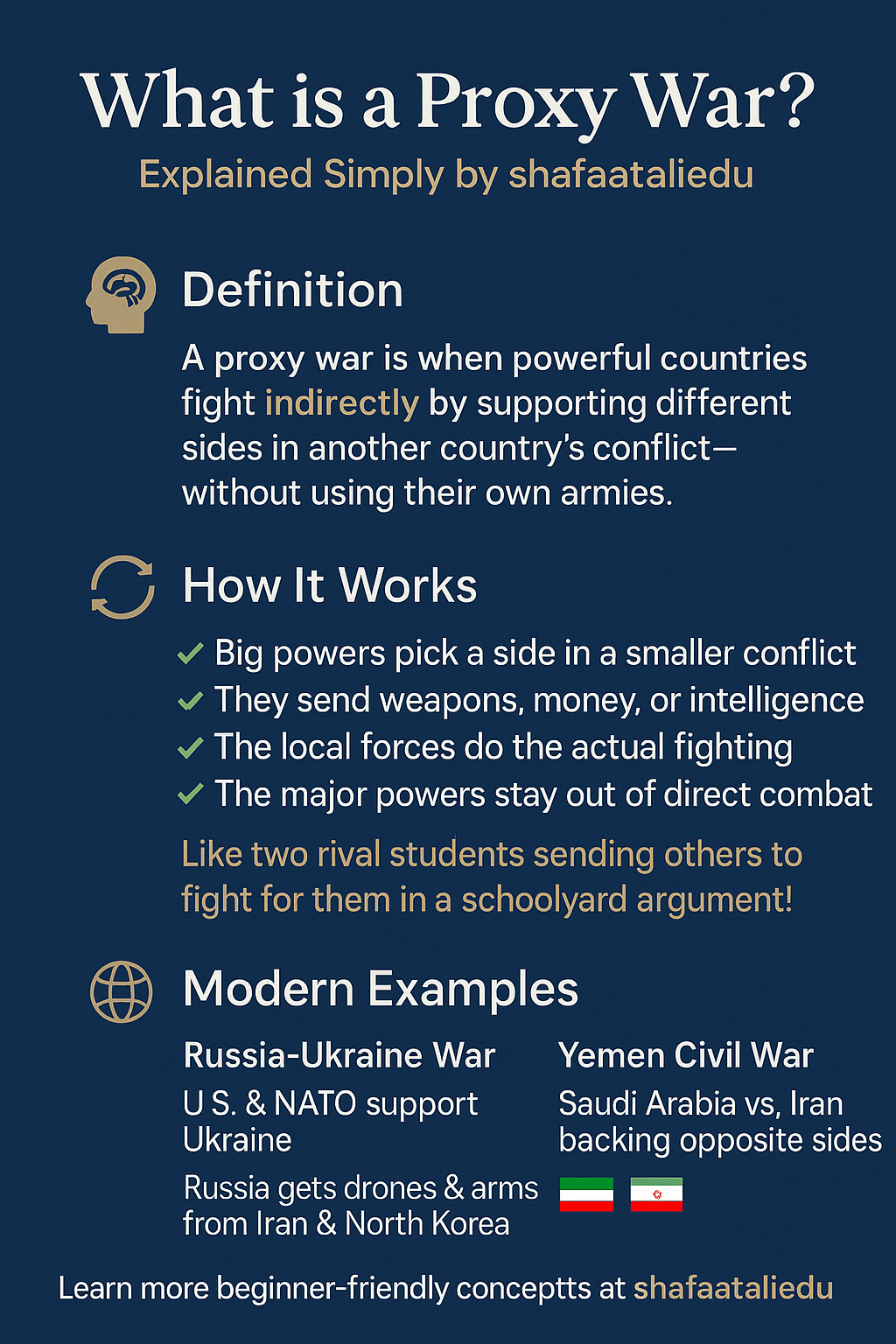
A proxy war is when two or more powerful countries support opposing sides in a conflict, without directly fighting each other. Instead of using their own armies, they provide weapons, funding, intelligence, or training to local forces. These wars often happen in smaller or less powerful nations, where the bigger players try to gain influence without risking a direct war.
A current example is the Russia-Ukraine war, which many analysts describe as a modern proxy war. While Ukraine and Russia are the direct combatants, countries like the United States and NATO allies have heavily supported Ukraine with weapons, funds, and intelligence. On the other hand, Russia has received growing support from countries like Iran and North Korea, including drones and ammunition. These indirect involvements reflect larger global power struggles.
Another active case is the civil war in Yemen, where Saudi Arabia and Iran support opposing sides. Saudi Arabia backs the Yemeni government, while Iran supports the Houthi rebels. This conflict is part of a broader rivalry for influence in the Middle East.
Proxy wars usually arise from geopolitical tensions, such as the competition between the U.S., China, and Russia. These powers avoid direct clashes to prevent world wars or nuclear escalation, but still try to shift the balance of power by involving themselves behind the scenes.
For the countries where proxy wars happen, the impact is severe: longer wars, more civilian casualties, and deep political instability.
As global rivalries grow in areas like Africa and the Indo-Pacific, experts warn that more proxy wars could emerge. Understanding how these indirect conflicts work helps us see the hidden hands behind many of today’s battles—and reminds us that peace often depends not just on the fighters, but on those who fuel the fight.

Leave a comment