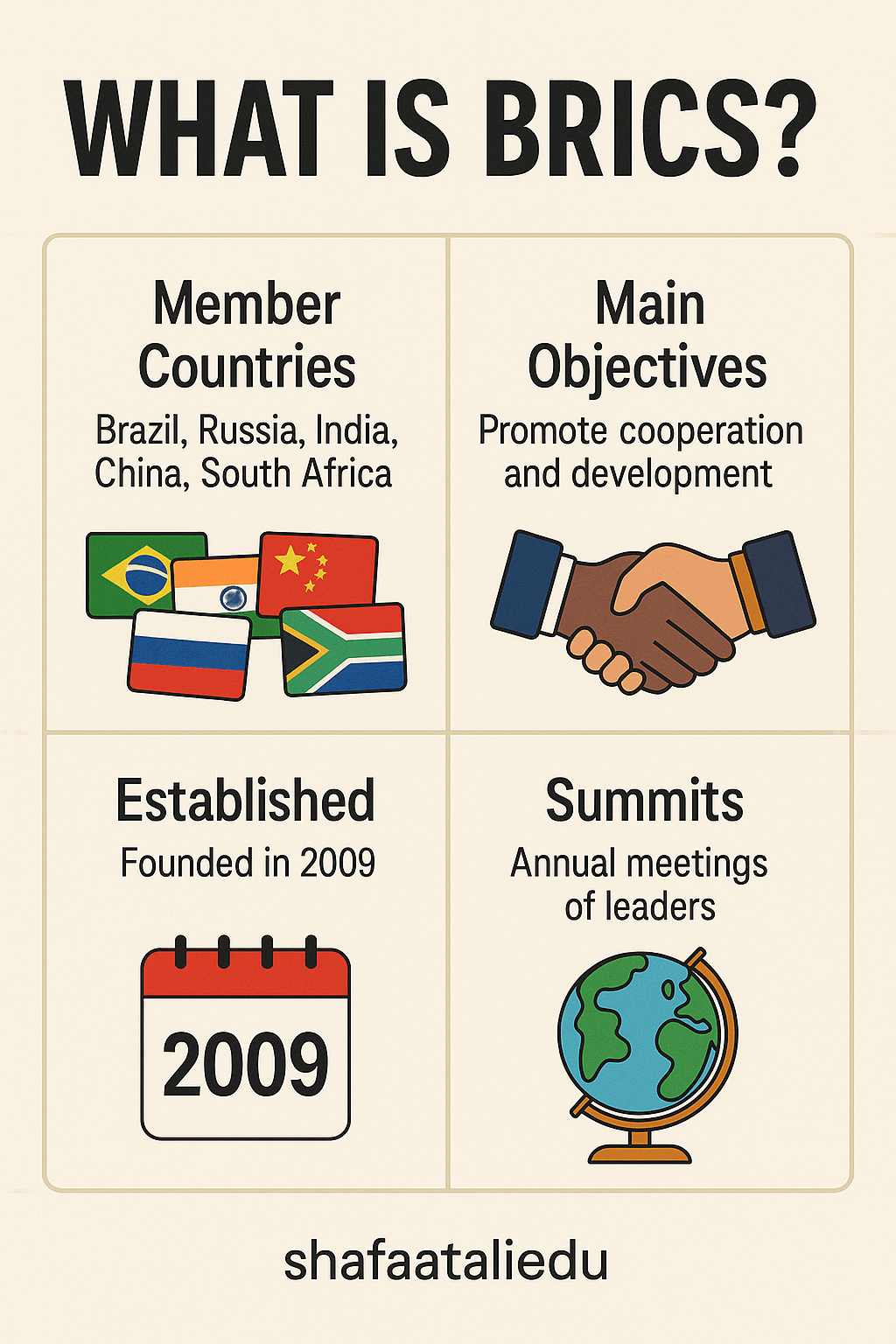
BRICS is a group of five major emerging economies: Brazil, Russia, India, China, and South Africa. The name “BRICS” comes from the first letters of each country. These nations came together to form a partnership that focuses on boosting their economic growth and influencing global affairs—especially as a counterbalance to Western-dominated institutions like the IMF and World Bank.
Imagine a group of friends in school who decide to work together on projects to get better results. Each brings something unique to the table—like one being good at math, another at science, and so on. That’s how BRICS works. For example, China and India are known for their large populations and fast-growing economies. Russia contributes energy resources, Brazil has a wealth of natural resources, and South Africa brings access to African markets.
The BRICS countries first met informally in 2006 and officially became a group in 2009. South Africa joined a year later, making it BRICS instead of just BRIC. Since then, they’ve held yearly summits to discuss issues like trade, development, and global politics.
One major achievement of BRICS is the creation of the New Development Bank (NDB) in 2014. This bank gives loans for infrastructure and sustainable development projects in member countries and other developing nations—much like the World Bank, but with more equal influence among its members.
BRICS is important because it represents over 40% of the world’s population and about 25% of global GDP. Though they differ in culture and politics, they share a common goal: to have a stronger voice in shaping the global economy.
Looking ahead, BRICS may continue to grow and possibly include more countries, reshaping how international cooperation works in the 21st century.

Leave a comment