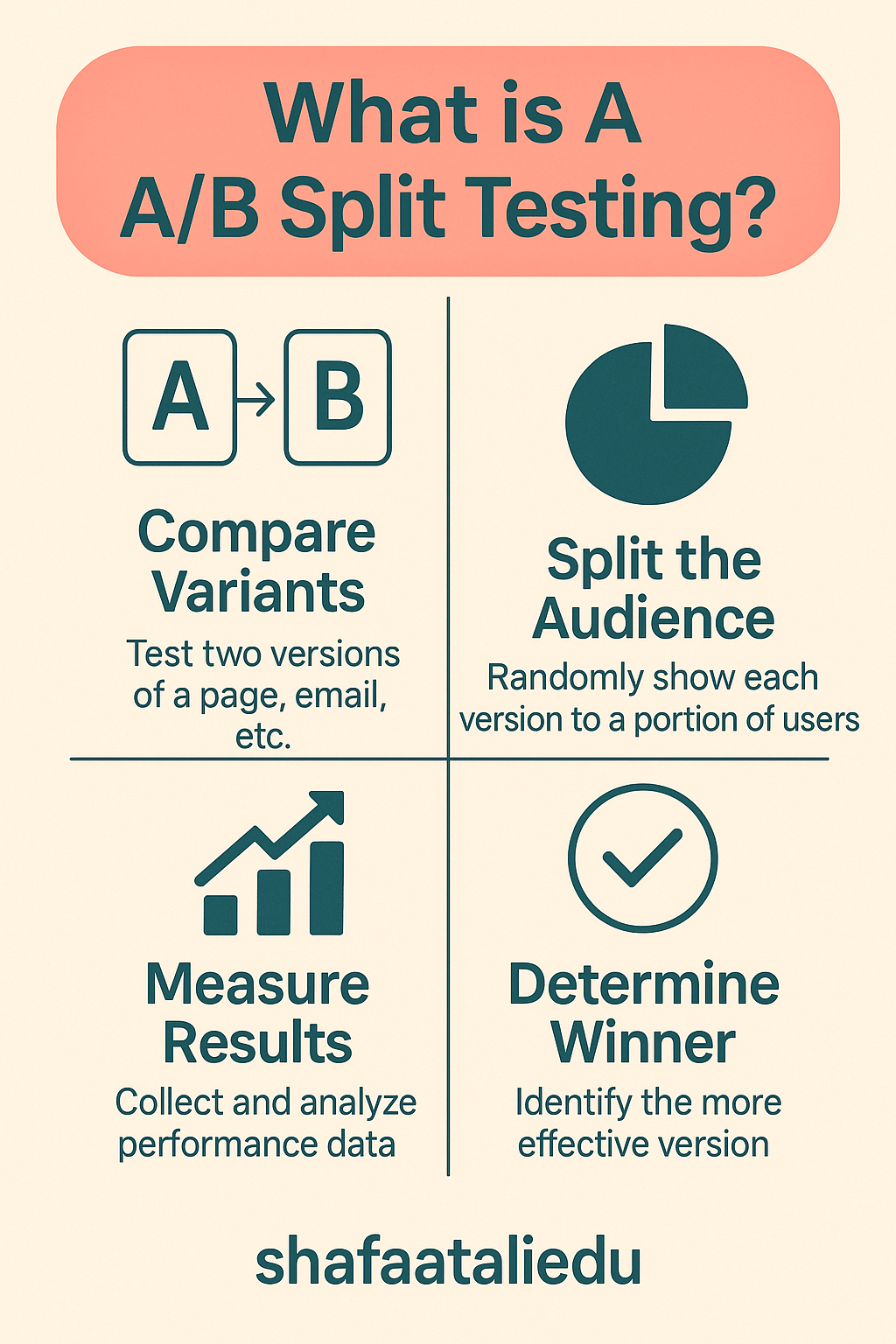
Ever wondered how websites decide which version of a page gets the most clicks or sales? That’s where A/B Split Testing comes in. It’s a simple yet powerful way to compare two versions of something—like a webpage, ad, or email—to see which one performs better.
Imagine you own an online store. You design two versions of a “Buy Now” button: one is red (Version A), and the other is green (Version B). You show Version A to half your visitors and Version B to the other half. After some time, you check which button got more clicks. The winning version is the one more people interacted with. That’s A/B Testing in action!
Here’s how it works, step by step:
- Choose what to test – It could be a headline, button color, image, or even an entire page layout.
- Create two versions – Keep everything the same except for the one element you’re testing.
- Split your audience – Randomly show Version A to one group and Version B to another.
- Measure results – Use analytics tools to see which version got more engagement.
- Pick the winner – Go with the version that meets your goal better, like more sign-ups or clicks.
A/B testing is widely used in marketing, web design, and app development. It takes the guesswork out of decision-making by letting real user behavior guide changes.
As businesses compete for attention online, even small improvements can lead to big results. Whether you’re running a blog or a global company, A/B testing helps you learn what truly works.
Looking ahead, A/B testing is evolving with AI and automation, making it faster and smarter than ever. Soon, you might not just test A vs. B—but A through Z.

Leave a comment