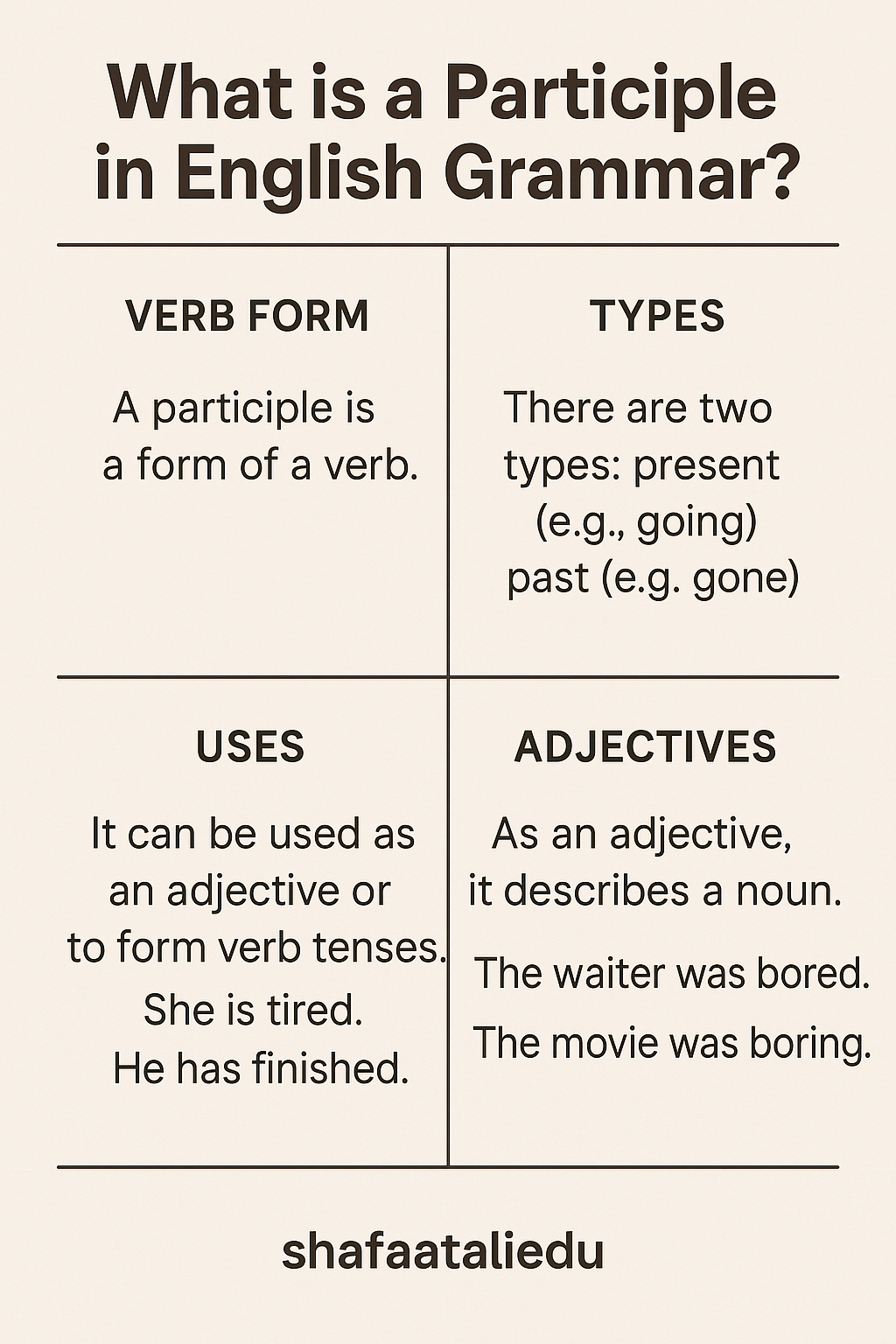
A participle is a special form of a verb that acts like an adjective. Sounds confusing? Let’s break it down.
Imagine verbs are action words—like run, eat, or sing. Now, sometimes we want to describe a noun (person, place, or thing) using these actions. That’s where participles come in. They let us turn a verb into something that describes.
There are two main types of participles: present participles and past participles.
- A present participle ends in -ing. For example:
- The running water relaxed me.
Here, running comes from the verb “run” but now describes the water.
- The running water relaxed me.
- A past participle usually ends in -ed, -d, -t, -en, or -n (depending on the verb). For example:
- The baked cookies smell delicious.
Here, baked describes the cookies. It comes from the verb “bake.”
- The baked cookies smell delicious.
Now here’s where it gets cooler—participles are also used to form verb tenses:
- She is running. (present participle)
- They have eaten. (past participle)
Quick Example:
Think of a participle as a snapshot of an action being used to describe something. If verbs are movies, participles are freeze-frames turned into adjectives.
Why should you care?
Because participles let your sentences become richer and more descriptive. Instead of saying, The man was tired. He sat down, you could say, The tired man sat down. See the difference?
Looking ahead, participles are the building blocks of more advanced grammar like participial phrases, so understanding them now sets you up for success later.

Leave a comment