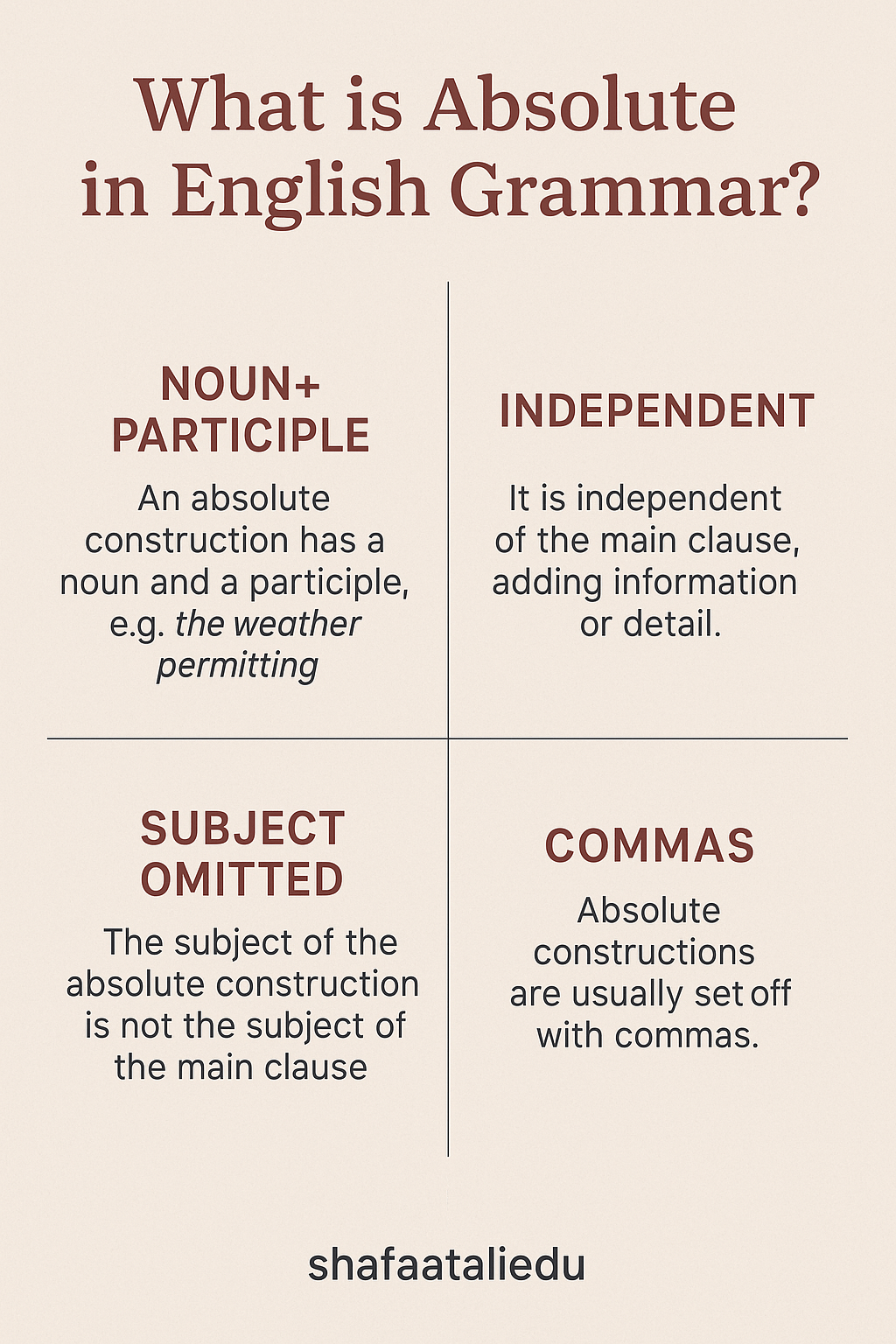
In English grammar, an absolute phrase is a group of words that adds extra information to a sentence but isn’t connected directly by a conjunction like “and” or “but.” It usually includes a noun or pronoun followed by a participle (a verb form ending in -ing or -ed) and gives background detail, often about time, condition, or cause.
Think of an absolute phrase as a mini-scene running alongside the main sentence. For example:
“The sun setting, we packed up our picnic.”
Here, “The sun setting” is the absolute phrase. It doesn’t change the main action—“we packed up our picnic”—but adds detail to set the mood and time.
Structure of an Absolute Phrase:
- Noun or pronoun
- A participle (verb form)
- Optional modifiers or objects
Example:
“Her arms folded across her chest, she waited quietly.”
This phrase gives you a visual of what’s happening without using a conjunction.
Key Points to Remember:
- Absolute phrases don’t act as the subject or verb of the main sentence.
- They are grammatically independent but contextually connected.
- Removing the absolute phrase won’t make the sentence ungrammatical, but it will lose richness or detail.
Why Use Absolutes?
They’re great for creating vivid imagery or giving background without breaking the flow. Writers often use them in fiction, journalism, and storytelling to enhance description and mood.
As you continue reading or writing, notice how absolute phrases subtly shape scenes. With a little practice, you’ll start using them to add depth and texture to your own writing.

Leave a comment