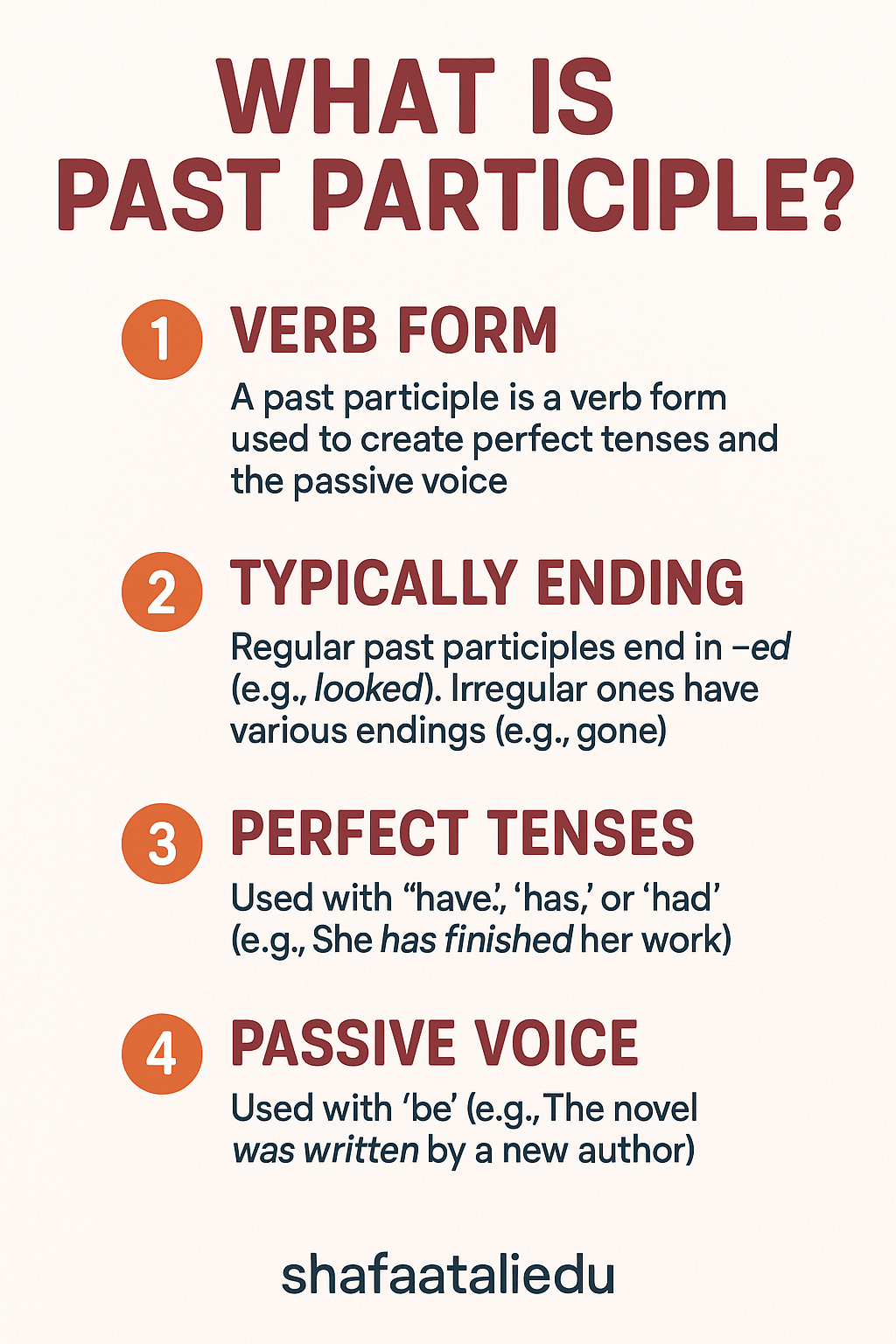
The past participle is a verb form that’s often used to show completed actions or states. It usually ends in -ed for regular verbs, like walked, jumped, or called. But with irregular verbs, the past participle can look completely different, like eaten (from eat), gone (from go), or written (from write).
To understand it better, let’s compare verb forms using an example:
- Base form: eat
- Past tense: ate
- Past participle: eaten
You won’t usually use the past participle on its own—it works with helping verbs like has, have, had, is, was, or been. Here’s how it works in real sentences:
- She has eaten breakfast. (Here, eaten is the past participle, used with has.)
- The book was written by a famous author. (Written is the past participle, used with was.)
Think of the past participle like the final product in a recipe. The action (verb) has already happened and you’re just showing the result. Regular verbs are like recipes you follow every time, but irregular verbs are like grandma’s secret dishes—you just have to memorize them!
We also use past participles in the passive voice (e.g., The window was broken) and perfect tenses (e.g., They have finished their homework).
So, whether you’re describing what you have done, what was done, or what had happened, the past participle helps give clarity and timing to your sentence.
Keep exploring verb forms—it’s one of the easiest ways to strengthen your grammar and sound more natural in English!

Leave a comment