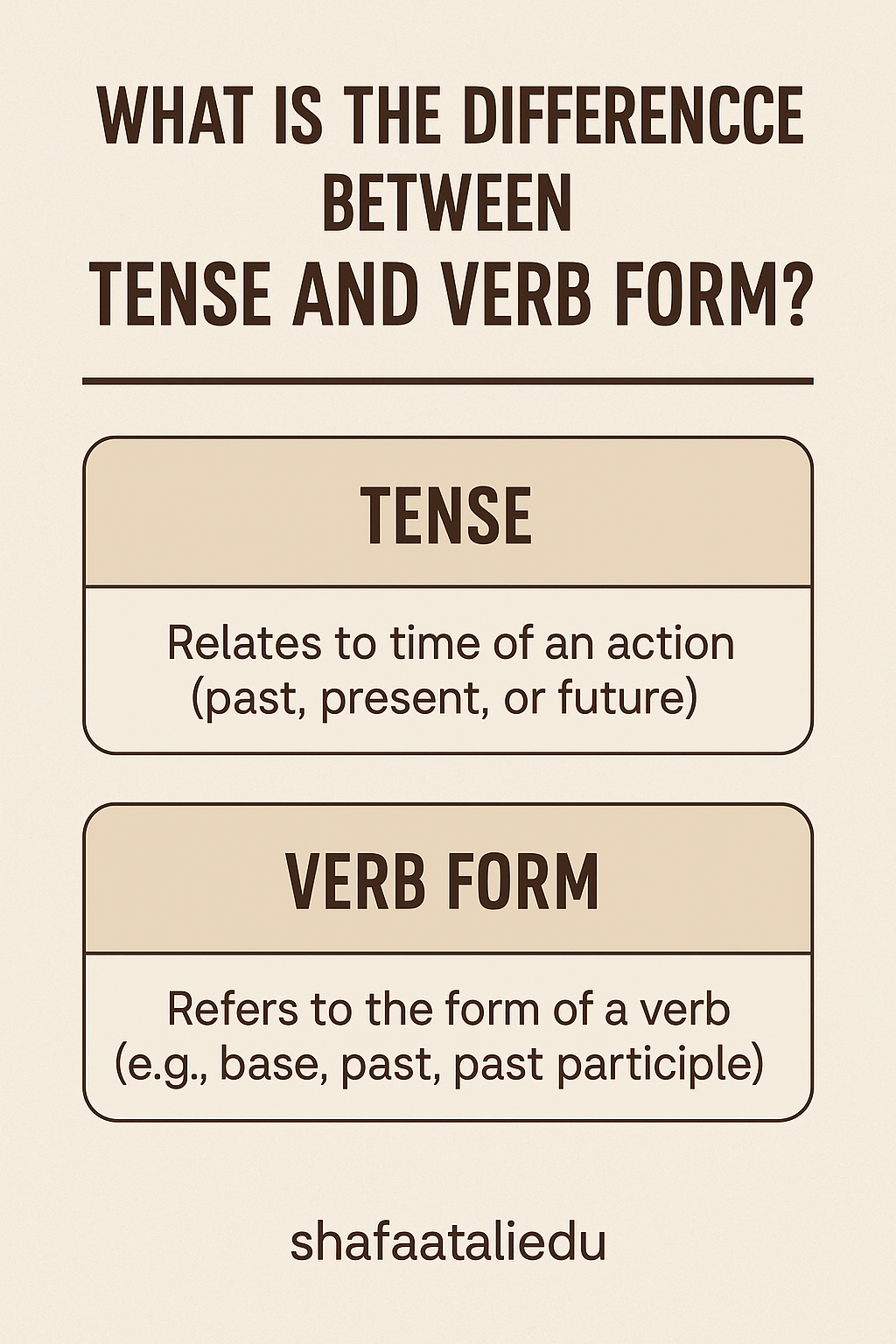
Tense and verb form are closely related, but they’re not the same thing. Let’s break them down in simple terms.
Tense is all about time. It tells you when something happens—past, present, or future. For example:
- I walk to school. (Present tense)
- I walked to school. (Past tense)
- I will walk to school. (Future tense)
Each of these shows when the action occurs. That’s the job of tense.
Now, verb form is the shape or version of the verb that you use to express different meanings, not just time. English verbs have several forms:
- Base form – walk, eat, go
- Past tense form – walked, ate, went
- Past participle – walked, eaten, gone
- Present participle – walking, eating, going
- Third person singular – walks, eats, goes
These verb forms are like the different “tools” you can use to build tenses or structures. For instance:
- To make present continuous: use is + present participle → She is walking.
- To make past perfect: use had + past participle → He had gone home.
So, tense = time, and verb form = the version of the verb you use to create tenses and other grammatical structures.
Think of it this way:
Tense is the clock, and verb forms are the building blocks you use to tell the story at the right time.
Mastering both helps you express yourself clearly and accurately in English!

Leave a comment