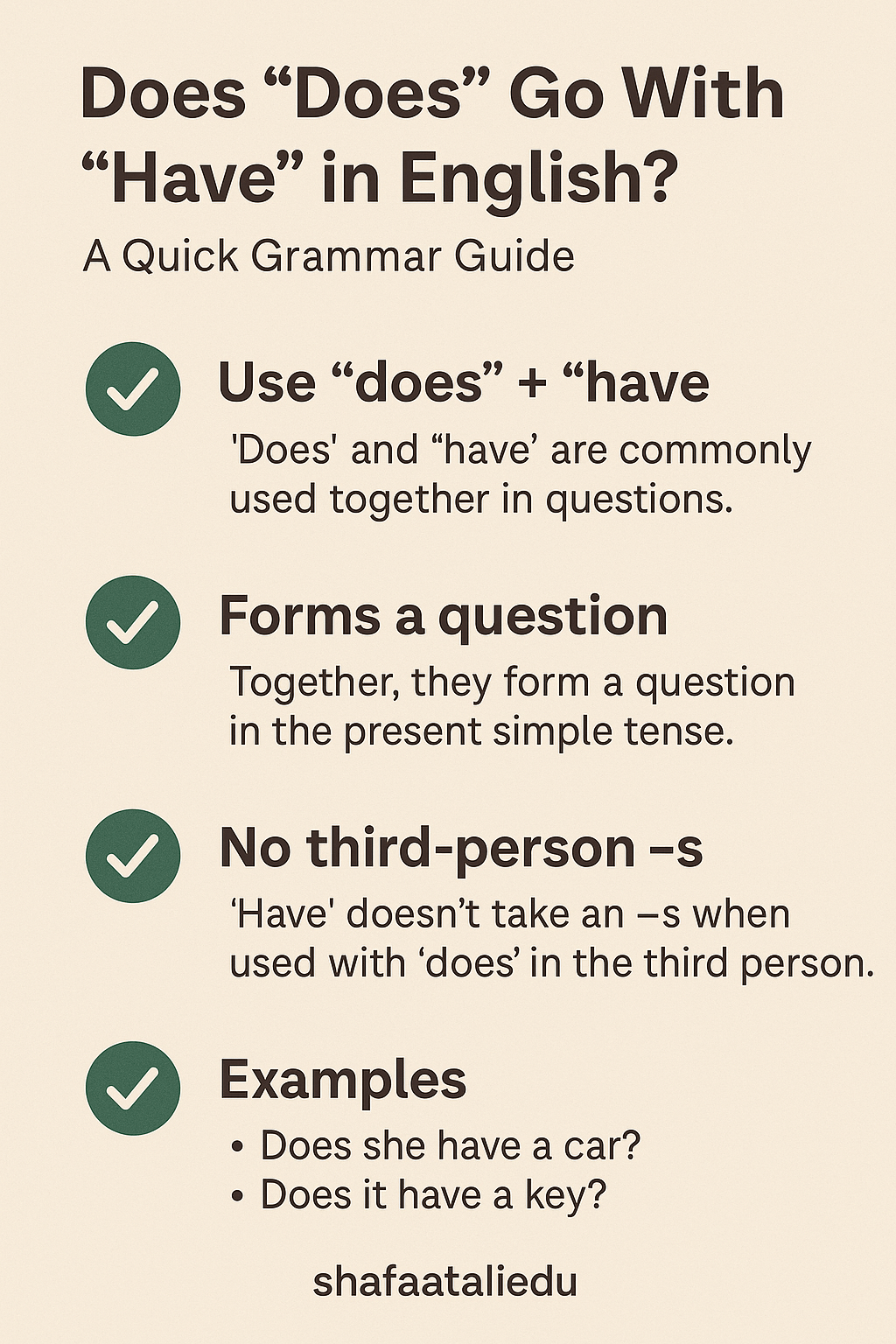
If you’ve ever wondered whether it’s correct to say “Does she have a car?” or “Does she has a car?”, you’re not alone. English learners often get confused about using “does” and “have” together. This quick guide clears it up with simple rules, examples, and grammar tips.
✅ Can We Use “Does” With “Have”?
Yes, we use “does” with the base form of the verb “have” — especially in questions and negative statements in the present simple tense.
🧠 Why Use “Does” With “Have”?
In English grammar, “does” is an auxiliary (helping) verb used with he, she, it, or singular nouns to:
- Form questions
- Make negative sentences
When you use “does,” the main verb (have) stays in its base form (not “has”).
🗂️ Grammar Structure
| Type | Subject | Correct Form |
|---|---|---|
| Positive | She | She has a laptop. |
| Question | Does she | Does she have a laptop? |
| Negative | She doesn’t | She doesn’t have a laptop. |
🔑 Rule: With “does,” never use “has.” Always use “have.”
✍️ Examples
✔️ Correct:
- Does your friend have a passport?
- He doesn’t have any money.
- Does it have a touchscreen?
❌ Incorrect:
- Does your friend has a passport?
- He doesn’t has any money.
- Does it has a touchscreen?
💡 Quick Tips
- ✅ Use “does + have” for he, she, it.
- ❌ Never say “does has” — it’s grammatically incorrect.
- Use “do + have” with I, you, we, they.
📝 Practice Sentences
Fill in the blanks:
- Does she ___ a bike? → have
- He doesn’t ___ time. → have
- Does it ___ a name? → have
🧠 Bonus Tip: “Do” vs “Does”
| Subject | Use | Example |
|---|---|---|
| I / You / We / They | do + have | Do they have children? |
| He / She / It | does + have | Does she have a problem? |
📚 Conclusion
So yes — “does” goes with “have,” not “has.”
Just remember: when “does” is your helper, “have” stays simple and clean.

Leave a comment