📌 Introduction
The word “have” is one of the most commonly used verbs in English. But despite its simplicity, it plays many roles in different sentence types. Whether you’re talking about ownership, actions, or forming questions and negatives, knowing how and when to use “have” is essential for speaking and writing correctly.
This article will explain everything you need to know about “have” — what it means, how it’s used, and how it differs from “has” and “had.”
📖 What is “Have”?
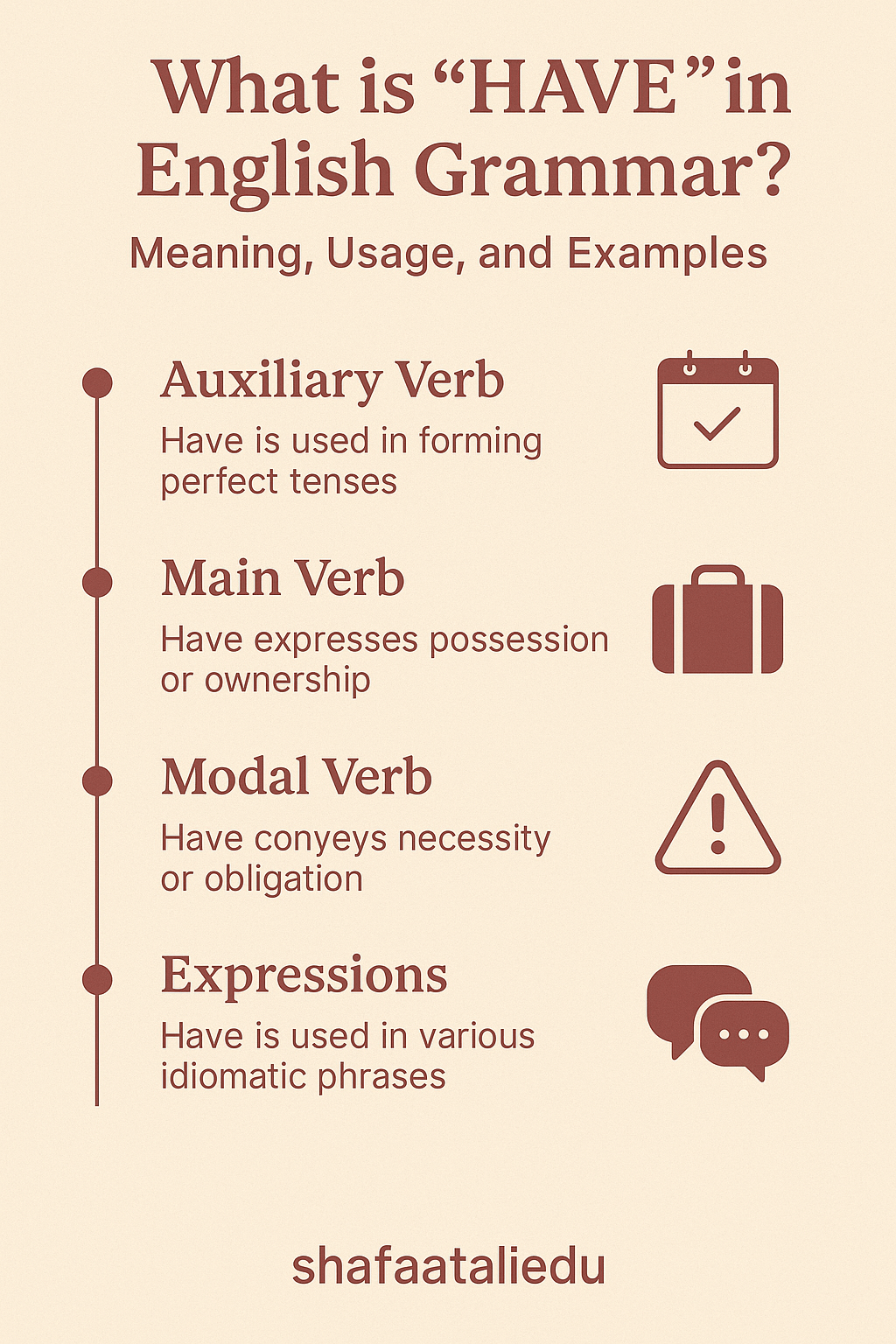
“Have” is a verb that can act as:
- A main verb (to show possession or experience)
- A helping (auxiliary) verb (to form perfect tenses or questions/negatives)
It is the base form of the verb and is used with I, you, we, they and plural nouns.
🧩 1. “Have” as a Main Verb
Used to show:
- Possession/ownership
→ I have a car.
→ They have two children. - Relationships or illnesses
→ I have a brother.
→ She has a fever. - Experiences
→ We had a great time yesterday.
🧩 2. “Have” as an Auxiliary Verb (Helping Verb)
Used to form perfect tenses:
| Tense | Example |
|---|---|
| Present Perfect | I have eaten breakfast. |
| Past Perfect | She had finished her homework. |
| Future Perfect | They will have left by 5 PM. |
✅ In these cases, “have” helps form the tense by working with the past participle of the main verb.
🧩 3. “Have” in Questions and Negatives
When using “do,” “does,” or “did” as helping verbs, have stays in its base form — even with “he/she/it.”
| Type | Subject | Example |
|---|---|---|
| Positive | She | She has a laptop. |
| Question | Does she | Does she have a laptop? ✅ |
| Negative | She doesn’t | She doesn’t have a laptop. ✅ |
⚠️ Common Mistake
❌ Does she has a phone?
✅ Does she have a phone?
🔑 Rule: Use “have” (not “has”) when there is a helping verb like does or did.
🧠 Who Uses “Have”?
| Subject | Use “Have”? |
|---|---|
| I | ✅ Yes |
| You | ✅ Yes |
| We | ✅ Yes |
| They | ✅ Yes |
| He/She/It | ❌ (Use “has” instead in positive statements) |
✅ But remember: even with he/she/it, always use “have” in questions and negatives.
🧠 Forms of “Have”
| Tense | Form | Example |
|---|---|---|
| Present | have / has | I have a cat. / He has a dog. |
| Past | had | She had a dream. |
| Present Perfect | have/has + past participle | I have seen it. / He has gone. |
| Past Perfect | had + past participle | They had finished the game. |
✍️ Practice Sentences
- I have a question.
- Do you have any siblings?
- They have not arrived yet.
- He has a new phone. (positive sentence – use “has”)
- Does he have a new phone? (question – use “have”)
✅ Summary
- “Have” is used to show possession, experience, or to form perfect tenses.
- Use it with I, you, we, they, and plural subjects.
- Use “have” (not “has”) after do/does/did in questions and negatives.
- As an auxiliary verb, “have” works with past participles to form perfect tenses.

Leave a comment