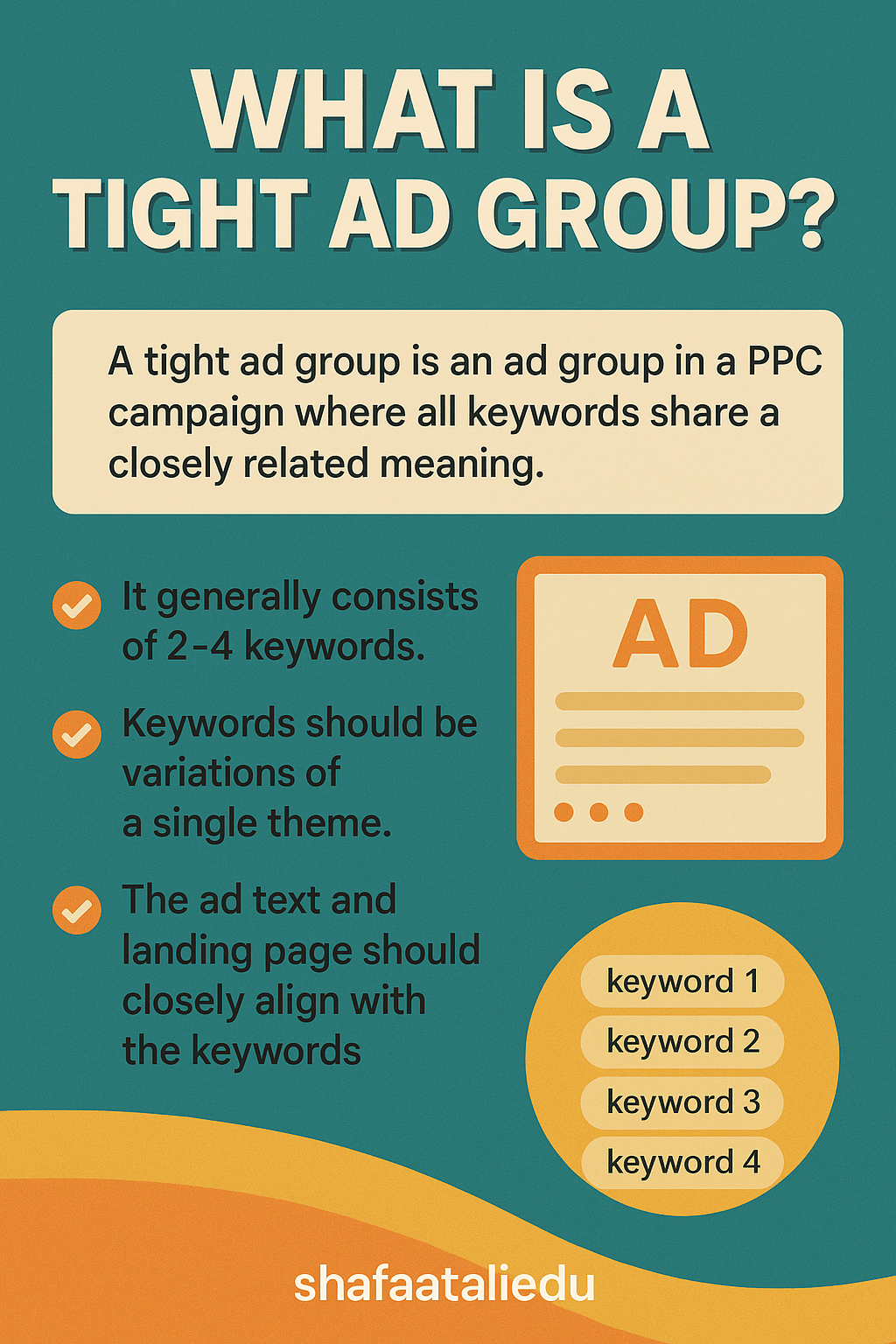
If you’re running Google Ads in 2025, one of the most important concepts to master is creating a tight ad group. But what exactly is a tight ad group? Why does it matter? And how can it improve your ad performance and lower your costs?
Let’s break it down in simple terms.
A tight ad group means that all the keywords in the group are closely related to one another, and the ads you write are highly relevant to those keywords. This is a smart strategy because Google rewards relevance. When your keywords, ads, and landing page are all aligned, you get a better Quality Score, lower Cost Per Click (CPC), and more clicks from the right audience.
Let’s look at an example. Suppose you run an online store selling running shoes. If you put the keywords “running shoes,” “trail running shoes,” and “lightweight running shoes” in one ad group—and then write an ad specifically about running shoes—you have a tight ad group. But if you also add “tennis shoes,” “basketball shoes,” or “workout gear” to the same group, it becomes too broad. Your ad may not match what people are searching for, and Google might lower your ad performance.
Here’s why tight ad groups work better than broad ones:
- Higher Relevance: Users see ads that closely match what they typed into Google.
- Better Quality Score: Google gives better scores to ads that are specific and useful.
- Lower CPC: Better scores often mean you pay less per click.
- Improved Click-Through Rate (CTR): People are more likely to click when the ad matches their intent.
Now let’s quickly go over how to create tight ad groups step by step:
- Step 1: Pick One Theme – Each ad group should have a clear theme, like “men’s running shoes” or “trail running shoes”.
- Step 2: Choose Similar Keywords – Include only keywords that are very close in meaning. Avoid mixing broad or unrelated terms.
- Step 3: Write Specific Ads – Tailor your ad copy to match the keywords in the group.
- Step 4: Match the Landing Page – Make sure the landing page talks about exactly what the ad promises.
Here’s a simple way to think about it: If your keywords were questions, would your ad be a clear answer to all of them? If not, tighten the group.
Let’s compare two quick examples:
Loose Ad Group Example:
- Keywords: running shoes, tennis shoes, gym clothes
- Ad: “Shop Sports Gear – Huge Selection Online”
- Result: Low relevance, poor CTR, high CPC
Tight Ad Group Example:
- Keywords: trail running shoes, waterproof running shoes, trail shoes
- Ad: “Best Trail Running Shoes – Shop Waterproof & Lightweight Pairs”
- Result: High relevance, better CTR, lower CPC
In 2025, Google Ads is more focused on intent than ever before. People want quick, accurate results. Creating tight ad groups helps you deliver what they need—fast. Whether you’re new to paid search or optimizing an old campaign, this simple technique can boost your results quickly.
Final Tips:
- Use 5–10 highly related keywords per ad group.
- Don’t mix brand and generic terms in the same group.
- Group by product type, audience, or goal—not just random keywords.
- Keep testing and adjusting for performance.
Tight ad groups are the secret to smarter, cheaper, and more effective ads. Keep your focus narrow, your messaging clear, and your audience in mind—and you’ll see better results in no time.

Leave a comment