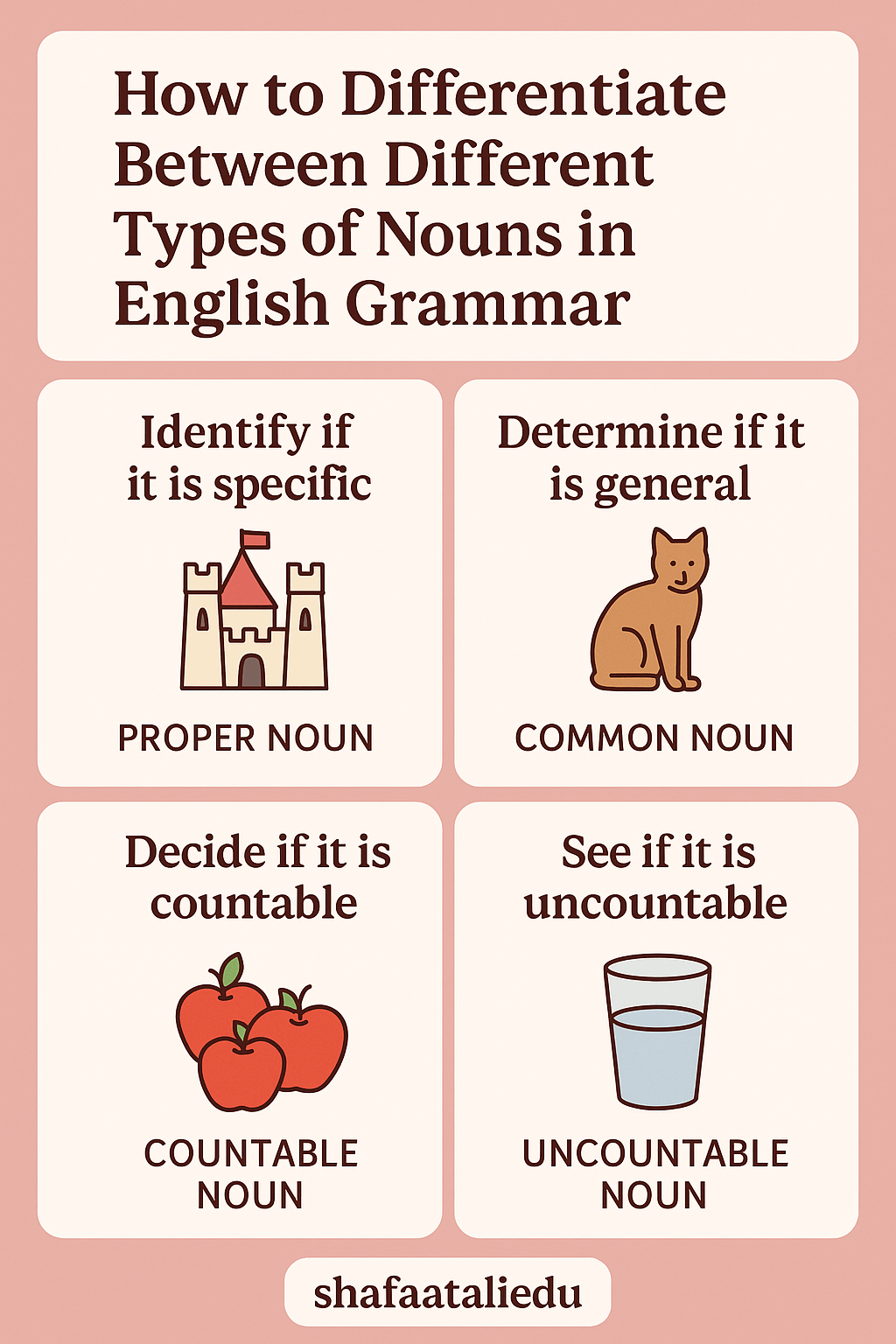
Understanding nouns is key to mastering English grammar. In 2025, English learners are using smarter tools like grammar apps and AI writing assistants, but nothing beats a strong foundation. This guide will help you clearly recognize different types of nouns and how they work in everyday sentences.
What Is a Noun?
A noun is a word that names a person, place, thing, idea, or quality. Everything you can see or think about is either a noun or described by one. But not all nouns are the same. Let’s explore the most common types.
Common vs Proper Nouns
Common Nouns
These refer to general items, people, or places—not specific names. They aren’t capitalized unless they begin a sentence.
Examples:
- book
- city
- teacher
Proper Nouns
These name specific people, places, or things and always begin with a capital letter.
Examples:
- Harry Potter
- Lahore
- Amazon
Tip: If you can add “the” in front and it still makes sense (e.g., “the teacher”), it’s likely a common noun.
Abstract vs Concrete Nouns
Abstract Nouns
These describe ideas, feelings, or qualities—things you can’t see or touch.
Examples:
- freedom
- love
- intelligence
Example sentence: Happiness is more important than money.
Concrete Nouns
These are physical things you can see, touch, or hear.
Examples:
- phone
- cake
- dog
Example sentence: The dog barked loudly at the stranger.
Countable vs Uncountable Nouns
Countable Nouns
You can count these easily—add numbers or make them plural.
Examples:
- apple → apples
- car → cars
Usage: She has three dogs.
Uncountable Nouns
These cannot be counted individually or made plural. They often refer to liquids, ideas, or substances.
Examples:
- water
- information
- rice
Usage: He gave me some advice. (not “advices”)
Collective Nouns
These refer to a group of people or things seen as one unit.
Examples:
- team
- family
- audience
Example sentence: The team is winning the match.
Real-life tip: In American English, collective nouns are usually treated as singular (The family is going), while British English may use plural verbs (The family are going).
Why This Matters in Real Life
Imagine writing a professional email or giving a speech. Choosing the right noun type ensures your meaning is clear and your grammar accurate. For example, mixing up “advice” (uncountable) with “advices” (incorrect) can weaken your message. Even AI writing tools in 2025 expect correct noun usage to improve clarity and tone.
Recap at a Glance
Here’s a quick summary of noun types:
- Common: general names (dog, teacher)
- Proper: specific names (Ali, Microsoft)
- Abstract: ideas (honesty, pain)
- Concrete: physical items (pen, door)
- Countable: can be counted (book, egg)
- Uncountable: cannot be counted (milk, knowledge)
- Collective: groups (team, jury)
With practice, these will come naturally to you. Try spotting different noun types in the next sentence you read or write.

Leave a comment