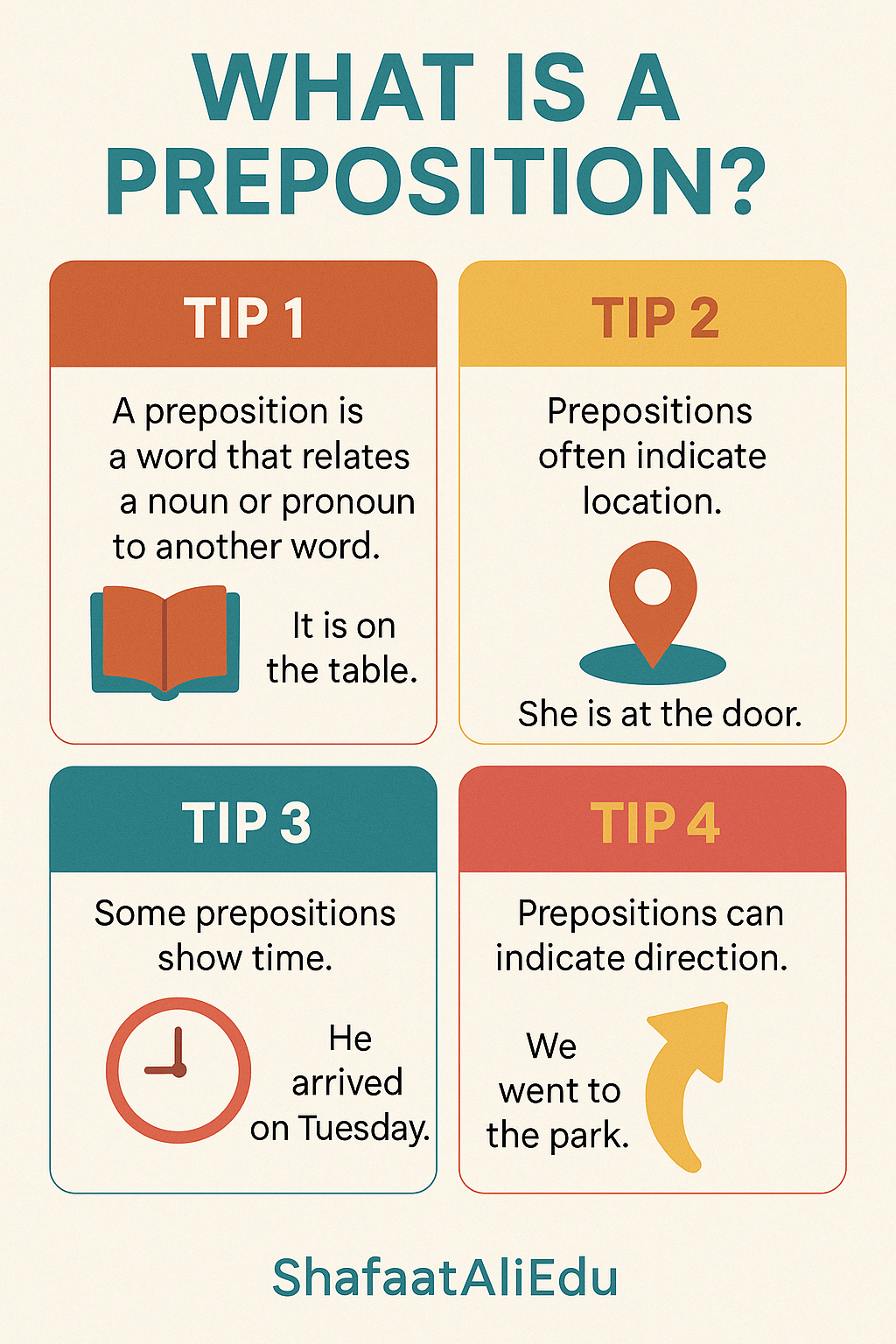
A preposition is a word that shows the relationship between a noun (or pronoun) and another part of the sentence. In simple terms, prepositions tell us where something is, when something happened, or how things are related.
Here’s an easy way to think of it: if you can describe where a cat is in relation to a box, you’re likely using a preposition.
Example:
- The cat is on the box.
- The cat is under the box.
- The cat is inside the box.
Words like on, under, and inside are all prepositions because they show the position of the cat in relation to the box.
Prepositions often come before a noun or pronoun to form a phrase called a prepositional phrase.
Example:
- She sat beside her friend. (“beside her friend” is the prepositional phrase)
There are different types of prepositions:
- Prepositions of place – in, on, at, under, over
- Prepositions of time – before, after, during, since
- Prepositions of direction/movement – to, into, onto, out of
- Prepositions of cause or purpose – because of, due to
- Prepositions of manner – by, with, like
Let’s put it all together in one sentence:
“After lunch, we walked to the park with our dog.”
- After, to, and with are prepositions, showing time, direction, and manner.
Even though prepositions are small, they’re powerful tools for adding clarity and detail to your sentences.
As you get more comfortable with prepositions, you’ll find your writing and speaking becoming more precise and vivid.

Leave a comment