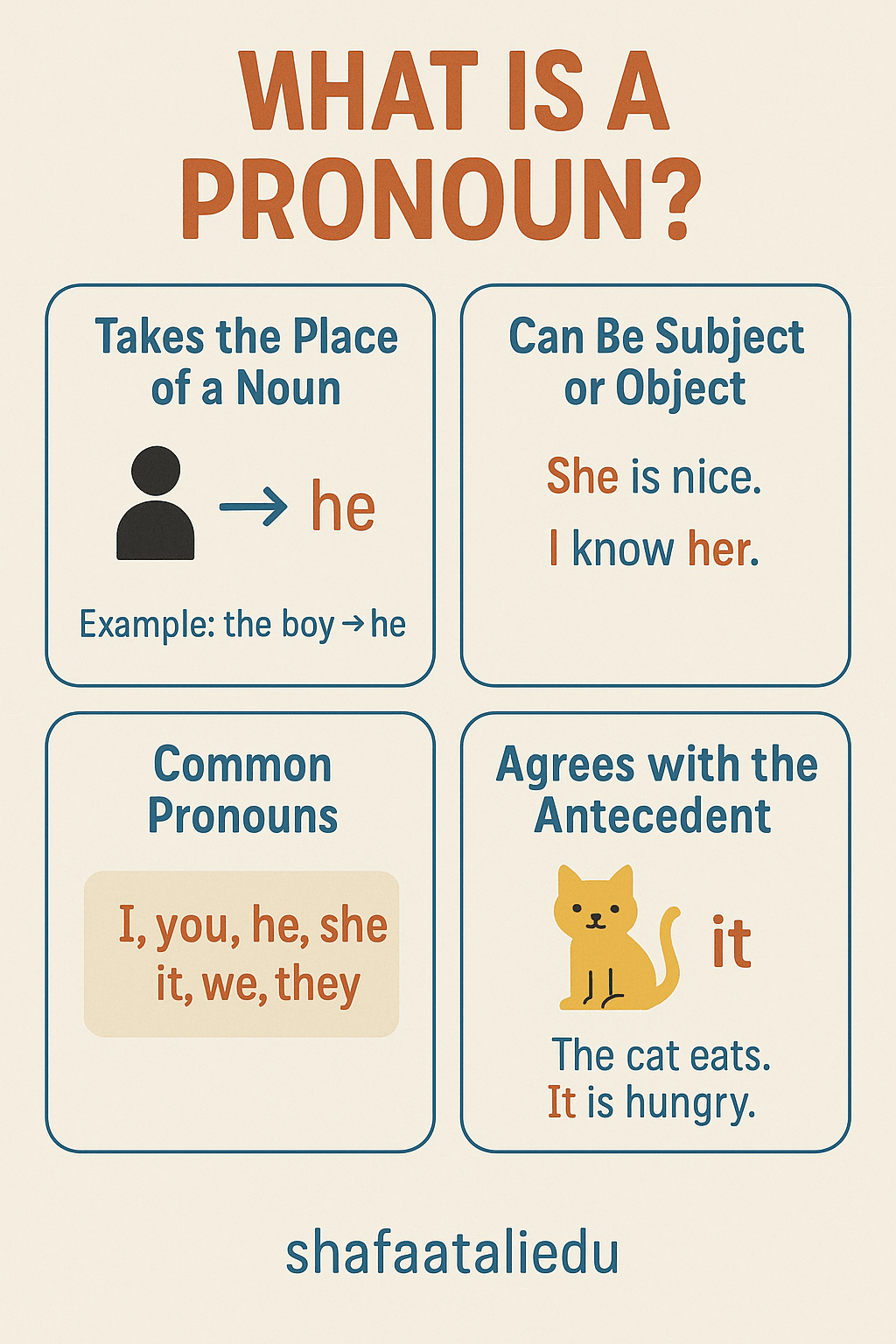
A pronoun is a word that takes the place of a noun in a sentence. Instead of repeating the same noun over and over, pronouns make our speech and writing smoother and less repetitive.
Let’s break it down with a simple example. Imagine your friend Sara:
Without pronouns: Sara loves music. Sara plays the guitar. Sara wants to join a band.
With pronouns: Sara loves music. She plays the guitar. She wants to join a band.
Here, “she” is a pronoun that replaces “Sara.” Much easier to read, right?
There are several types of pronouns, and each serves a different purpose:
- Personal Pronouns: These refer to specific people or things. Examples include I, you, he, she, it, we, they.
- Possessive Pronouns: Show ownership. Examples: mine, yours, his, hers, ours, theirs.
- Reflexive Pronouns: Refer back to the subject. Examples: myself, yourself, herself, ourselves.
- Demonstrative Pronouns: Point to specific things. Examples: this, that, these, those.
- Interrogative Pronouns: Used to ask questions. Examples: who, what, which, whose.
- Relative Pronouns: Connect clauses. Examples: who, whom, whose, which, that.
- Indefinite Pronouns: Refer to non-specific things. Examples: everyone, someone, anything, nothing.
Think of pronouns as stand-ins, like actors playing different roles to avoid overusing the same word. They help us express ideas more clearly and naturally.
In everyday communication—writing an email, telling a story, or chatting with friends—pronouns keep our language flowing and flexible.
As you keep exploring grammar, notice how pronouns shape the way we share information. They may be small words, but they do a big job!

Leave a comment