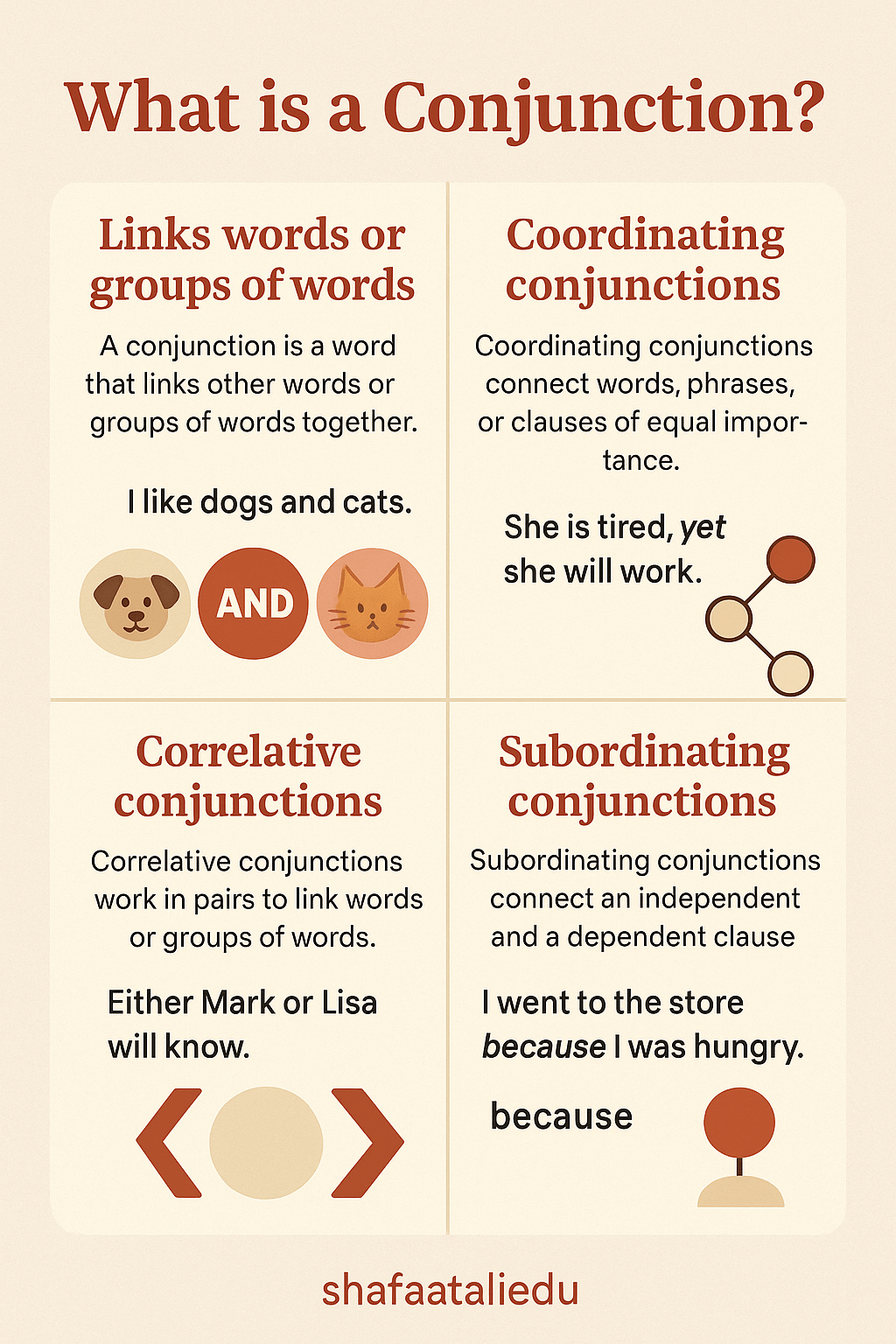
A conjunction is a word that connects other words, phrases, or sentences. It’s like glue that holds parts of a sentence together, helping ideas flow smoothly and making writing or speaking more natural.
Think of it like this: If words are puzzle pieces, conjunctions are the links that snap them together.
There are three main types of conjunctions:
- Coordinating Conjunctions – These connect equal parts, like two nouns or two sentences.
The most common ones are FANBOYS:
For, And, Nor, But, Or, Yet, So- Example: I want tea and cookies.
- Example: She was tired, but she kept working.
- Subordinating Conjunctions – These join a main sentence with a dependent (less important) idea.
Common ones include: because, although, if, when, while, since- Example: I stayed home because it was raining.
- Example: Although he was late, he finished the test.
- Correlative Conjunctions – These come in pairs and work together.
Examples: either…or, neither…nor, both…and, not only…but also- Example: Either you study now or you’ll regret it later.
- Example: Both the teacher and the students enjoyed the lesson.
Why are conjunctions important? They help you express complex ideas without sounding choppy. Instead of writing several short sentences, conjunctions let you connect your thoughts smoothly.
In short, conjunctions are the tools that help your sentences work together as a team!

Leave a comment