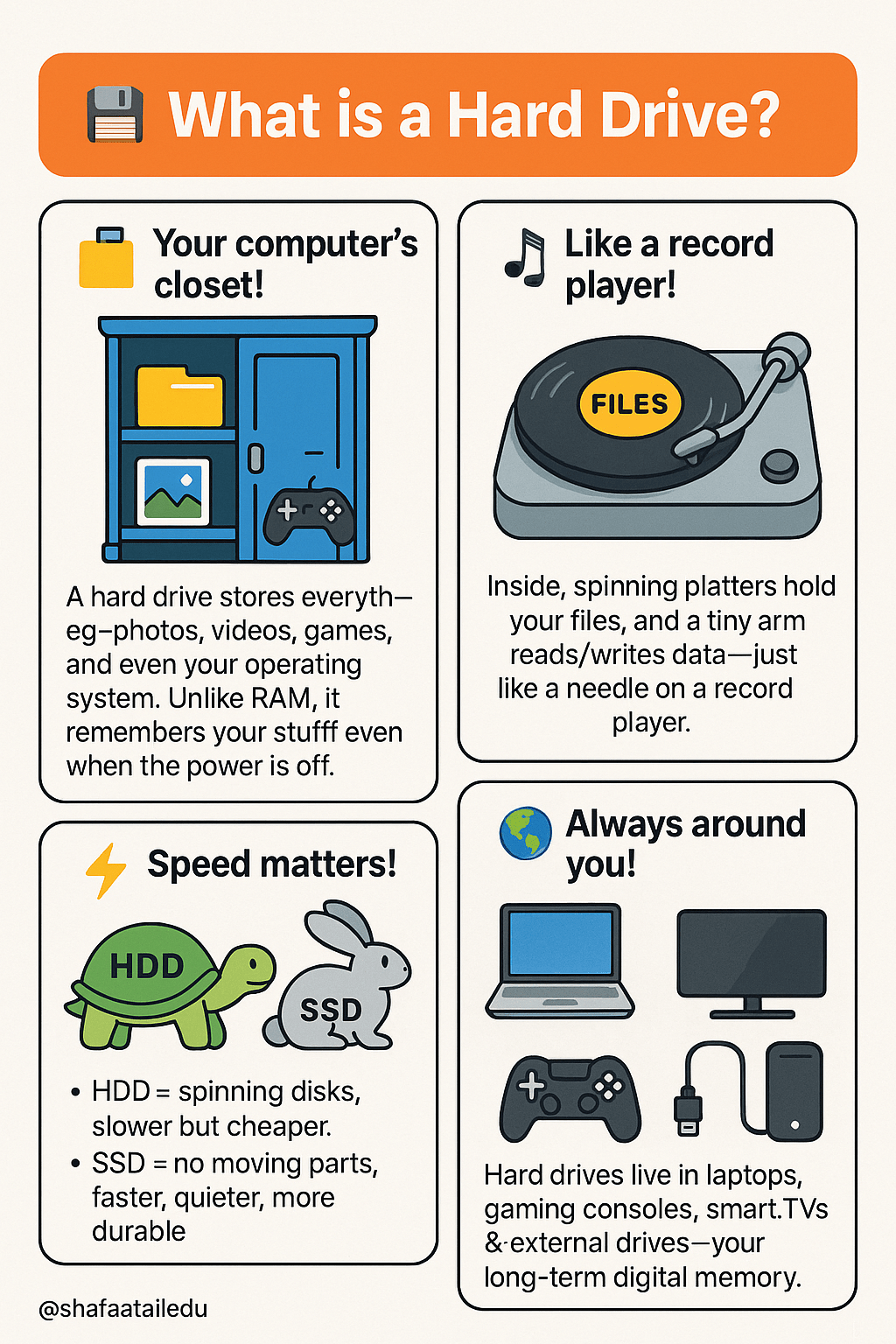
Think of a hard drive like a giant digital closet where your computer stores everything—photos, videos, games, documents, and even the operating system. Just like a closet holds your clothes even when the lights are off, a hard drive keeps your data safe even when the computer is powered down.
A hard drive (HDD) is a storage device inside your computer that saves information permanently. Unlike RAM, which forgets everything when the computer shuts down, the hard drive remembers it all. Inside, it works a bit like a record player: spinning magnetic disks (called platters) store your files, and a small arm (like a record player’s needle) reads and writes data onto those disks.
For example, when you download a movie, it gets stored on the hard drive. Later, when you click play, your computer fetches the movie from that drive. The more storage space the hard drive has—like 500 GB or 1 TB—the more “stuff” you can keep in your digital closet.
Today, there are also SSDs (Solid-State Drives), which are faster, quieter, and more durable because they don’t have spinning parts. Think of SSDs as high-tech closets where you can grab things instantly. Many modern laptops use SSDs instead of traditional HDDs for speed.
Hard drives aren’t limited to computers—they’re in gaming consoles, smart TVs, and even external drives you can plug in like a portable suitcase for your files.
In short, the hard drive is your computer’s long-term memory. Without it, your device wouldn’t know where your files live or even how to run the system. As technology grows, hard drives are getting bigger, faster, and more efficient, making it easier for us to store our ever-expanding digital lives.

Leave a comment