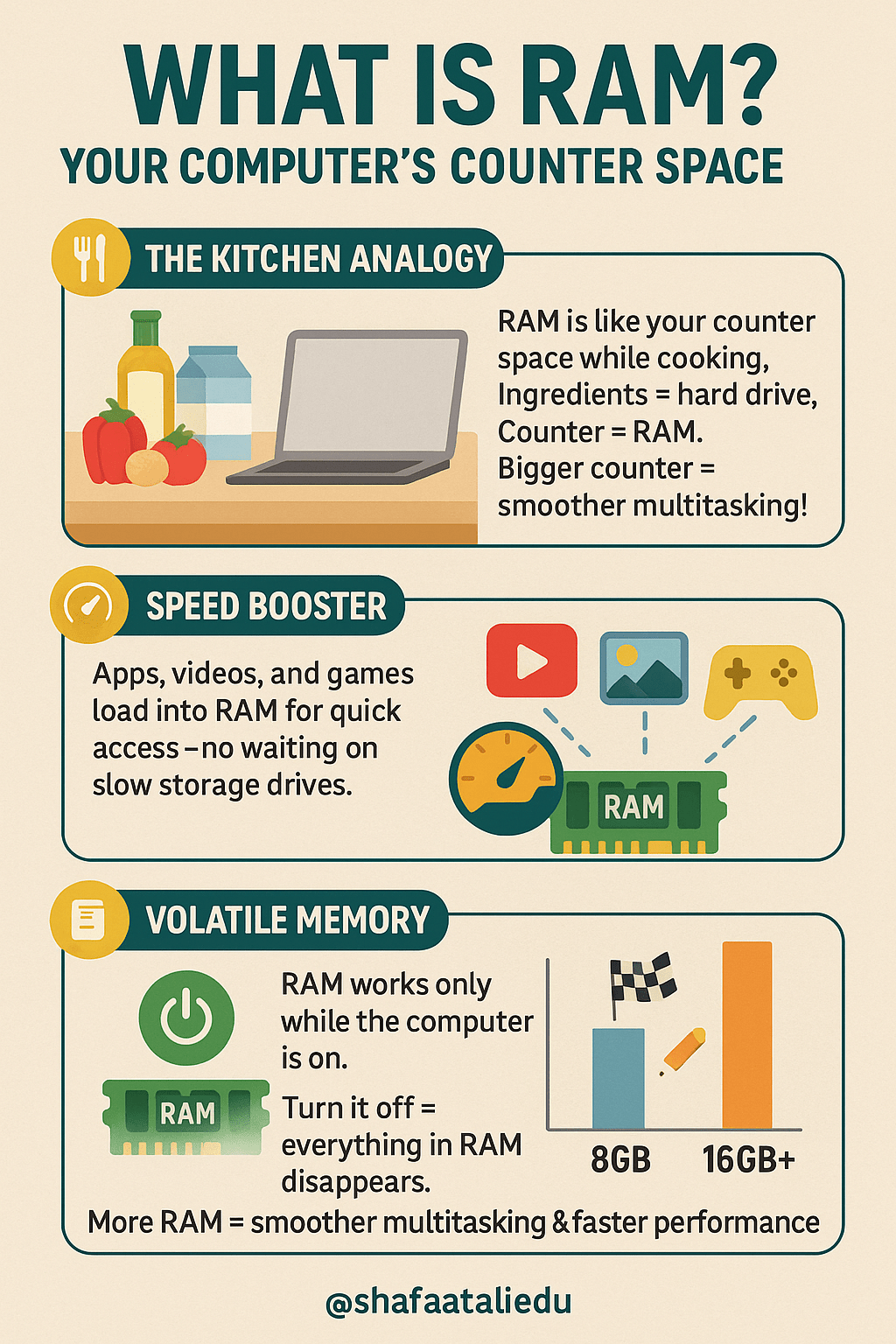
Imagine you’re cooking dinner. You pull ingredients from the fridge (long-term storage) and place them on the counter (workspace) to prepare the meal. The counter is your short-term working space—and in computers, that’s exactly what RAM (Random Access Memory) does.
RAM is the temporary memory your computer uses to keep things running quickly. When you open an app, watch a video, or play a game, your computer loads the necessary data into RAM so it can access it instantly, rather than digging through the slower hard drive every time. The more RAM you have, the bigger your “counter space,” meaning you can multitask more smoothly without your system slowing down.
Here’s a simple example: Imagine browsing the internet while listening to music and editing a document. Each of these tasks uses some RAM. If your computer has limited RAM, it’s like having a tiny counter—things get cluttered quickly, and the system struggles. With more RAM, you have plenty of room to keep everything accessible at once.
It’s important to note that RAM is volatile memory—this means it only works while your computer is on. Once you shut down, everything in RAM disappears, unlike files stored on your hard drive or SSD, which stay there until you delete them.
Today, most computers come with at least 8GB of RAM, which is enough for everyday tasks. Gamers, video editors, or professionals who run heavy software often use 16GB or more for smoother performance.
So, think of RAM as your digital desk space—the bigger and faster it is, the more efficiently you can work. As technology evolves, RAM will continue to get faster, making future devices even more powerful and responsive.

Leave a comment