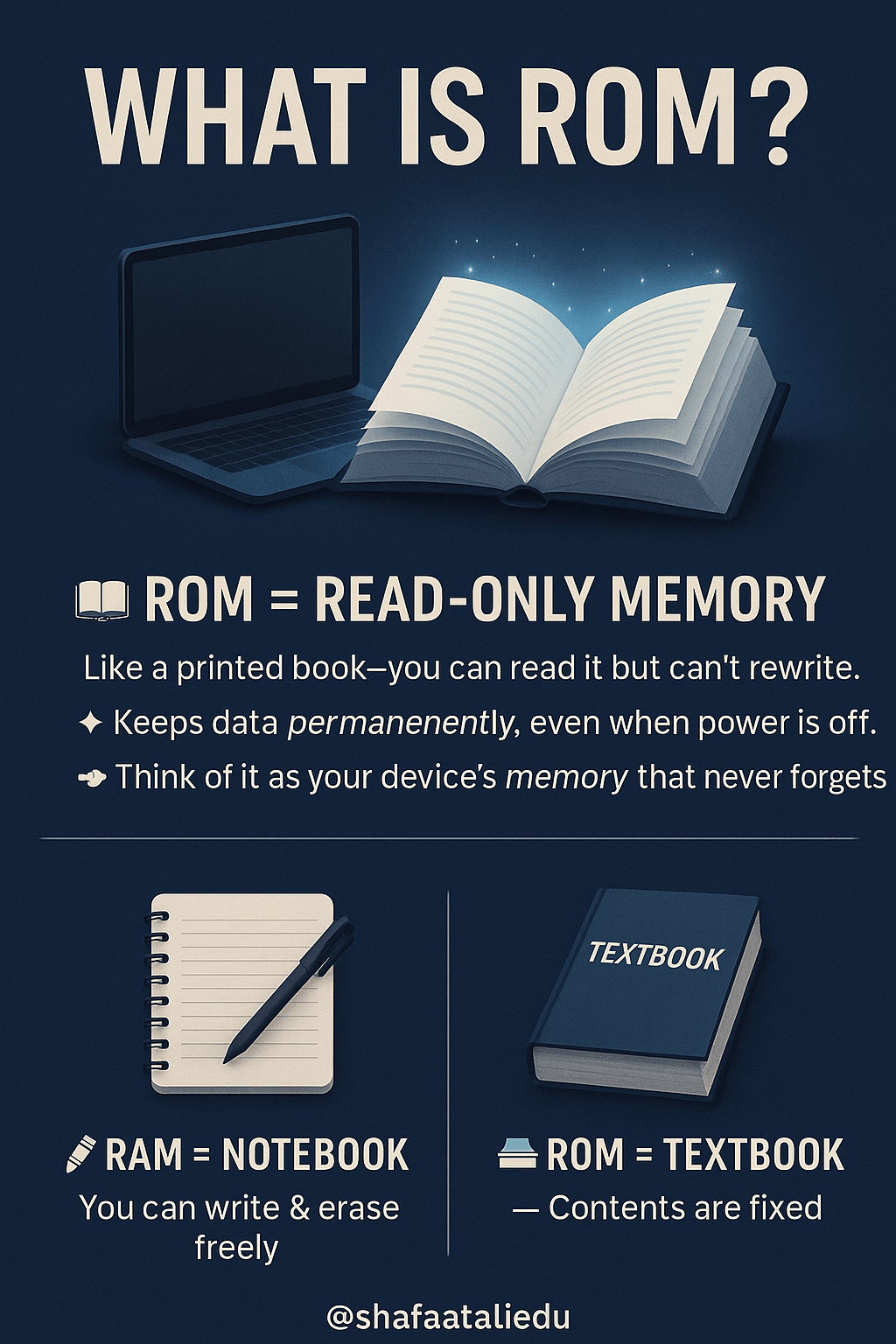
Imagine you bought a book that you can only read but never write in. You can flip through the pages as many times as you want, but you can’t change the story inside. That’s exactly how ROM (Read-Only Memory) works in computers. It’s a type of memory that stores data permanently, even when the computer is turned off.
Unlike RAM (Random Access Memory), which is like a notebook you can freely write on and erase, ROM is more like a printed textbook—its contents don’t change. This makes it perfect for storing instructions that a computer must always remember, like how to start up when you press the power button. These instructions are often called the firmware.
For example, when you turn on your laptop, ROM provides the basic startup code that tells your computer how to load the operating system. Without ROM, your device would be like a car with no ignition—it wouldn’t even know how to start.
There are different types of ROM too. The original ROM was permanently written at the factory, but today we also have EPROM (Erasable Programmable ROM) and EEPROM (Electrically Erasable Programmable ROM), which allow limited updates. Think of these like a whiteboard you can occasionally rewrite, but only with special tools.
ROM is not just in computers—it’s in smartphones, microwaves, washing machines, and even cars. Any gadget that needs “built-in memory” to know what to do relies on ROM.
So, while you may never directly see or interact with ROM, it quietly makes sure your devices always remember their most important instructions. In the future, as technology keeps advancing, ROM will continue evolving, giving our gadgets smarter and faster ways to “remember how to work.”

Leave a comment