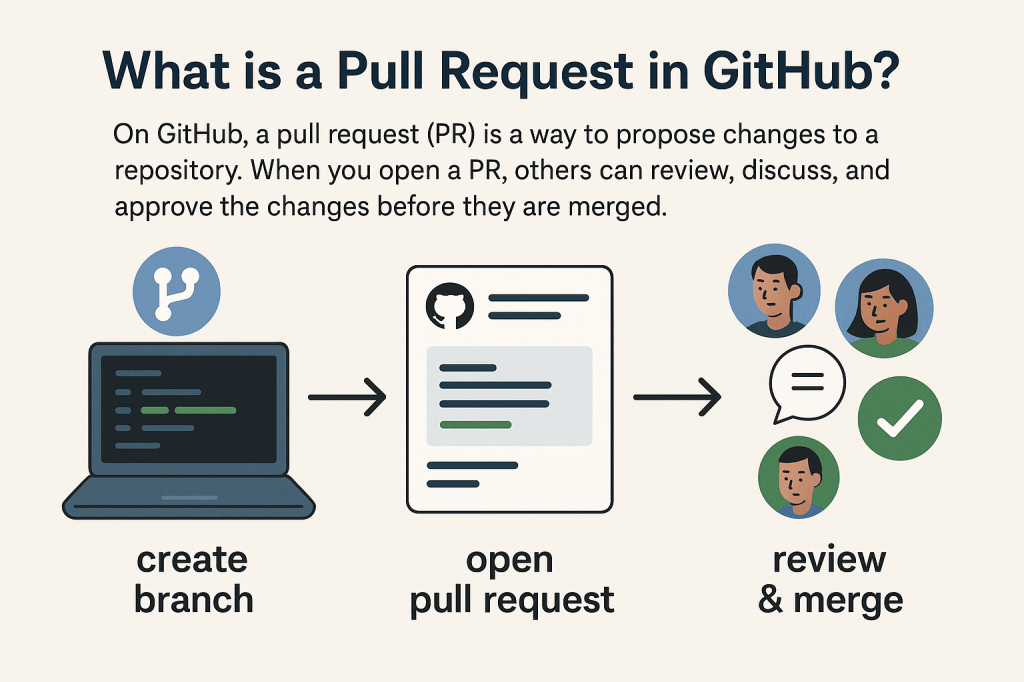
Imagine you’re working on a group project, and instead of emailing files back and forth, everyone works on their own copy. When you’re done improving something, you raise your hand and say, “Hey team, I’m ready to add my work to the main project.” That’s basically what a pull request is on GitHub.
Let’s break it down.
GitHub is a platform where developers store and manage code. Think of it like Google Docs for coding, but with more powerful tools for teams. When you want to suggest changes to a project, you don’t change the main project directly. Instead, you create a branch (a copy of the code), make your edits, and then create a pull request (PR). This is your way of asking, “Can someone review and merge my changes into the main project?”
For example, let’s say you find a typo on a website’s homepage. You fix it on your branch, and then open a pull request. Other developers can now see what you changed, comment on it, suggest improvements, or approve it. Once everyone’s happy, the changes get merged.
This process keeps things organized. It avoids broken code sneaking into the main project and encourages collaboration—especially when many people are working on the same files.
In 2025, pull requests are used by beginners learning GitHub and by massive teams at companies like Microsoft or Google. They’re central to modern software development.
So, next time you’re working on a coding project and want to contribute, remember: a pull request is how you start the conversation.
Curious next step? Explore how to write a great pull request description—it’s just as important as the code itself!

Leave a comment