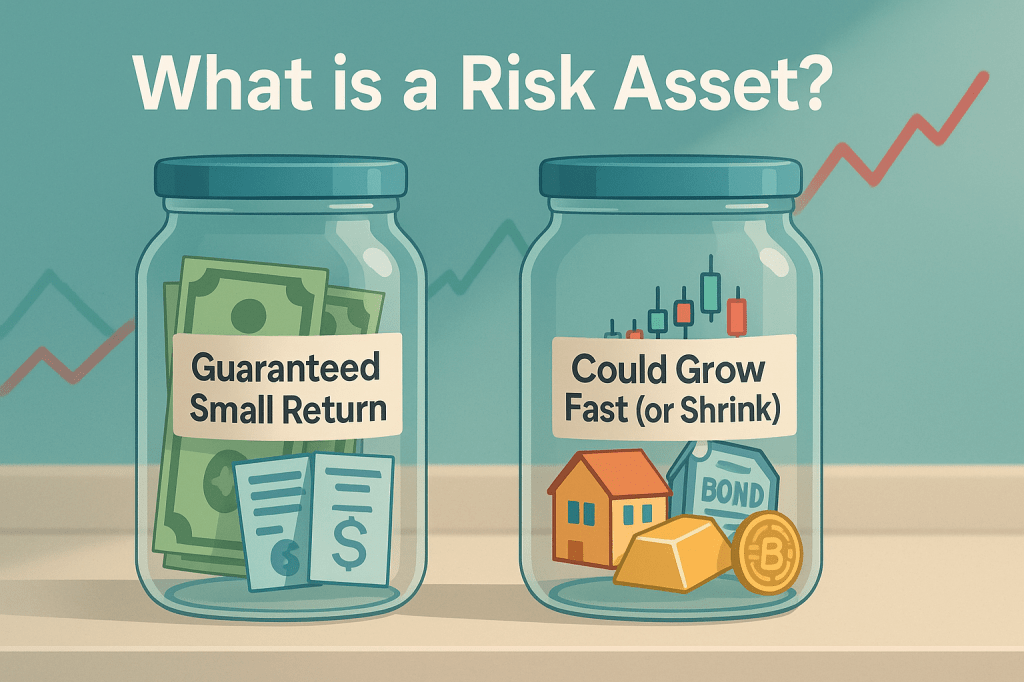
Imagine two jars on your kitchen counter. One is labeled “Guaranteed Small Return,” the other “Could Grow Fast (or Shrink).” When my cousin started saving in 2025, he kept reaching for the exciting jar—shares of AI chipmakers, a clean energy ETF, even a spot Bitcoin ETF. That second jar holds risk assets.
A risk asset is any investment whose price can move up or down a lot and whose future return is uncertain. Think stocks, corporate bonds, real estate, commodities, cryptocurrencies, venture capital, and emerging market debt. These contrast with near risk free assets like short term government Treasury bills from stable countries.
Why do people buy them? Because risk and potential reward are linked. Investors expect higher average returns from assets that can be bumpy in the short run. That is the classic risk premium: you accept volatility today for the chance of better growth over years.
How is risk measured? Professionals look at volatility, drawdowns, and beta—how much something tends to move when the overall market moves. You do not need the formulas to get the idea: if an asset has a history of big swings, it is a risk asset.
Common 2025 examples include: broad stock index funds, sector ETFs focused on AI or clean energy, high yield corporate bond funds, real estate investment trusts, commodities like gold and oil, and regulated spot Bitcoin ETFs. All can rise or fall quickly as news, earnings, rates, and sentiment change.
So, should you own them? Start with a simple checklist. First, time horizon: money needed within one year belongs in cash or very safe instruments. Second, diversification: mix different risk assets and include some safer holdings. Third, behavior: can you stay calm during a 20% drop? If not, lower the risk.
Here is a quick example. You invest $200 each month into a global stock ETF. After six months, markets dip and your account falls by 12%. That hurts, but you keep buying. A year later, prices recover; your average cost is lower because you bought through the dip. Nothing was guaranteed—your plan managed risk.
Key pitfalls to avoid: chasing the hottest story, ignoring fees and taxes, borrowing to invest without a safety buffer, and putting short term money into long term bets. A steady, rules based process usually beats jumping in and out based on headlines or social media buzz.
In short, a risk asset is simply an investment with uncertain returns and meaningful price swings. Used thoughtfully, it is a tool for growth. Used carelessly, it can derail goals. The real skill is matching your mix of risk and safety to your timeline and temperament. What future are you investing for today?

Leave a comment