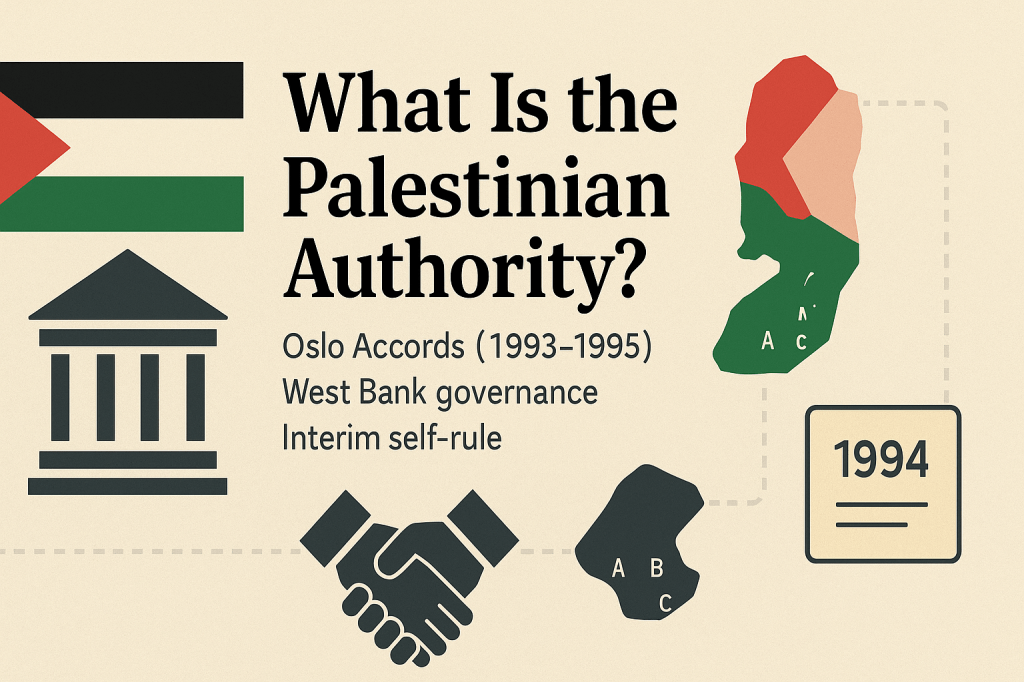
The Palestinian Authority (PA) is a governing body set up in 1994 after the Oslo Accords, the peace agreements between Israel and the Palestine Liberation Organization (PLO). The PA was designed to give Palestinians limited self-rule in parts of the West Bank and (at first) Gaza while a final peace deal was negotiated. (Encyclopedia Britannica)
Why It Was Created
- The Oslo process aimed to build trust and gradually transfer certain powers—like education, health, and policing—to Palestinian leadership.
- The PA became the day-to-day administrator for Palestinians in areas assigned to it, with the final status of borders, Jerusalem, refugees, and security left for later talks. (Encyclopedia Britannica)
Where the PA Governs
- West Bank: Under the 1995 Oslo II deal, the West Bank was divided into Areas A, B, and C:
- Area A: PA handles civil affairs and internal security.
- Area B: PA manages civil affairs; security is shared with Israel.
- Area C: Under Israeli control (most land area and all Israeli settlements). (Anera)
- Gaza Strip: The PA has de jure authority but has not controlled Gaza de facto since 2007, when Hamas took over. Today, the PA mainly operates in parts of the West Bank. (Encyclopedia Britannica)
Who Leads the PA?
- The PA has a president and a prime minister.
- Mahmoud Abbas serves as PA president; in March 2024, Mohammad Mustafa became prime minister. The presidency remains the most powerful office. (Council on Foreign Relations)
What the PA Does (in Simple Terms)
Think of the PA as a local government for Palestinians in parts of the West Bank:
- Public services: Schools, clinics, local roads, water and electricity coordination.
- Policing: PA security forces handle internal security in Area A and coordinate with Israel on certain issues.
- Economy and finance: Collects some taxes, pays public salaries, and works with donors on development projects.
- Diplomacy: Works with other countries and international bodies as part of broader Palestinian representation (alongside the PLO). (Encyclopedia Britannica)
A Quick Example
If a new primary school is planned in a West Bank city like Ramallah (Area A), the PA’s Ministry of Education oversees the project, hires teachers, and runs the school year. If a road passes through Area B or C, the PA must coordinate—or seek permission—with Israeli authorities to improve or expand it. (Anera)
Why Is the PA Controversial?
- Limited powers: Because the final peace deal never happened, the PA’s authority remains restricted, especially in Area C. (Anera)
- Security coordination: The PA’s cooperation with Israeli forces is defended by some as necessary for stability, but criticized by others for undermining its legitimacy. (Le Monde.fr)
- Gaza–West Bank split: The PA’s lack of control in Gaza since 2007 has deepened Palestinian political division. (Encyclopedia Britannica)
- Leadership and reform: International actors often push reforms to strengthen PA governance and public trust. Leadership changes—like appointing a new prime minister in 2024—are part of that conversation. (Council on Foreign Relations)
How It Fits Into the Bigger Picture
- Many countries recognize a State of Palestine, while final borders and sovereignty are still unresolved. The PA functions within this interim framework, handling daily governance while broader political questions remain open. (Encyclopedia Britannica)
In One Line
The Palestinian Authority is the interim government that manages many everyday affairs for Palestinians in parts of the West Bank, created by the Oslo Accords with limited powers and ongoing political challenges. (Encyclopedia Britannica)

Leave a comment