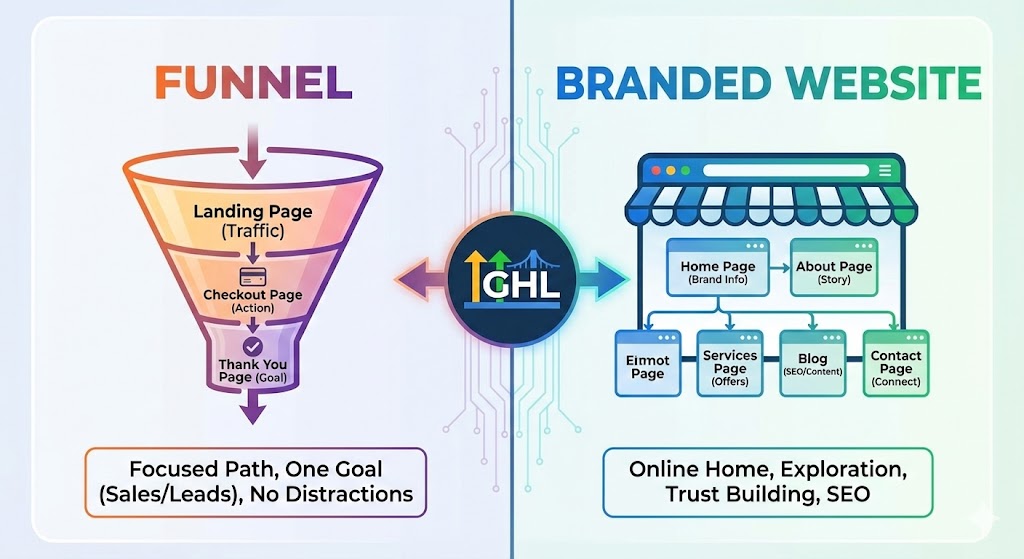
If you’re building your online presence using GoHighLevel (GHL), you’ve probably heard two important terms: funnels and branded websites. While both help you grow your business, they work in different ways. Understanding the difference can help you choose the right option for your goals.
In this article, we’ll break down the differences in simple terms, with examples, so you can decide which one fits your needs.
1. What Is a Funnel in GHL?
A funnel is a guided series of steps designed to make a visitor take a specific action—like buying a product, booking a call, or signing up for a freebie.
Think of a funnel like a straight road with one direction.
Key Features of a Funnel
- Very focused, usually one goal
- Step-by-step structure (example: Landing Page → Checkout Page → Thank You Page)
- No distractions, fewer links
- High conversions because people have only one clear action
- Ideal for ads, sales campaigns, lead generation, and product launches
Example of a Funnel
Imagine you’re selling a fitness eBook.
Your funnel might look like this:
- Landing Page – Shows benefits of the eBook
- Checkout Page – Payment form
- Thank You Page – Confirms the purchase
Simple, clean, and leads the visitor to one action: Buy the eBook.
2. What Is a Branded Website in GHL?
A branded website is a multi-page site that represents your entire business. It’s more like a digital storefront where visitors explore different pages freely.
Key Features of a Branded Website
- Has multiple pages like Home, About, Services, Blog, Contact
- Focuses on brand building, not just conversions
- Visitors can navigate anywhere using menu links
- Looks more professional and builds trust
- Great for SEO and long-term branding
Example of a Website
Your website can include:
- Home Page – First impression of your business
- About Page – Your story
- Services Page – Details about your offers
- Blog – Articles for SEO traffic
- Contact Page – Ways to reach you
A website helps build credibility and gives complete information about your business.
3. Key Differences Between Funnels and Websites in GHL
Here’s a simple breakdown:
| Feature | Funnel | Branded Website |
|---|---|---|
| Goal | Conversions (sales/lead) | Branding + information |
| Navigation | No menu, fewer links | Full navigation menu |
| Focus | One action at a time | Many pages, broader info |
| Best Use | Ads, promotions, launches | Online presence, SEO |
| Design | Minimal, distraction-free | More detailed and branded |
| Pages | Sequential steps | Multi-page structure |
4. When Should You Use a Funnel?
Use a funnel when you want:
- More sales
- More leads
- Higher conversion rates
- To run paid ads
- To promote a specific product or event
Example:
Promoting a webinar? A funnel with a registration page + confirmation page is perfect.
5. When Should You Use a Branded Website?
Use a website when you want:
- A professional online presence
- To appear on Google search
- To educate customers about your brand
- To host blogs and resources
- To build authority and trust
Example:
If you’re a coach or consultant, your website helps clients learn about you before they book a session.
6. Do You Need Both in GHL?
Yes—most businesses use both.
- Website = Brand + Trust
- Funnel = Sales + Leads
Your website builds reputation, while your funnels convert traffic into customers.
Conclusion
In GHL, a funnel is focused on conversions, leading visitors through a specific path with no distractions. A branded website, on the other hand, is your long-term online home, helping users learn about your business and explore freely.
Using both together can give your business the perfect mix of professional online presence and high-converting campaigns.

Leave a comment