Many people often use the words startup and entrepreneurship as if they mean the same thing. While they are closely related, they are not exactly the same. Understanding the difference can help you decide what path is right for you, especially if you are planning to start a business or already have an idea in mind.
In this article, we will explain the difference between a startup and entrepreneurship in simple and clear terms, with examples to make everything easy to understand.
What Is Entrepreneurship?
Entrepreneurship is a broad concept. It refers to the process of starting, managing, and growing any business to earn a profit and create value.
An entrepreneur is someone who:
- Identifies a problem
- Creates a solution
- Takes financial and personal risk
- Runs the business to earn income
Examples of Entrepreneurship
- Opening a grocery store
- Starting a restaurant
- Running a tuition center
- Launching a clothing shop
- Freelancing as a graphic designer
These businesses may not be highly innovative, but they still solve real problems and generate income.
What Is a Startup?
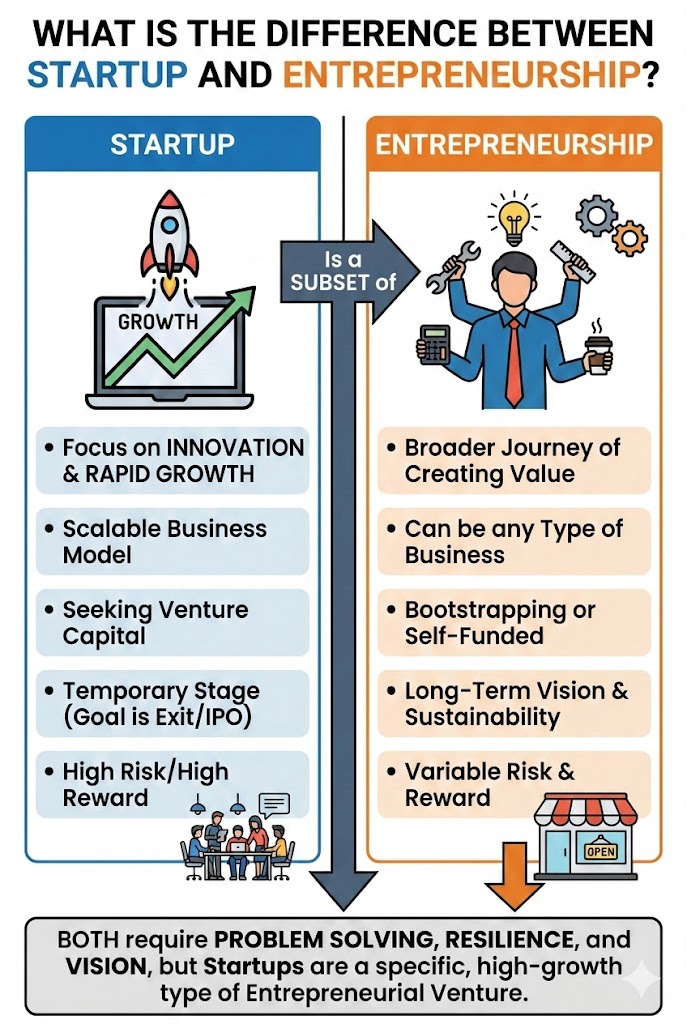
A startup is a type of entrepreneurship, but with a specific focus. Startups are businesses that aim for rapid growth, often using new ideas, technology, or innovation.
Startups usually:
- Solve a new or existing problem in a unique way
- Are designed to scale quickly
- Often rely on technology
- Look for investors or funding
- Aim to grow beyond local markets
Examples of Startups
- A food delivery app
- An online learning platform
- A fintech payment app
- A software tool for businesses
- A health-tech mobile app
These businesses are built to grow fast and reach many users.
Key Differences Between Startup and Entrepreneurship
Below are the main differences explained in simple terms:
1. Scope
- Entrepreneurship: Very broad. Includes all types of businesses.
- Startup: Narrow. Focused on innovation and fast growth.
2. Innovation
- Entrepreneurship: May or may not be innovative.
- Startup: Always focuses on innovation or a new approach.
3. Growth Goal
- Entrepreneurship: Growth can be slow and steady.
- Startup: Growth is usually fast and aggressive.
4. Risk Level
- Entrepreneurship: Risk depends on the business type.
- Startup: Higher risk because ideas are new and untested.
5. Funding
- Entrepreneurship: Often self-funded or bank-funded.
- Startup: Often funded by investors, venture capital, or angel investors.
6. Business Size
- Entrepreneurship: Can remain small or local.
- Startup: Aims to become large and global.
Simple Example to Understand Better
Imagine two people:
- Person A opens a bakery in their neighborhood. The goal is to earn stable income and serve local customers.
👉 This is entrepreneurship. - Person B creates an online platform that connects local bakeries with customers and delivers baked goods using an app.
👉 This is a startup.
Both are entrepreneurs, but only one is running a startup.
Can a Startup Become a Normal Business?
Yes. Many startups eventually turn into regular businesses once they:
- Achieve stability
- Stop rapid experimentation
- Focus on steady profits
For example, many big tech companies started as startups and later became established businesses.
Key Takeaways
In simple words:
- Entrepreneurship is the journey of starting and running a business
- Startup is a fast-growing, innovative type of entrepreneurship
Every startup is entrepreneurship, but not every entrepreneur runs a startup.
If you want stability and long-term income, entrepreneurship may be the right choice. If you enjoy innovation, risk, and rapid growth, a startup could be a better fit.

Leave a comment