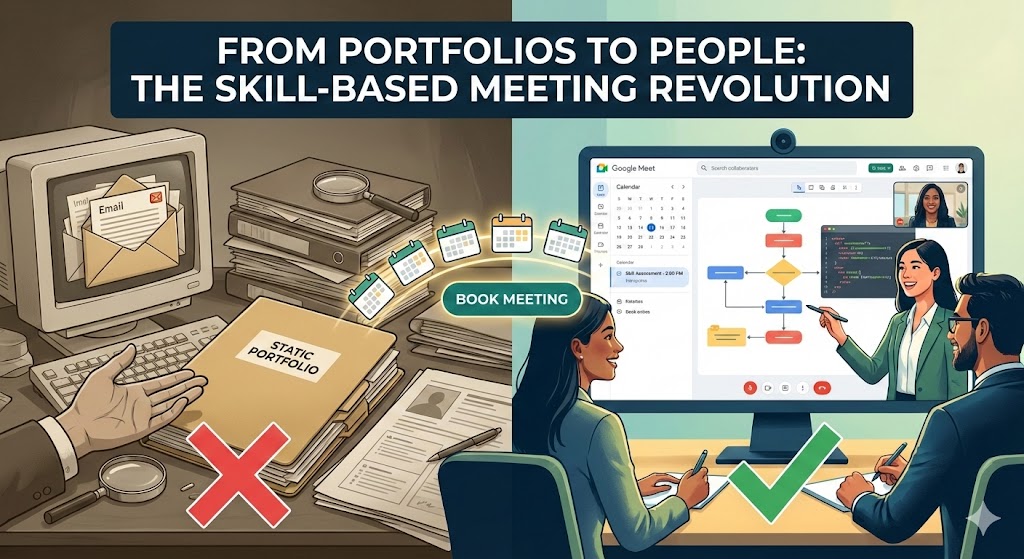
For decades, the portfolio has been the ultimate gatekeeper in hiring. Whether you are vetting a designer, a developer, or a writer, the standard process is: Send me your work, and I’ll decide if you’re good.
However, in an age of templates, AI assistance, and team-based projects, a portfolio often hides more than it reveals. It shows the final polished product, but it fails to capture the process.
To truly evaluate talent, modern leaders are shifting toward Skill-Based Meetings. Instead of judging a static PDF, they are booking brief, focused video calls to assess how a candidate thinks, communicates, and solves problems in real-time.
The Reality Gap: Portfolios vs. Conversations
A portfolio is a historical record. A conversation is a live simulation. Here is why the shift matters:
- Attribution Issues: In a portfolio, you never know if the candidate did 100% of the work or just polished the final 10%.
- Problem Solving: A portfolio shows the solution. A meeting reveals how they handled the constraints, budget cuts, and client pushback to get to that solution.
- Cultural Fit: You can’t assess adaptability, humor, or grace under pressure from a website link.
Real-World Case Studies
To understand the difference, let’s look at two realistic scenarios.
Case Study A: The “Perfect” Graphic Designer
The Portfolio: Candidate A submits a stunning portfolio. The visuals are flawless, and the typography is trendy.
The Meeting: During a 15-minute video call, the hiring manager asks, “Walk me through a time a client hated your initial concept.”
The Result: Candidate A freezes. They struggle to articulate their rationale and admit they usually just do what the creative director tells them.
Verdict: Great hands, but lacks the strategic thinking required for a senior role.
Case Study B: The “Messy” Problem Solver
The Portfolio: Candidate B has a modest portfolio. The work is solid but not award-winning.
The Meeting: The hiring manager opens a Google Meet and shares a screen with a broken user flow. They ask, “How would you fix this?”
The Result: Candidate B immediately starts asking questions about the user demographic, suggests three quick fixes, and explains the trade-offs of each.
Verdict: Hired. They demonstrated capability over just presentation.
How to Execute a Skill-Based Meeting Strategy
You do not need complex HR software to do this. You simply need a streamlined process using tools you already have, like Google Workspace or Microsoft 365.
1. The Professional Approach (Outreach)
Stop sending generic emails. Be specific about why you want to talk.
Template:
“Hi [Name],
I’ve reviewed your background and I’m interested in your approach to [Specific Skill, e.g., System Architecture].
Rather than just reviewing your past work, I prefer to have a brief, 20-minute discussion to see how you tackle real-world challenges.
Let’s chat this week. You can select a time that suits you here: [Link to Calendar].”
2. The Logistics (Scheduling)
Minimize friction. The back-and-forth email thread (“Are you free Tuesday?” “No, how about Wednesday?”) is unprofessional and wastes time.1
- Use Appointment Slots: In Google Calendar, set aside “hiring blocks” and share that specific link.
- Automate the Tech: Ensure your calendar invite automatically generates a video conferencing link (Google Meet, Zoom, or Teams).
- Time Zones: Always enable time-zone detection in your scheduling tool to avoid international mix-ups.
3. The Agenda (The Assessment)
A skill-based meeting is not a casual chat. It requires structure to be effective.
| Time | Agenda Item | Goal |
| 0-5 Mins | The Context | Briefly introduce the role and the specific problem your team is trying to solve. |
| 5-15 Mins | The “Walkthrough” | Ask the candidate to open a project they are proud of and explain the hardest decision they made during its creation. |
| 15-25 Mins | The Live Scenario | Present a hypothetical problem relevant to your business (e.g., “Our site traffic dropped 10% last week; how would you diagnose it?”). |
| 25-30 Mins | Feedback & Next Steps | Allow them to ask you questions. |
Why Google Meet/Video is Essential
While a phone call is better than an email, video is non-negotiable for skill assessments because of Screen Sharing.
- For Coders: “Share your screen and walk me through this repository.”
- For Marketers: “Pull up a recent campaign and show me the data analytics.”
- For Designers: “Open Figma and show me how you organize your layers.”
This prevents rehearsed answers and forces the candidate to demonstrate competence live.
Conclusion
Portfolios still serve a purpose—they get a candidate noticed. But they should never be the sole basis for a hiring decision.
By moving from passive reviewing to active conversation, you reduce the risk of a bad hire. You stop hiring people who are good at making portfolios, and start hiring people who are good at doing the job.
Stop browsing. Start booking.

Leave a comment