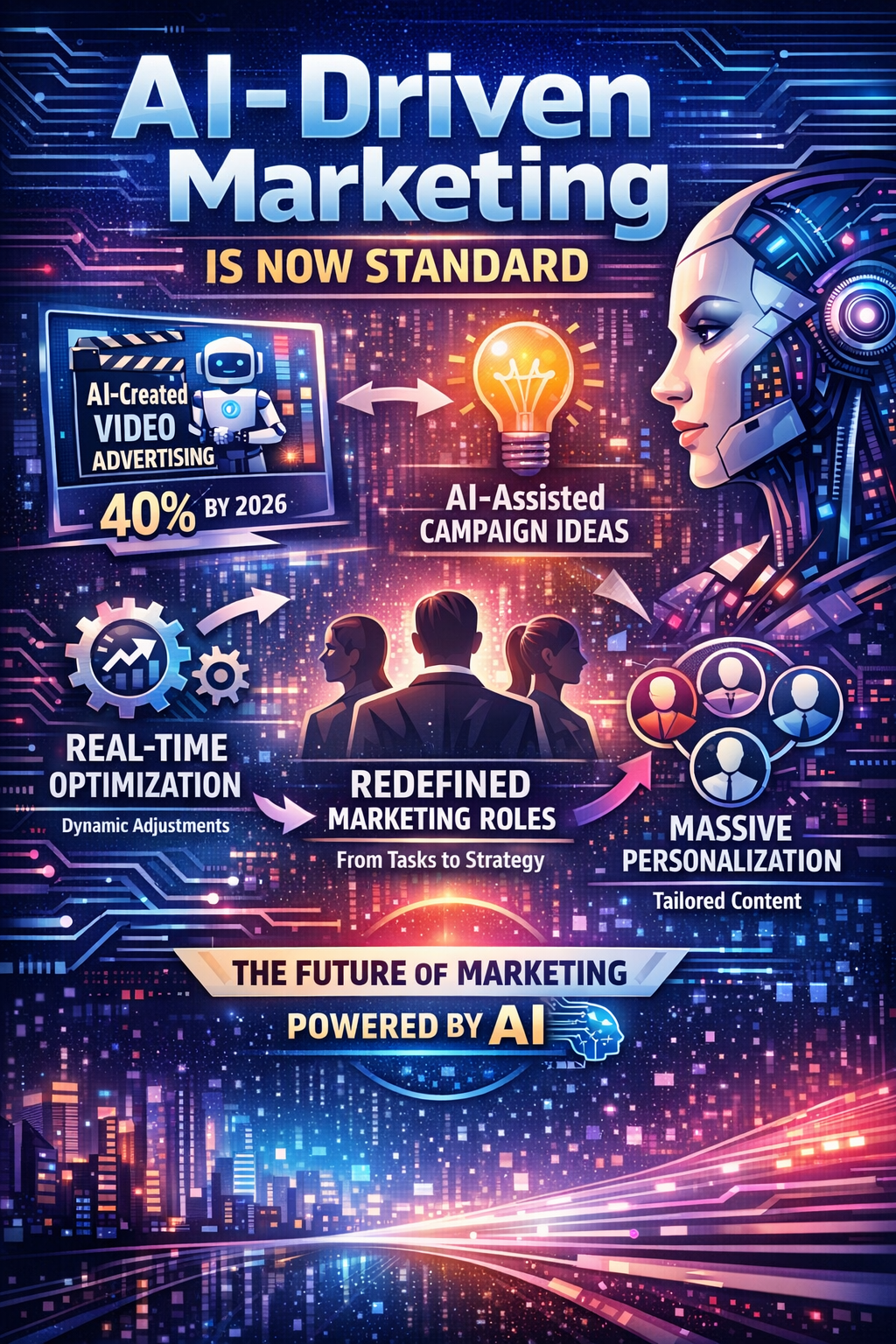
AI-driven marketing is no longer a future trend or an experimental idea. It has officially become the new standard. From generating video ads to optimizing campaigns in real time, artificial intelligence is now deeply embedded in how brands plan, execute, and scale their marketing efforts.
Generative AI, in particular, has moved far beyond simple text generation. Today, it is actively shaping creative strategies, automating decision-making, and helping marketers deliver more personalized messages at a speed and scale that was impossible just a few years ago.
In fact, many advertisers now expect up to 40% of video ads to be AI-created by 2026, signaling a major shift in how marketing content is produced and managed.
Let’s break down what this shift really means, how it’s happening, and what marketers need to understand moving forward.
1. From Experiment to Everyday Tool
Just a short time ago, AI in marketing was seen as a “nice-to-have” feature. Teams tested it cautiously, often in small pilot projects. That phase is over.
Today, AI tools are used daily for tasks like:
- Writing ad copy and headlines
- Generating images and videos for campaigns
- Suggesting campaign ideas and creative angles
- Optimizing ad performance automatically
- Personalizing content for different audiences
Instead of replacing creativity, AI is becoming a creative partner. Marketers now use it to speed up workflows, explore more ideas, and focus on strategy rather than repetitive tasks.
2. Generative AI Is Powering Video Advertising
Video advertising has traditionally been expensive and time-consuming. It required large teams, long production cycles, and high budgets. Generative AI is changing all of that.
How AI is used in video ads today:
- Automatically creating short-form video ads for social platforms
- Generating multiple variations of the same video for different audiences
- Editing videos by adjusting visuals, text, and voiceovers
- Testing different versions to see what performs best
For example, instead of producing one video ad, a brand can now generate dozens of variations in minutes. AI can adjust visuals, captions, and calls-to-action based on audience behavior, location, or platform.
This is why industry experts predict that nearly half of all video ads could be AI-created within the next year or two.
3. Campaign Ideas Are Now AI-Assisted
Coming up with fresh campaign ideas used to be one of the most time-consuming parts of marketing. Today, AI systems can analyze trends, customer data, and past performance to suggest ideas almost instantly.
AI can help marketers:
- Brainstorm campaign themes
- Identify trending topics in real time
- Suggest content formats that perform well
- Align ideas with audience preferences
This doesn’t mean human creativity is disappearing. Instead, marketers are using AI to enhance brainstorming, reduce creative blocks, and validate ideas faster.
Think of AI as a creative assistant that never runs out of energy or ideas.
4. Real-Time Optimization Is Changing Everything
One of the biggest shifts in AI-driven marketing is dynamic optimization. Campaigns no longer need to wait days or weeks to see results and make changes.
AI systems can now:
- Monitor campaign performance in real time
- Adjust messaging automatically
- Change visuals or headlines based on engagement
- Allocate budget to top-performing ads
For example, if one version of an ad starts performing better with a specific audience, AI can instantly push more budget toward it while reducing spend on weaker variations.
This leads to:
- Better performance
- Lower ad costs
- Faster decision-making
5. Marketing Roles Are Being Redefined
AI isn’t eliminating marketing jobs, but it is redefining them.
Instead of spending time on manual tasks, marketers are shifting toward higher-level responsibilities such as:
- Strategic planning
- Creative direction
- Brand storytelling
- Ethical and quality control
- Data interpretation
AI handles the “how,” while humans focus on the “why.”
Modern marketers are becoming AI managers, guiding systems, reviewing outputs, and making final decisions. Those who understand how to work with AI are gaining a clear advantage.
6. Personalization at Massive Scale
Personalization used to be limited to basic elements like first names in emails. AI has taken personalization to an entirely new level.
Today, AI can personalize:
- Ad messages for different user segments
- Product recommendations
- Landing page content
- Email subject lines and timing
All of this happens automatically and at scale. A single campaign can deliver thousands of unique experiences, tailored to individual preferences and behaviors.
7. Challenges Brands Must Still Manage
While AI-driven marketing offers huge benefits, it also comes with responsibilities.
Brands must pay attention to:
- Content quality and accuracy
- Brand voice consistency
- Data privacy and compliance
- Over-reliance on automation
Human oversight is still essential. AI works best when guided by clear goals, ethical standards, and strong brand values.
Key Takeaways
- AI-driven marketing is now the industry standard, not an experiment
- Generative AI is transforming video advertising at scale
- Campaign ideas and creative strategy are increasingly AI-assisted
- Real-time optimization is improving performance and efficiency
- Marketing roles are evolving toward strategy and oversight
Looking Ahead
As AI continues to advance, its role in marketing will only grow stronger. The brands that succeed won’t be the ones that fear AI — they’ll be the ones that embrace it thoughtfully.
AI-driven marketing isn’t about replacing humans. It’s about empowering marketers to move faster, think bigger, and connect more meaningfully with their audiences.
The future of marketing is already here — and it’s intelligently driven by AI.

Leave a comment