Learning something new feels exciting, but forgetting it after a few days can be frustrating. You read a book, watch a course, or understand a concept perfectly — and then it slowly fades away. This happens to almost everyone. The good news is that knowledge retention is a skill you can improve with the right approach.
In this article, we’ll explore why we forget, how to retain information better, how to understand complex concepts, and whether fixed learning paths really work or curiosity-based learning is a better option.
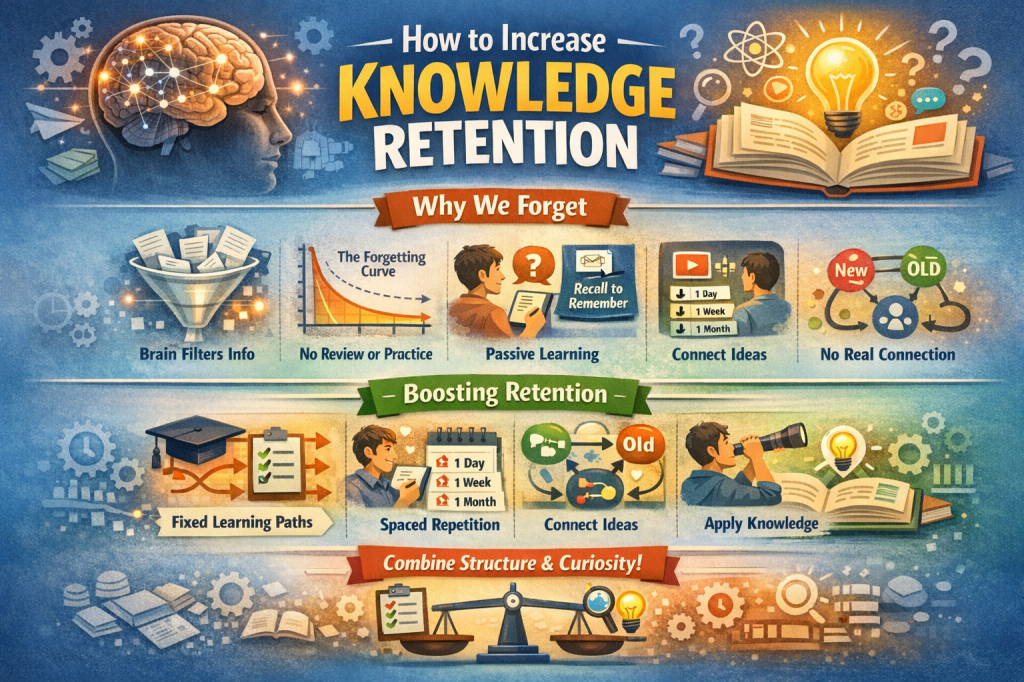
Why Do We Forget What We Learn?
Forgetting is not a weakness. It’s actually how the brain works.
Here are the main reasons we forget information over time:
1. The Brain Filters Information
Your brain is exposed to massive amounts of data every day. To save energy, it keeps only what it thinks is useful. If you don’t revisit or use something, your brain assumes it’s not important.
2. Lack of Reinforcement
If you learn something once and never return to it, the memory stays weak. Strong memories are built through repetition and use.
3. Passive Learning
Simply reading or watching doesn’t force your brain to work deeply. Passive learning creates fragile memories that fade quickly.
4. No Emotional or Practical Connection
Information that isn’t emotionally engaging or practically useful is easier to forget.
How to Increase Information and Knowledge Retention
Retention improves when learning becomes active, meaningful, and repeated.
1. Use Active Recall
Instead of rereading notes, try to recall information from memory.
Examples:
- Ask yourself questions after studying
- Write what you remember without looking
- Teach the idea to someone else
This strengthens memory pathways much more than passive review.
2. Practice Spaced Repetition
Revisiting information over time helps move it into long-term memory.
A simple spacing plan:
- Review after 1 day
- Again after 1 week
- Again after 1 month
This works because it reminds the brain that the information is important.
3. Connect New Knowledge to Old Knowledge
Your brain remembers better when ideas are connected.
For example:
- Link a new concept to something you already know
- Use analogies and real-life examples
- Compare similarities and differences
Connections create stronger memory networks.
4. Apply What You Learn
Using knowledge in real life locks it in.
Examples:
- Write about what you learned
- Solve problems related to the topic
- Apply concepts to your work or hobbies
How to Retain Understanding of Complex Concepts
Complex ideas are harder to retain because they involve multiple layers. The key is simplification and structure.
1. Break Concepts into Smaller Parts
Instead of learning everything at once:
- Divide the topic into chunks
- Learn one part at a time
- Understand how each part fits together
This reduces cognitive overload.
2. Learn the “Why” Before the “How”
Memorizing steps without understanding leads to forgetting.
Always ask:
- Why does this work?
- What problem does this solve?
- What happens if one part changes?
Understanding builds long-lasting knowledge.
3. Use the Feynman Technique
Explain the concept in simple language as if teaching a beginner.
If you struggle to explain it:
- You’ve found a gap in understanding
- Go back and clarify that part
Simple explanations mean deep understanding.
4. Use Visual Thinking
Diagrams, flowcharts, and mind maps help make abstract ideas concrete.
Visual memory often lasts longer than text-based memory.
Do Fixed Learning Paths Really Work?
Fixed learning paths are structured sequences like:
- Courses
- Degree programs
- Step-by-step roadmaps
When Fixed Learning Paths Work Well
- For beginners with no background
- For regulated fields like medicine or engineering
- When discipline and structure are needed
They reduce decision fatigue and ensure foundational coverage.
Limitations of Fixed Learning Paths
- They can feel slow or boring
- They assume everyone learns the same way
- They may include unnecessary material
- They can reduce curiosity and motivation
Learning becomes a task instead of a natural process.
What If You Learn Based on Curiosity Instead?
Curiosity-driven learning means:
- Learning what genuinely interests you
- Following questions as they arise
- Trusting understanding over memorization
Benefits of Curiosity-Based Learning
- Higher motivation
- Deeper engagement
- Stronger memory retention
- Better creative thinking
When you’re curious, your brain naturally pays more attention.
Risks of Only Relying on Curiosity
- Knowledge gaps may appear
- You may miss foundational concepts
- Learning can feel scattered
Curiosity alone works best when combined with reflection and review.
The Best Approach: Structured Curiosity
Instead of choosing one method, combine both.
How to Do This Effectively
- Use a loose learning path as a guide
- Follow curiosity within that structure
- Regularly review and connect ideas
- Focus on understanding, not speed
This approach keeps learning flexible but meaningful.
Key Takeaways
- Forgetting happens because the brain filters unused information
- Active recall and spaced repetition improve retention
- Understanding beats memorization for complex concepts
- Fixed learning paths provide structure but can limit curiosity
- Curiosity-based learning boosts engagement and memory
- The best results come from combining structure with curiosity
Learning is not about storing information — it’s about building understanding that lasts.

Leave a comment