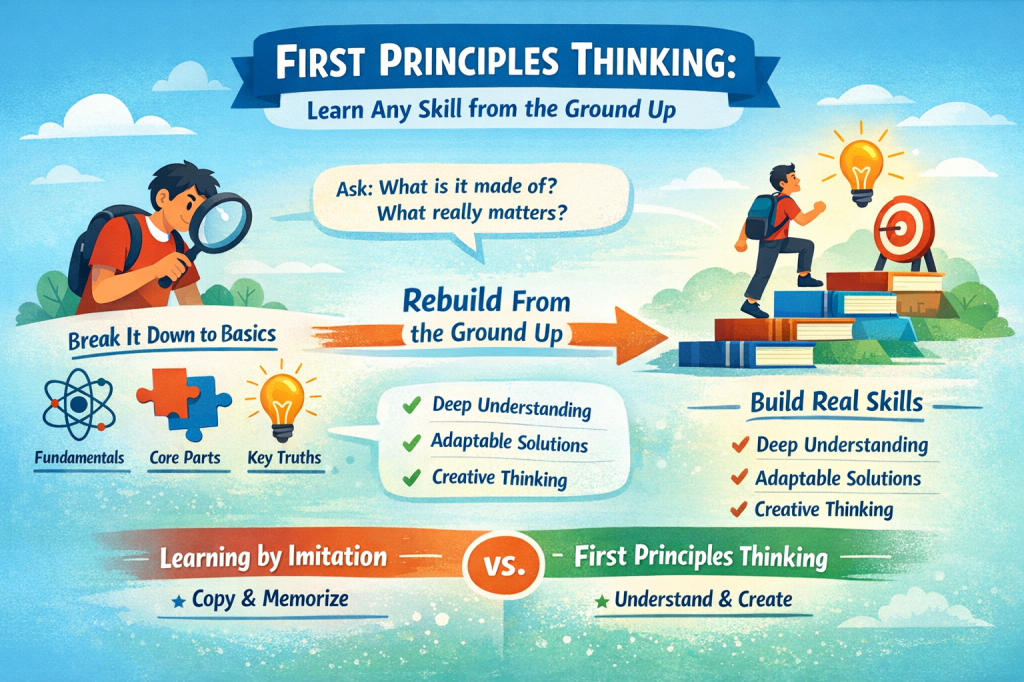
Learning a new skill can sometimes feel overwhelming. Whether it’s coding, writing, public speaking, or even fitness, we often get stuck copying others or following rigid systems that don’t fully make sense. This is where first principles thinking can completely change the way you learn.
In this article, we’ll break down what first principles thinking really means, why it’s powerful, and how you can use it step by step to learn new skills faster and more effectively.
What Is First Principles Thinking?
First principles thinking is a way of solving problems by breaking things down to their most basic truths and building up from there.
Instead of relying on:
- What everyone else is doing
- Traditional methods
- Assumptions and shortcuts
You ask:
- What is this really made of?
- What do I absolutely need to know?
- What are the core fundamentals?
In simple terms, first principles thinking means learning from the ground up, not from borrowed conclusions.
First Principles Thinking vs. Learning by Imitation
Most people learn skills by imitation. For example:
- Copying a YouTube tutorial exactly
- Memorizing steps without understanding why they work
- Following “best practices” blindly
This approach can work, but it has limits.
Learning by Imitation
- Faster at the start
- Easy to follow
- Breaks down when something changes
Learning with First Principles
- Slower at the beginning
- Builds deep understanding
- Makes you adaptable and confident
When you understand the basics, you can adjust, improve, and even create your own methods.
Why First Principles Thinking Is So Powerful
Here’s why this way of thinking stands out:
- It removes confusion
You focus only on what truly matters, not unnecessary details. - It improves problem-solving
When you get stuck, you can go back to the basics and rebuild. - It helps you learn faster in the long run
Deep understanding saves time later. - It boosts creativity
You’re no longer limited by existing rules or methods.
How First Principles Thinking Works (Simple Breakdown)
To apply first principles thinking, follow these three steps:
1. Identify the Goal
Ask yourself:
- What skill do I want to learn?
- What does “being good” at this skill actually mean?
Example:
If the skill is writing, the goal might be:
Communicating ideas clearly and engagingly to readers.
2. Break the Skill Down to Its Core Parts
Now ask:
- What are the basic building blocks of this skill?
- What cannot be removed?
For writing, core parts might be:
- Clear thinking
- Simple language
- Structure (beginning, middle, end)
- Practice and feedback
Everything else—tools, apps, styles—is secondary.
3. Rebuild the Skill from the Basics
Once you know the fundamentals:
- Practice each core part separately
- Improve them one by one
- Combine them gradually
This creates strong foundations instead of shaky shortcuts.
Applying First Principles Thinking to Learning New Skills
Let’s look at how you can apply this approach in real life.
Example 1: Learning a New Language
Traditional Approach
- Memorize long word lists
- Follow a fixed course
- Get stuck when speaking
First Principles Approach
Break language down to its basics:
- Sounds and pronunciation
- Common words
- Basic sentence structure
- Daily usage
You then focus on:
- Speaking simple sentences early
- Learning words you actually use
- Practicing daily conversations
This makes learning more natural and practical.
Example 2: Learning Coding
Instead of:
- Jumping between frameworks
- Copy-pasting code
Use first principles:
- What is code? (Instructions for computers)
- What are variables, loops, and logic?
- How does input turn into output?
Once you understand these basics, learning any programming language becomes much easier.
Example 3: Learning Fitness or Exercise
Rather than:
- Following random workout plans
Break it down:
- Muscles grow from resistance
- Rest is required for recovery
- Nutrition fuels performance
With this understanding, you can design workouts that suit your body and goals.
How to Start Using First Principles Thinking Today
Here are simple steps you can apply immediately:
- Ask “why” more often
- Question assumptions
- Strip problems down to basics
- Learn fundamentals before tools
- Practice deliberately, not mindlessly
You don’t need to be an expert—just stay curious.
Common Mistakes to Avoid
While using first principles thinking, avoid these traps:
- Overthinking instead of practicing
- Ignoring proven methods completely
- Trying to reinvent everything at once
First principles thinking works best when combined with action and real-world practice.
Key Takeaways
- First principles thinking means learning from the ground up
- It focuses on fundamentals, not shortcuts
- It helps you adapt, solve problems, and learn deeply
- You can apply it to any skill—writing, coding, fitness, or language
Looking Ahead: Becoming a Better Learner
Once you start using first principles thinking, you’ll notice a shift in how you approach learning. Instead of feeling lost or dependent on others, you’ll feel more confident breaking down complex skills into simple parts.
Over time, this mindset turns you into a self-directed learner—someone who can learn anything, anytime.

Leave a comment