If you’re new to Python programming, the terms class and object can feel confusing at first. They’re closely related, often mentioned together, and sometimes used interchangeably by beginners—which leads to misunderstandings.
In this article, we’ll break down the difference between a class and an object in Python using simple language, clear examples, and real-world analogies. By the end, you’ll understand not only what they are, but why they matter and how they work together.
Understanding the Core Idea (In Plain English)
Before diving into definitions, let’s start with a simple idea:
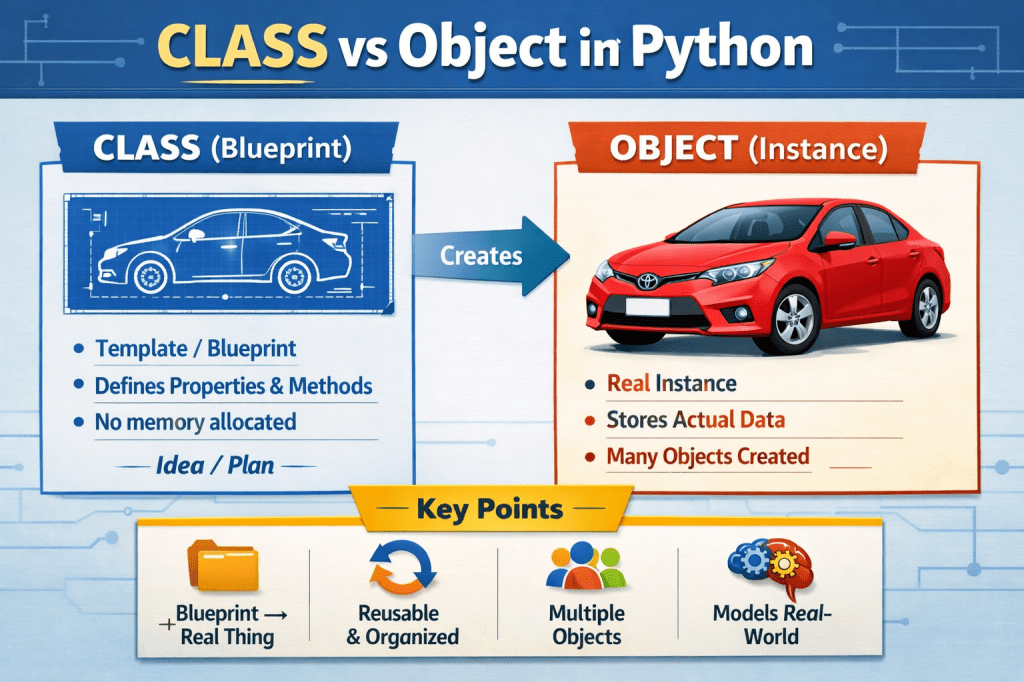
A class is a blueprint.
An object is something built using that blueprint.
That’s it. Almost everything else builds on this one idea.
What Is a Class in Python?
A class is a template or blueprint used to create objects. It defines:
- What data an object will have (variables)
- What actions an object can perform (functions, called methods)
Think of a class as a design—not the real thing.
Real-World Analogy
Imagine you’re designing a car.
- The car design (engine type, color options, speed) is the class
- The design itself isn’t a real car—you can’t drive it
Simple Python Example
class Car: brand = "Toyota" def drive(self): print("The car is moving")Here:
Caris a class- It defines a property (
brand) - It defines a behavior (
drive)
But no car exists yet.
What Is an Object in Python?
An object is a real instance created from a class.
It represents an actual thing that you can use, modify, and interact with.
If a class is the blueprint, the object is the finished product.
Continuing the Analogy
- The actual Toyota Corolla parked outside is an object
- You can drive it, paint it, sell it
Simple Python Example
my_car = Car()Here:
my_caris an object- It is created from the
Carclass
You can now use it:
print(my_car.brand)my_car.drive()Output:
ToyotaThe car is movingKey Differences Between Class and Object
Let’s make the differences crystal clear.
1. Definition
| Class | Object |
|---|---|
| Blueprint or template | Instance of a class |
| Logical structure | Real entity |
| Defines properties and methods | Uses those properties and methods |
2. Memory Allocation
- Class:
No memory is allocated for data when a class is defined. - Object:
Memory is allocated when an object is created from a class.
In simple terms:
- Class = idea
- Object = actual data stored in memory
3. Number Allowed
- You can define one class
- You can create many objects from that class
Example:
car1 = Car()car2 = Car()car3 = Car()All three objects use the same blueprint but exist independently.
4. Modification
- Changing a class affects all future objects
- Changing an object affects only that object
Example:
car1.brand = "Honda"Now:
car1.brand→ Hondacar2.brand→ Toyota
A Slightly More Realistic Example
Let’s look at a more practical example using a Student class.
class Student: def __init__(self, name, age): self.name = name self.age = age def introduce(self): print(f"My name is {self.name} and I am {self.age} years old")Creating objects:
student1 = Student("Ali", 20)student2 = Student("Sara", 22)Using objects:
student1.introduce()student2.introduce()Each student object:
- Has its own data
- Uses the same class structure
Why Python Needs Classes and Objects
You might wonder: Why not just write simple code without classes?
Classes and objects help you:
- Organize code – related data and functions stay together
- Reuse logic – write once, use many times
- Model real-world problems – users, products, orders, messages
- Scale projects – essential for large applications
Almost every modern Python project—web apps, data science, automation—relies heavily on classes and objects.
Common Beginner Mistakes (And How to Avoid Them)
- Thinking class and object are the same
→ Remember: blueprint vs instance - Forgetting to create an object
→ You can’t use class methods without an object (most of the time) - Confusing variables inside a class
→selfalways refers to the current object
Understanding these early will save you a lot of frustration later.
Key Takeaways
- A class is a blueprint that defines structure and behavior
- An object is a real instance created from a class
- One class can create many independent objects
- Classes don’t store real data—objects do
- This concept is the foundation of object-oriented programming in Python
Once this idea clicks, learning advanced topics like inheritance and polymorphism becomes much easier.
If you enjoy learning foundational concepts like this and want to apply them to real-world skills such as business, communication, and personal growth, you may find my collection of books on personal development and digital skills helpful.

Leave a comment