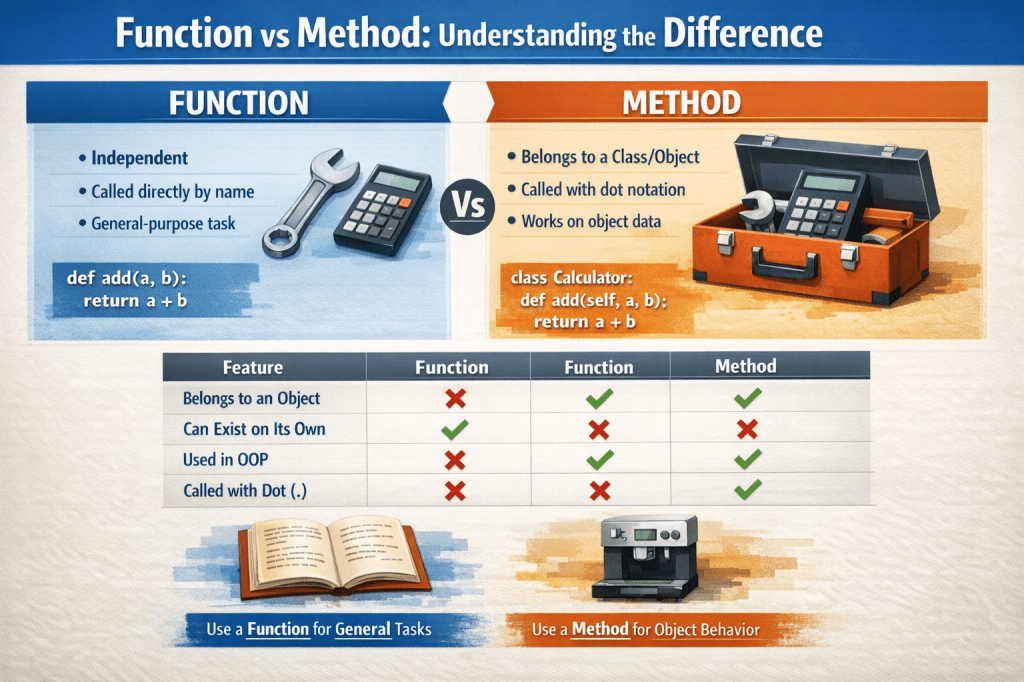
If you’re learning computer programming, you’ve probably seen the terms function and method used a lot—sometimes even interchangeably. This can be confusing for beginners because they seem to do the same thing: both run a block of code to perform a task.
So what’s the real difference?
In simple terms, all methods are functions, but not all functions are methods. The difference mainly comes down to where they live and how they are used.
Let’s break this down in a clear, beginner-friendly way.
What Is a Function?
A function is a reusable block of code that performs a specific task. You can think of it as a small machine: you give it some input, it does something, and it may return an output.
Key characteristics of a function:
- Exists independently
- Is not tied to an object
- Can be called directly by its name
- Helps avoid repeating code
Simple example:
Imagine a function that adds two numbers.
def add(a, b): return a + bHere:
addis a function- It takes two inputs (
aandb) - It returns their sum
You can call this function anywhere in your program:
result = add(3, 5)The function doesn’t belong to anything else—it stands on its own.
What Is a Method?
A method is a function that belongs to an object. In other words, it is defined inside a class and works on the data of that class.
Key characteristics of a method:
- Belongs to a class or object
- Is called using dot notation
- Usually works with object data
- Is part of object-oriented programming (OOP)
Simple example:
class Calculator: def add(self, a, b): return a + bHere:
addis a method- It belongs to the
Calculatorclass - It must be called using an object
calc = Calculator()result = calc.add(3, 5)The method only makes sense in the context of the object it belongs to.
The Core Difference Explained Simply
Think of it like this:
- A function is like a free-standing tool
- A method is like a tool inside a toolbox
Both do work, but one lives on its own, while the other belongs to something.
Side-by-Side Comparison
| Feature | Function | Method |
|---|---|---|
| Belongs to an object | ❌ No | ✅ Yes |
| Can exist on its own | ✅ Yes | ❌ No |
| Used in OOP | ❌ Not required | ✅ Required |
Called using dot (.) | ❌ No | ✅ Yes |
| Access to object data | ❌ No | ✅ Yes |
Why Programming Languages Make This Distinction
Modern programming encourages organizing code logically. That’s where methods shine.
- Functions are great for general-purpose tasks
- Methods are ideal for object-specific behavior
For example:
- A function might calculate tax for any number
- A method might calculate tax for a specific
Invoiceobject
This separation makes programs:
- Easier to read
- Easier to maintain
- Easier to scale
Real-World Analogy
Imagine a kitchen:
- A function is like a public recipe you can use anywhere
- A method is like a recipe built into a specific appliance
You can follow a recipe without owning the appliance—but the appliance’s built-in recipe only works with that appliance.
Do All Languages Treat Them the Same Way?
No, and this is where confusion often comes from.
- In procedural languages (like C), you mostly use functions
- In object-oriented languages (like Java, Python, C#), methods are common
- Some languages blur the line, but the concept still exists
Even in languages where everything is technically an object, programmers still use the terms differently to describe intent and structure.
When Should You Use a Function vs a Method?
Use a function when:
- The task is general
- It doesn’t depend on object data
- It can be reused across many parts of the program
Use a method when:
- The task belongs logically to an object
- It needs access to object properties
- You’re modeling real-world behavior
Key Takeaways
- A function is an independent block of reusable code
- A method is a function that belongs to a class or object
- Methods are a core part of object-oriented programming
- The difference is about context, not capability
- Understanding this helps you write cleaner, more organized code
Once this distinction clicks, reading and writing code becomes much easier—especially as programs grow larger and more complex.
If you enjoy learning concepts like this and want to explore how programming skills connect to business, communication, and personal growth, you may find some helpful reads in my collection of books on business and personal development available on Apple Books.

Leave a comment