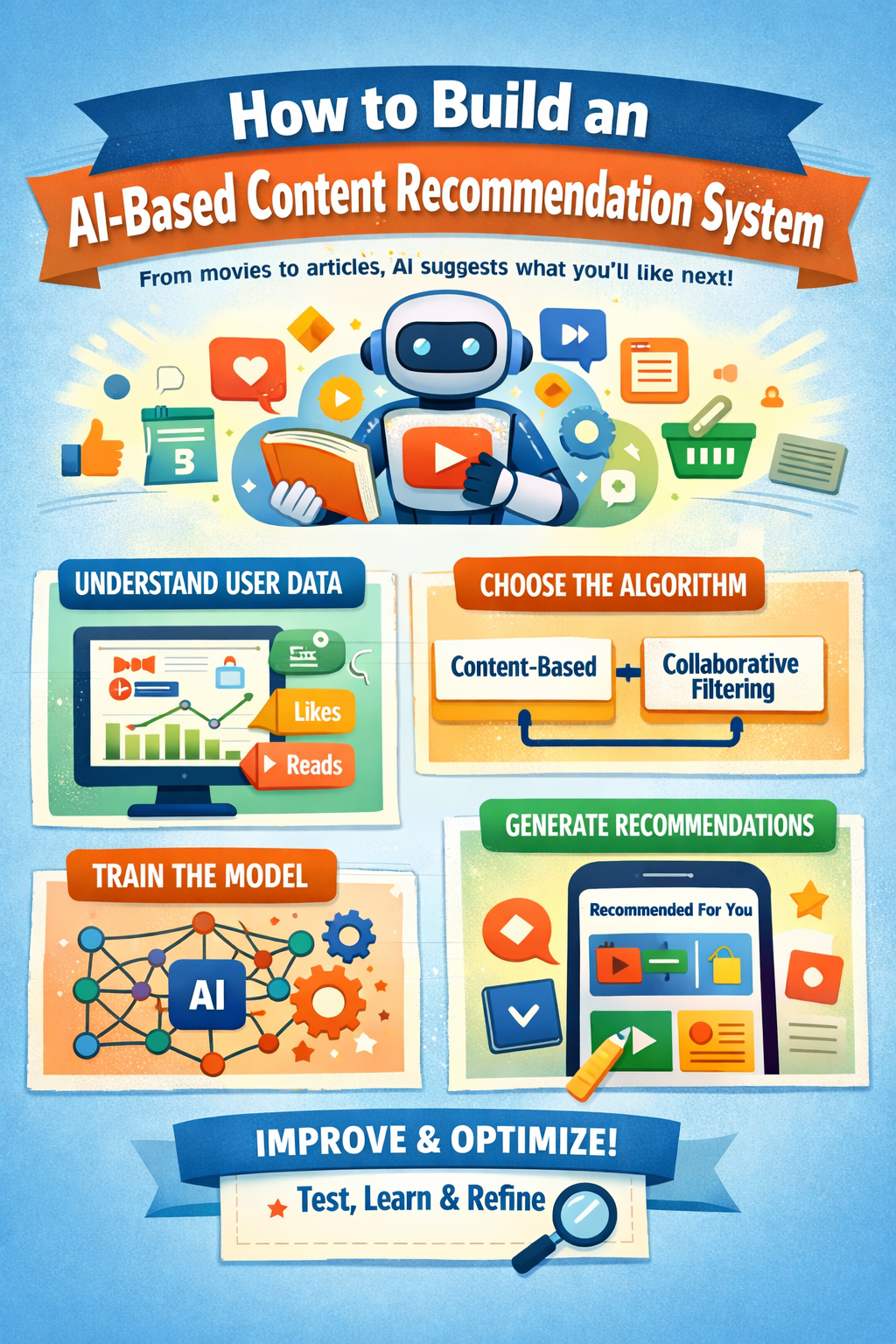
AI-based content recommendation systems are everywhere today. From Netflix suggesting your next favorite show to blogs showing related articles, recommendation systems help users discover content they actually care about.
In this article, I’ll explain how to build an AI-based content recommendation system in simple, beginner-friendly terms. You don’t need to be a data scientist to understand the core ideas. We’ll break everything down step by step with clear examples.
What Is an AI-Based Content Recommendation System?
A content recommendation system is a tool that suggests articles, videos, products, or posts to users based on their behavior, interests, or preferences.
Examples you see every day:
- YouTube recommending videos
- Blogs showing “Related Articles”
- E-commerce sites suggesting products
- News apps personalizing headlines
AI improves these systems by learning from data instead of relying on fixed rules.
Why Use AI for Content Recommendations?
Traditional recommendations use simple logic like:
- “Show the most popular articles”
- “Show the latest posts”
AI-based systems go much further.
Benefits of AI-based recommendations:
- Personalized content for each user
- Higher engagement and time spent
- Better user experience
- Continuous learning and improvement
Key Types of Recommendation Systems
Before building one, it’s important to understand the main types.
1. Content-Based Filtering
This method recommends content similar to what a user already likes.
Example:
- If a user reads many AI articles, recommend more AI-related posts.
How it works:
- Analyzes content features (keywords, topics, tags)
- Matches them with user preferences
2. Collaborative Filtering
This method uses behavior from many users.
Example:
- “Users who read this article also read that one.”
How it works:
- Finds users with similar interests
- Recommends content liked by similar users
3. Hybrid Recommendation Systems
This combines both approaches.
Why hybrid is powerful:
- Works even with new users
- More accurate recommendations
- Used by most large platforms
Step-by-Step Guide to Building an AI-Based Recommendation System
Step 1: Define Your Goal
Start by asking:
- What content are you recommending?
- Who are your users?
- What action matters most? (clicks, reads, watch time)
Example goals:
- Increase article reads on a blog
- Keep users longer on a platform
- Improve content discovery
Clear goals guide your entire system design.
Step 2: Collect the Right Data
AI systems learn from data. The better your data, the better your recommendations.
Common data sources:
- User clicks
- Reading time
- Likes, shares, or comments
- Search history
- Content tags and categories
Example:
If a user spends 5 minutes reading AI tutorials, that’s a strong interest signal.
Step 3: Prepare and Clean the Data
Raw data is often messy.
Important tasks:
- Remove duplicates
- Handle missing values
- Normalize text (lowercase, remove symbols)
- Convert text into numerical form
This step is critical because AI models only understand numbers.
Step 4: Choose the Recommendation Approach
Pick a method based on your needs.
For small platforms:
- Content-based filtering is simpler and effective
For large platforms:
- Collaborative or hybrid systems work better
Beginner-friendly approach:
- Start with content-based recommendations
- Add collaborative filtering later
Step 5: Build the AI Model
Here’s where machine learning comes in.
Popular techniques:
- TF-IDF for text similarity
- Cosine similarity to compare content
- Matrix factorization for collaborative filtering
- Neural networks for advanced systems
Simple example:
- Convert articles into vectors
- Compare similarity between articles
- Recommend the closest matches
Step 6: Generate Recommendations
Once the model is ready:
- Identify user interests
- Match them with similar content
- Rank results based on relevance
You can recommend based on:
- Recently viewed content
- Most similar articles
- Popular content within a topic
Step 7: Test and Improve the System
No recommendation system is perfect on day one.
Ways to evaluate performance:
- Click-through rate (CTR)
- Time spent on content
- User retention
- A/B testing different models
Use feedback to keep improving the system.
Common Challenges and How to Solve Them
Cold Start Problem
New users or new content lack data.
Solutions:
- Show popular content
- Ask users to select interests
- Use content-based filtering initially
Data Privacy Concerns
Users care about how their data is used.
Best practices:
- Collect only necessary data
- Be transparent
- Follow data protection laws
Tools and Technologies You Can Use
You don’t need to build everything from scratch.
Popular tools:
- Python for data processing
- Machine learning libraries
- Databases for storing user behavior
- Cloud platforms for scalability
Start simple and expand as your system grows.
Key Takeaways
- AI-based content recommendations personalize user experiences
- Start with clear goals and quality data
- Content-based systems are great for beginners
- Hybrid systems offer the best long-term results
- Continuous testing improves accuracy over time
Looking Ahead
As AI evolves, recommendation systems will become even smarter. Future systems will understand user intent better, adapt in real time, and deliver highly personalized experiences across platforms.
If you’re just starting, focus on building a simple system first. Once that works, you can gradually add more advanced AI techniques.

Leave a comment