If you’re new to computer programming, the word arguments might sound confusing or even intimidating. But don’t worry—arguments are actually one of the most basic and useful ideas in programming. Once you understand them, many other concepts will start to make a lot more sense.
In this article, we’ll break down what arguments are, why they matter, and how they’re used, all in a simple, beginner-friendly way.
Understanding the Basic Idea of Arguments
At its core, an argument is a value you pass into a function or method so it can do its job.
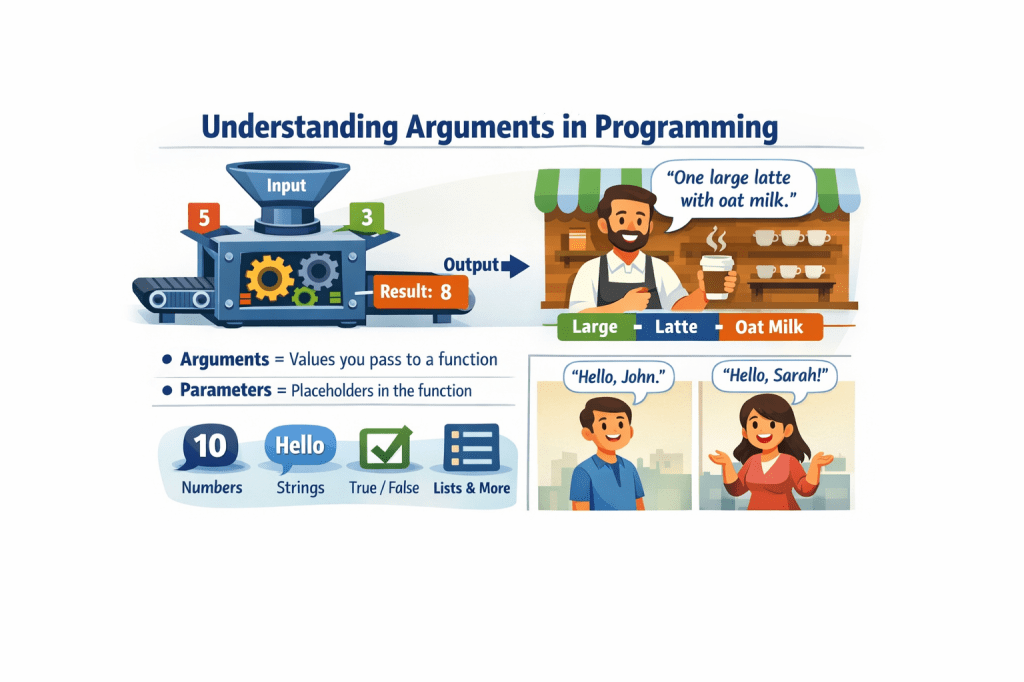
Think of a function like a machine.
- The machine has a task (for example, adding numbers)
- You give it some input
- It produces an output
That input is what programmers call an argument.
A Real-World Analogy
Imagine ordering coffee ☕:
- You tell the barista: “One large latte with oat milk.”
- The barista already knows how to make coffee
- Your choices customize the result
Those choices—large, latte, oat milk—are like arguments.
They tell the process how to behave.
Arguments vs Parameters (Important Difference)
Beginners often mix up arguments and parameters, so let’s clear that up early.
- Parameters are variables listed in a function’s definition
- Arguments are the actual values you pass when calling the function
Simple Example (in plain language)
- Function definition: “Add two numbers”
- The placeholders (like number1 and number2) are parameters
- Function call: “Add 5 and 3”
- The values 5 and 3 are arguments
You can remember it this way:
Parameters are names. Arguments are real values.
Why Arguments Are So Important
Arguments make programs flexible and reusable.
Without arguments:
- You’d need a new function for every possible situation
- Programs would be long, repetitive, and hard to manage
With arguments:
- One function can handle many different inputs
- Your code becomes cleaner and more powerful
Example Without Arguments
- A function that only prints “Hello, John”
Example With Arguments
- A function that prints “Hello” to any name you pass
Same function. Many results. That’s the power of arguments.
How Arguments Are Used in Programming
Although syntax differs between programming languages, the idea of arguments stays the same.
Here’s what usually happens:
- You define a function with parameters
- You call the function
- You pass arguments inside the parentheses
- The function uses those values to perform its task
Common Types of Arguments
Most programming languages allow you to pass different kinds of arguments, such as:
- Numbers (e.g., 10, 3.14)
- Text (strings) (e.g., “Hello”, “World”)
- True/False values
- Lists or arrays
- Objects or data structures
As you progress, you’ll learn that arguments can even be other functions.
Default Arguments (Beginner-Friendly Feature)
Some programming languages allow default arguments.
This means:
- If no argument is provided, the function uses a preset value
Why This Is Helpful
- Makes functions easier to use
- Reduces errors
- Gives sensible behavior even when inputs are missing
For example:
- A greeting function might default to saying “Hello, Guest”
- If you provide a name, it uses that instead
Passing Multiple Arguments
Many functions accept more than one argument.
For example:
- A calculator function might take:
- First number
- Second number
- Operation type
The key rule:
- Arguments must usually be passed in the correct order
Some languages also allow:
- Named arguments (you specify which value belongs to which parameter)
- Optional arguments
These features make programs more readable and safer.
Common Mistakes Beginners Make
When learning about arguments, beginners often run into a few issues:
- Passing too many or too few arguments
- Using the wrong data type
- Confusing parameters with arguments
- Forgetting the order of arguments
The good news?
These mistakes are normal and part of learning.
Key Takeaways
- Arguments are values passed into a function
- They allow functions to work with different data
- Arguments make code reusable and flexible
- Parameters are placeholders; arguments are real values
- Almost every useful program relies on arguments
Once you understand arguments, concepts like functions, methods, and APIs become much easier to grasp.
If you’re interested in building real skills—whether in programming, communication, or personal growth—you might enjoy exploring my books on business and personal development available on Apple Books. They’re designed to help beginners turn knowledge into practical confidence.

Leave a comment