If you work with retail data, e-commerce catalogs, product analytics, or supply chains, you may have come across the term regional GPC taxonomy. At first glance, it sounds technical and intimidating—but the idea behind it is actually quite simple.
In this article, I’ll break it down step by step, using plain language and real-world examples, so you can clearly understand what regional GPC taxonomy is, why it exists, and how it’s used in practice.
Understanding GPC Taxonomy (First Things First)
Before we talk about regional GPC taxonomy, let’s understand GPC taxonomy itself.
GPC stands for Global Product Classification.
It is a standardized system developed by GS1 to classify products in a consistent, structured way.
Think of GPC taxonomy as:
A universal “product language” that helps businesses describe products the same way across systems.
Example:
Instead of one company calling a product “soft drink” and another calling it “carbonated beverage”, GPC gives both the same official category code.
What Does “Taxonomy” Mean Here?
A taxonomy is simply a hierarchical classification system—like a family tree.
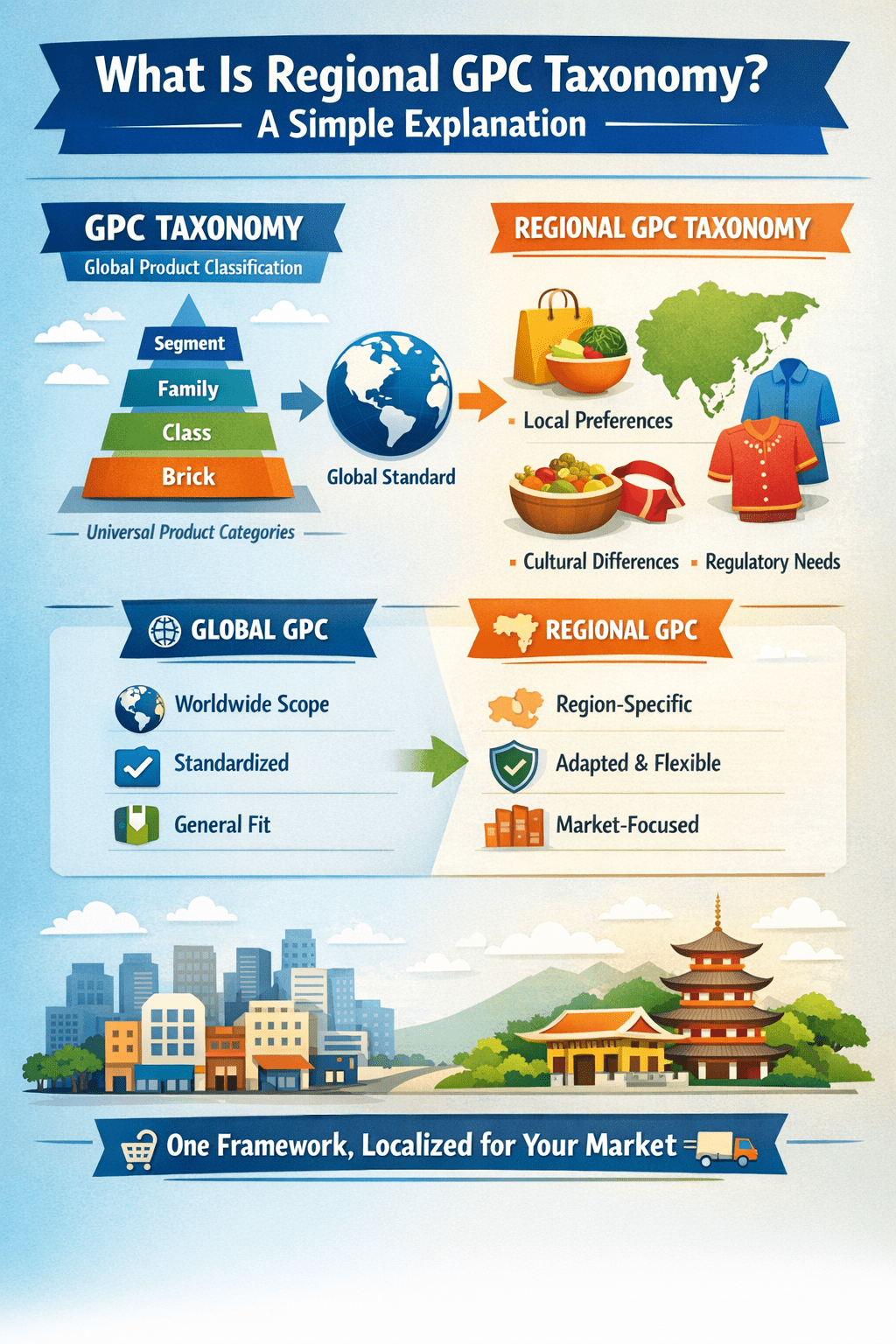
In GPC, products are organized from broad to specific:
- Segment (very broad)
- Family
- Class
- Brick (most detailed level)
- Attributes (optional extra details)
Example:
- Segment: Food & Beverages
- Family: Beverages
- Class: Soft Drinks
- Brick: Cola Carbonated Soft Drinks
This structure makes product data easier to manage, search, analyze, and exchange.
So, What Is Regional GPC Taxonomy?
Now let’s add the “regional” part.
Regional GPC taxonomy refers to localized adaptations or interpretations of the global GPC standard to fit:
- Regional consumer behavior
- Local regulations
- Cultural differences
- Market-specific product variations
In short:
It’s the same global GPC framework, adjusted to make sense in a specific region or market.
Why Regional GPC Taxonomy Is Necessary
A single global classification doesn’t always work perfectly everywhere.
Here’s why:
1. Products Differ by Region
Some products are common in one region but rare—or nonexistent—in another.
- Rice varieties in Asia
- Dairy substitutes in Europe
- Packaged spice mixes in South Asia
A regional taxonomy allows more accurate categorization.
2. Cultural Buying Habits Matter
Consumers shop differently in different regions.
- Breakfast foods vary widely
- Clothing categories change with climate
- Household items are grouped differently
Regional taxonomy reflects how people actually shop.
3. Regulatory & Legal Requirements
Some regions require:
- Specific labeling
- Controlled product categories
- Regulated food or medical classifications
Regional GPC helps businesses stay compliant.
How Regional GPC Taxonomy Works in Practice
The core structure stays global, but regions may:
- Emphasize certain categories more
- Add region-specific “bricks”
- Use localized attribute values
- Map local product catalogs to GPC differently
Example: Beverage Classification
A global GPC may include:
- Carbonated Soft Drinks
A regional version may further distinguish:
- Traditional herbal drinks
- Fortified energy beverages
- Local fermented drinks
All still fit under GPC—but in a way that reflects local reality.
Who Uses Regional GPC Taxonomy?
Regional GPC taxonomy is widely used by:
- Retailers (online and offline)
- E-commerce marketplaces
- Manufacturers and suppliers
- Data analytics teams
- ERP and product information systems (PIM)
Common Use Cases:
- Product catalog standardization
- Faster product onboarding
- Better search and filtering
- Accurate sales and category analysis
- Cross-border trade alignment
Regional vs Global GPC: Key Differences
| Aspect | Global GPC | Regional GPC |
|---|---|---|
| Scope | Worldwide | Region-specific |
| Flexibility | Standardized | Adapted |
| Cultural fit | General | High |
| Regulation alignment | Broad | Local |
| Product relevance | Universal | Market-focused |
Both work together—not against each other.
Why This Matters for Businesses
If you sell, manage, or analyze products across regions, regional GPC taxonomy helps you:
- Avoid messy, inconsistent product data
- Improve customer search experience
- Reduce integration issues between systems
- Scale into new markets faster
- Make better category-level decisions
In today’s data-driven commerce world, clean classification equals competitive advantage.
What This Means for You
Regional GPC taxonomy is not about reinventing product classification—it’s about making global standards practical at the local level.
If you’re involved in:
- E-commerce
- Retail operations
- Product data management
- Business analytics
Understanding this concept will help you work smarter with product data, not harder.
And if you’re interested in learning how structured systems like taxonomy, communication, and strategy connect to income growth and business success, you may find valuable insights in my collection of books on business and personal development available on Apple Books.

Leave a comment