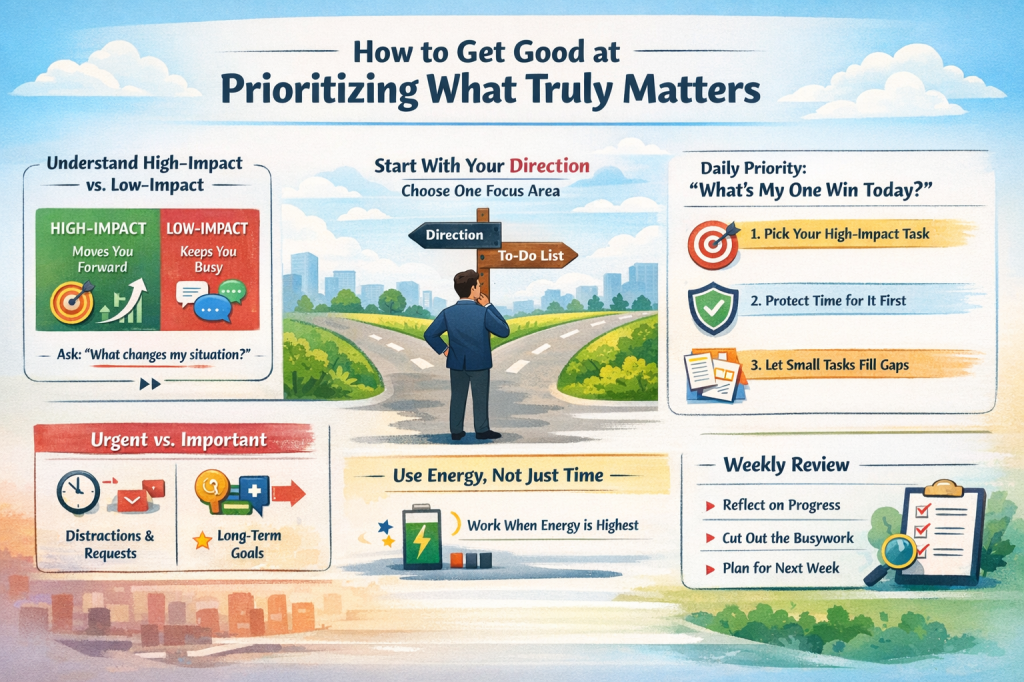
Prioritizing sounds simple—just do the most important things first. But in real life, it’s one of the hardest skills to master. Every day, you’re pulled in different directions: things you should learn, tasks that feel urgent, messages demanding attention, and goals that matter but don’t scream for action.
Good prioritization isn’t about doing more. It’s about consistently doing the right things.
Let’s break this down in a practical, beginner-friendly way so you can start prioritizing what to learn, what to work on, and how to use your time—without feeling overwhelmed.
Understand What “High-Impact” Really Means
A high-impact activity is something that creates disproportionate results compared to the time and energy you put into it.
In simple terms:
- Low-impact work keeps you busy
- High-impact work moves your life forward
Examples:
- Learning a core skill that compounds over years (high-impact)
- Scrolling productivity videos all day (low-impact)
- Having one hard conversation that clears confusion (high-impact)
- Answering every notification instantly (low-impact)
The key shift is this:
Ask “What changes my situation?” instead of “What keeps me occupied?”
Start With Your Direction, Not Your To-Do List
You cannot prioritize effectively if you don’t know where you’re going.
Before choosing tasks, get clarity on one primary direction for the current phase of your life.
Ask yourself:
- What am I trying to improve right now?
- What would make the next 3–6 months meaningfully better?
- Which area, if improved, would reduce stress or unlock progress elsewhere?
Examples of focus areas:
- Career skill-building
- Health and energy
- Financial stability
- A specific project or business
- Relationships or communication
You don’t need to fix everything at once. Prioritization improves the moment you choose one main direction.
How to Prioritize What to Learn
The biggest mistake people make is learning randomly.
Instead, use this filter:
1. Learn Skills That Multiply Other Skills
High-impact learning usually:
- Improves your earning ability
- Improves how you think or communicate
- Improves how you manage yourself
Examples:
- Communication and writing
- Problem-solving
- Sales or persuasion
- Managing attention and energy
- One core technical or professional skill
2. Learn Just Enough to Apply
Learning becomes high-impact only when applied.
Instead of asking:
“What else should I learn?”
Ask:
“What do I need to learn to take the next action?”
Progress beats knowledge accumulation.
How to Decide What Deserves Your Attention Today
A powerful daily prioritization question is:
“If I did only one thing today, what would make today a win?”
This becomes your anchor task.
Here’s a simple daily framework:
Step 1: Identify Your One High-Impact Task
This task usually:
- Feels slightly uncomfortable
- Moves a long-term goal forward
- Is easy to avoid, but costly to ignore
Step 2: Protect Time for It First
Do it:
- Before checking messages
- Before low-effort tasks
- When your energy is highest
Everything else is secondary.
Step 3: Let Small Tasks Fill the Gaps
Emails, admin, and errands are not bad—but they should orbit your main task, not replace it.
Stop Confusing Urgent With Important
Urgency is loud. Importance is quiet.
Urgent tasks:
- Notifications
- Other people’s requests
- Deadlines that repeat every day
Important tasks:
- Skill-building
- Planning
- Deep thinking
- Long-term projects
A helpful rule:
If a task keeps coming back unchanged, it’s probably not high-impact.
High-impact work usually reduces future work.
Use Energy, Not Time, as Your Main Metric
Two hours of focused work beats eight hours of distracted effort.
To prioritize better:
- Do demanding work when energy is highest
- Save simple tasks for low-energy periods
- Stop planning days that assume you’ll be motivated all the time
Ask daily:
- When am I mentally sharp?
- When am I easily distracted?
Then align your most important work accordingly.
Build a Simple Weekly Review Habit
Once a week, ask:
- What actually moved the needle this week?
- What felt busy but didn’t matter?
- What should I do less of next week?
Prioritization improves through reflection, not perfection.
Over time, patterns become obvious—and clarity compounds.
What This Means for You
Getting good at prioritizing isn’t about willpower or fancy systems. It’s about learning to:
- Choose direction before tasks
- Focus on leverage over volume
- Protect attention as a valuable resource
- Repeatedly ask what truly moves your life forward
If you’d like deeper insights on decision-making, communication, and building a more intentional life, you may find some of my books on Apple Books helpful—especially those focused on personal growth and practical thinking.
The goal isn’t to do everything.
The goal is to do what matters most, consistently.

Leave a comment