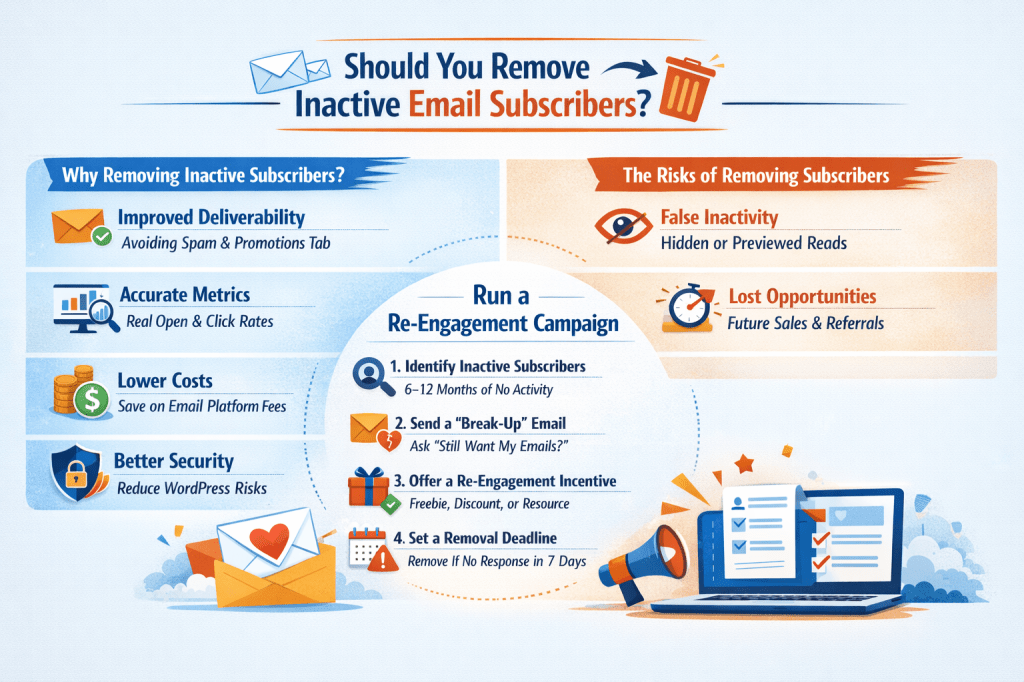
Email marketing isn’t just about growing your list—it’s about keeping it healthy. One of the most common (and smartest) questions marketers ask is whether they should remove subscribers who never open or engage with emails.
The short answer: yes, in most cases.
But the how and when matter just as much as the decision itself.
Let’s break it down in a clear, beginner-friendly way so you can make the right call without hurting your business.
Why Removing Inactive Subscribers Is a Smart Move
Keeping people on your list who never open your emails might feel harmless, but over time it can quietly damage your results.
1. Improved Email Deliverability
Email providers like Gmail and Outlook watch how people interact with your emails. When many subscribers ignore or delete your messages, it sends a bad signal.
Low engagement can cause:
- Your emails landing in spam
- Promotions being hidden
- Even active subscribers missing your emails
A smaller, engaged list almost always performs better than a large, silent one.
2. More Accurate Performance Metrics
Inactive subscribers distort your numbers.
When you remove them:
- Open rates become realistic
- Click-through rates actually mean something
- You can clearly see what content resonates
This makes future campaigns easier to optimize and scale.
3. Lower Email Marketing Costs
Most email platforms charge based on subscriber count.
If you’re using tools like Mailchimp or ConvertKit, you’re likely paying for people who never read a word you send.
Cleaning your list = saving money.
4. Better Security for WordPress Sites
If inactive subscribers are actual user accounts in WordPress, unused accounts can become a security risk over time.
Old, unmanaged accounts:
- Increase attack surfaces
- Add unnecessary database clutter
- Complicate user management
The Real Risks of Removing Subscribers
While list cleaning is beneficial, it’s not risk-free.
False Inactivity
Some subscribers:
- Read emails with images turned off
- Preview emails without triggering open tracking
- Only open when a topic truly interests them
They may look inactive but still value your content.
Lost Future Opportunities
Someone who isn’t engaging today might:
- Buy later
- Refer others
- Re-engage when their needs change
Deleting them permanently removes that possibility.
That’s why blind deletion is a bad idea.
The Best Practice: Run a Re-Engagement Campaign
Before removing anyone, give them one last clear chance to stay.
Step 1: Identify Inactive Subscribers
Create a segment of people who:
- Haven’t opened or clicked
- In the last 6–12 months
This timeframe is long enough to fairly judge interest.
Step 2: Send a “Break-Up” Email
This email should be honest, simple, and direct.
Popular subject lines include:
- “Are you still there?”
- “Should I remove you from my list?”
- “Do you still want my emails?”
Surprisingly, these often perform very well.
Step 3: Offer a Reason to Re-Engage
Sometimes people just need a nudge.
You can include:
- A free guide
- A discount
- A valuable blog post or resource
Make it easy and worthwhile to click.
Step 4: Set a Clear Ultimatum
Let them know:
- If they don’t click to confirm
- They’ll be removed in 7 days
Clarity builds trust and avoids confusion.
Step 5: Remove the Truly Inactive
If there’s still no response, it’s safe—and healthy—to remove them.
Special Caution for WordPress & WooCommerce Users
If your subscribers are registered users on your site, be extra careful.
Do not delete:
- Customers with purchase history
- Active members
- Subscribers tied to WooCommerce orders
Even if they don’t open emails, they may still be valuable customers.
Always back up your database before bulk deleting users.
What This Means for You
A clean email list:
- Improves deliverability
- Saves money
- Increases engagement
- Strengthens your brand’s reputation
Think of list cleaning not as “losing subscribers,” but as focusing on the people who actually want to hear from you.
If you’re serious about building smarter systems around email, communication, and income growth, you may also find value in my books on business and personal development available on Apple Books.

Leave a comment