Business communication is one of those skills that quietly shapes your success. Whether you’re running a company, working a job, freelancing, or building an online brand, how well you communicate can open doors—or close them.
In this guide, we’ll break down what business communication really is, the core basics you must master, how to become good at it, and what’s changing in business communication in 2026.
Everything is explained simply, even if you’re a complete beginner.
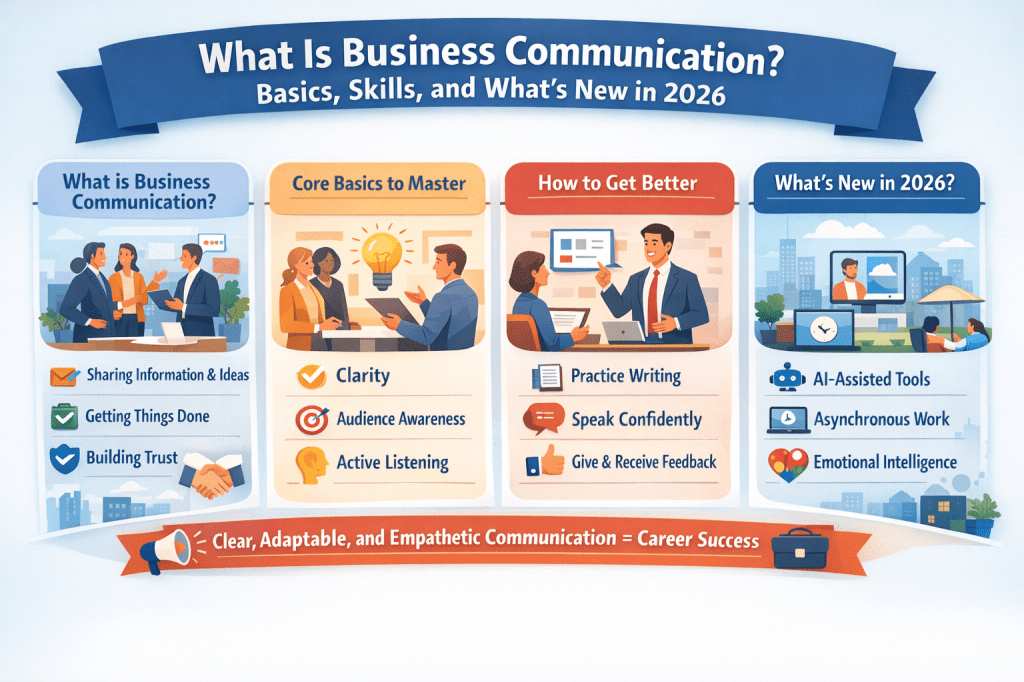
What Is Business Communication?
Business communication is the process of sharing information, ideas, and decisions within and outside an organization to achieve professional goals.
In simple terms, it’s how people communicate at work to:
- Get things done
- Build trust
- Avoid confusion
- Make better decisions
It includes speaking, writing, listening, and even body language—not just emails and meetings.
Common Examples of Business Communication
- Emails and reports
- Team meetings and presentations
- Client calls and negotiations
- Instant messages and collaboration tools
- Feedback, instructions, and updates
Good business communication makes work smoother. Poor communication creates mistakes, delays, and frustration.
The Basics of Business Communication
To communicate effectively in a business setting, you need to understand a few core principles. These are the foundation.
1. Clarity Comes First
Your message should be easy to understand the first time.
Bad:
“Let’s touch base regarding the deliverables.”
Better:
“Let’s meet tomorrow to review the project tasks.”
Clear communication saves time and prevents misunderstandings.
2. Purpose-Driven Communication
Every message should have a clear goal:
- Are you informing?
- Asking?
- Persuading?
- Updating?
If you don’t know why you’re communicating, the message will feel confusing to others.
3. Audience Awareness
How you speak to a client is different from how you talk to a teammate.
Always consider:
- Who is receiving the message?
- What do they already know?
- What tone fits the situation?
This helps you choose the right words, tone, and level of detail.
4. Active Listening
Business communication is not just talking—it’s listening.
Active listening means:
- Paying full attention
- Not interrupting
- Asking clarifying questions
- Confirming understanding
Many workplace problems happen because people listen to reply, not to understand.
5. Professional Tone
Professional doesn’t mean cold or robotic. It means:
- Respectful
- Polite
- Calm
- Clear
You can be friendly while still being professional.
Types of Business Communication You Should Know
Understanding these helps you choose the right approach.
Verbal Communication
- Meetings
- Calls
- Presentations
Best for quick decisions and discussions.
Written Communication
- Emails
- Reports
- Proposals
- Messages
Best for documentation and clarity.
Non-Verbal Communication
- Body language
- Eye contact
- Facial expressions
- Voice tone
Often communicates more than words themselves.
How to Become Good at Business Communication
The good news? This is a learnable skill.
1. Practice Clear Writing
- Keep sentences short
- Avoid unnecessary jargon
- Use bullet points when possible
Before sending a message, ask: Would this confuse someone new?
2. Improve Speaking Confidence
- Speak slowly and clearly
- Pause instead of using filler words
- Prepare key points before meetings
Confidence grows with repetition, not perfection.
3. Learn to Give and Receive Feedback
Good communicators:
- Give feedback respectfully
- Focus on solutions, not blame
- Accept feedback without getting defensive
This builds trust and leadership credibility.
4. Ask Better Questions
Strong communication often comes from asking the right questions, such as:
- “Can you clarify the priority here?”
- “What outcome are we aiming for?”
- “Is there a deadline I should know about?”
Questions prevent assumptions.
5. Adapt to Different Communication Styles
Some people prefer details. Others want summaries.
Being good at business communication means adjusting your style instead of forcing your own.
What’s New in Business Communication in 2026?
Business communication is evolving fast. Here’s what’s new and important in 2026.
1. AI-Assisted Communication
AI tools now help professionals:
- Draft clearer emails
- Summarize meetings
- Improve tone and grammar
- Translate messages instantly
The focus is shifting from writing faster to communicating smarter.
2. Rise of Asynchronous Communication
Not everything happens in real time anymore.
Teams now rely more on:
- Recorded updates
- Shared documents
- Message threads instead of meetings
This reduces meeting overload and respects time zones.
3. Stronger Focus on Emotional Intelligence
In 2026, how you communicate emotionally matters more than ever.
Skills in demand:
- Empathy
- Conflict management
- Inclusive language
- Cultural awareness
Technical skills get attention, but communication skills build long-term careers.
4. Hybrid and Remote Communication as the Norm
Clear written communication is now essential because:
- Fewer face-to-face cues exist
- Messages must stand on their own
- Misunderstandings cost more in remote teams
Professionals who communicate well remotely stand out.
What This Means for You
Business communication is no longer a “soft skill.” It’s a core career skill.
If you can:
- Express ideas clearly
- Listen actively
- Adapt to new tools
- Communicate with empathy
You automatically become more valuable in any role or business.
If you want to go deeper into skills like communication, confidence, business thinking, and personal growth, you may find my books on personal development and professional skills helpful. They’re written for real people building real careers, not theory.

Leave a comment