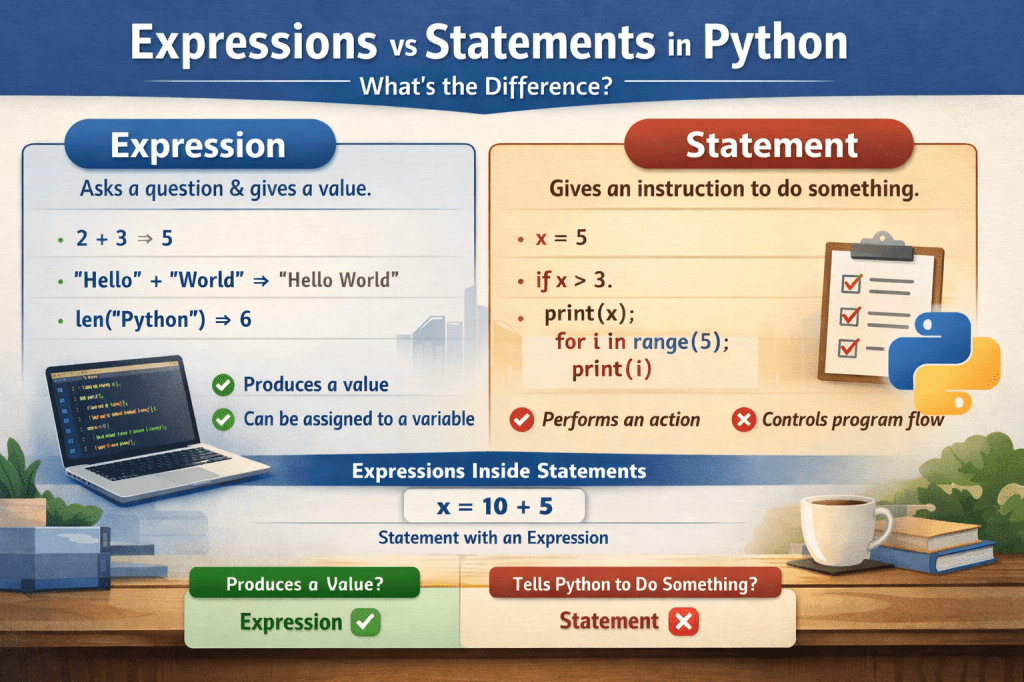
If you’re learning Python, you’ll often hear people talk about expressions and statements. At first, they can feel like the same thing—after all, both are just lines of code, right?
Not quite.
Understanding the difference between an expression and a statement is a small concept that makes a big difference in how clearly you understand Python code, especially when you start writing functions, conditions, and loops.
Let’s break it down in the simplest way possible.
What Is an Expression in Python?
An expression is any piece of code that produces a value.
Think of it like a math problem or a question that Python can answer.
Simple definition:
An expression evaluates to a value.
Examples of expressions
2 + 3This expression evaluates to 5.
"Hello" + " World"This expression evaluates to "Hello World".
len("Python")This expression evaluates to 6.
Even something as simple as:
xis an expression because it evaluates to the value stored in x.
Key idea
If you can use it on the right side of an assignment, it’s probably an expression.
result = 10 * 2Here, 10 * 2 is an expression that evaluates to 20.
What Is a Statement in Python?
A statement is a complete instruction that tells Python to do something.
Instead of producing a value, it performs an action.
Simple definition:
A statement performs an operation.
Examples of statements
x = 5This is an assignment statement. It tells Python to store 5 in x.
if x > 3: print(x)This is an if statement. It controls the flow of your program.
for i in range(5): print(i)This is a for loop statement.
Key idea
Statements usually don’t return values you can store or reuse directly.
You can’t do this:
y = if x > 3: print(x)That’s because if is a statement, not an expression.
The Core Difference (In Plain English)
Here’s the simplest way to remember it:
- Expression → asks a question and gives an answer
- Statement → gives Python an instruction
Or:
| Feature | Expression | Statement |
|---|---|---|
| Produces a value | ✅ Yes | ❌ No |
| Can be assigned to a variable | ✅ Yes | ❌ No |
| Performs an action | ❌ Not directly | ✅ Yes |
| Controls program flow | ❌ No | ✅ Yes |
Expressions Inside Statements
Here’s where many beginners get confused:
statements often contain expressions.
Example:
x = 10 + 510 + 5→ expression (evaluates to15)x = 10 + 5→ statement (assigns the value)
Another example:
if x > 5: print("Big")x > 5→ expression (evaluates toTrueorFalse)if→ statement (decides what to do next)
So while expressions and statements are different, they often work together.
Expressions You Might Not Realize Are Expressions
Some expressions don’t look like math, but they still return values.
x > yThis evaluates to True or False.
my_list[0]This evaluates to the first item in the list.
my_function()If the function uses return, this is also an expression.
Statements That Feel Like Expressions (But Aren’t)
Some things look like they should return values, but they don’t.
print("Hello")This is a statement, not an expression.
It performs an action (printing) but returns None.
import mathThis is an import statement. It doesn’t evaluate to a usable value.
Why This Difference Actually Matters
You might be wondering: “Okay, but why should I care?”
Here’s why this concept is important:
1. Avoiding syntax errors
Understanding what can and can’t be assigned prevents mistakes like:
x = for i in range(5): print(i)2. Writing cleaner code
Knowing what returns values helps you write clearer, more predictable functions.
3. Learning advanced Python faster
Topics like:
- List comprehensions
- Lambda functions
- Conditional expressions
all rely heavily on expressions.
A Quick Mental Test
Whenever you see a piece of code, ask yourself:
“Does this produce a value, or does it tell Python to do something?”
- Produces a value → Expression
- Tells Python what to do → Statement
If you build this habit early, Python will feel much more intuitive as you grow.
What This Means for You
Expressions are about values.
Statements are about actions.
Python programs are essentially a mix of:
- Expressions that calculate results
- Statements that control what happens next
Once you clearly understand this distinction, reading and writing Python code becomes far less confusing—and much more enjoyable.
If you enjoy learning concepts like this and want to apply them to real-world skills like business, communication, and personal growth, you might find my books helpful on Apple Books—especially those focused on personal development and practical thinking.

Leave a comment