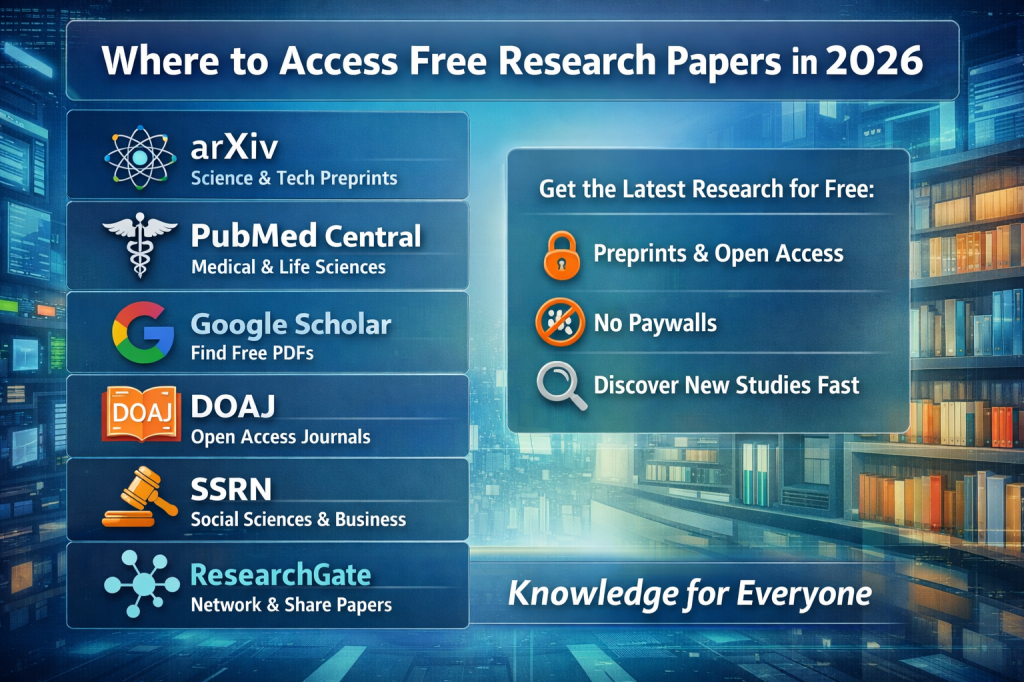
Keeping up with new research shouldn’t require expensive journal subscriptions. In 2026, the open-access movement is stronger than ever, and many high-quality platforms now offer free, legal access to the latest research papers across science, technology, medicine, and the humanities.
Whether you’re a student, researcher, entrepreneur, or simply curious, this guide will walk you through the best places to find up-to-date research papers for free, explained clearly from a beginner’s perspective.
Why Free Access to Research Matters
Research drives innovation. But traditional academic publishing often locks new knowledge behind paywalls, limiting who can learn from it.
Free research platforms solve this by:
- Sharing preprints or open-access papers
- Allowing global access regardless of income
- Speeding up the spread of new ideas
In 2026, many researchers publish their work openly before it appears in paid journals—making free platforms more valuable than ever.
arXiv – The Go-To for Science and Tech
arXiv is one of the oldest and most trusted preprint servers in the world.
What you’ll find:
- Physics
- Computer science
- Mathematics
- Artificial intelligence
- Data science
Why it’s great:
- Papers are uploaded before journal publication
- Many cutting-edge ideas appear here first
- Completely free, no account required
If you’re interested in AI, machine learning, or theoretical science, arXiv is essential.
PubMed Central – Free Medical & Life Science Research
For health and biology-related topics, PubMed Central is a goldmine.
What you’ll find:
- Medicine
- Public health
- Genetics
- Clinical studies
Key advantage:
Unlike PubMed (which sometimes links to paid journals), PubMed Central hosts full-text papers for free, often funded by public research grants.
If you’re researching health trends, treatments, or biomedical innovation, start here.
Google Scholar – The Smart Research Shortcut
Google Scholar isn’t a database itself, but it’s one of the best tools for discovering free versions of papers.
How to use it effectively:
- Search for a paper or topic
- Look for links on the right labeled [PDF]
- Click versions hosted on universities or preprint servers
In 2026, Google Scholar’s AI-powered recommendations make it even easier to discover relevant, recent research.
DOAJ – Fully Open-Access Journals Only
The Directory of Open Access Journals (DOAJ) lists peer-reviewed journals that are 100% free to read.
Why it matters:
- No paywalls
- Quality control and editorial standards
- Covers science, social sciences, and humanities
If you want research that’s both free and formally peer-reviewed, DOAJ is a reliable choice.
SSRN – Social Sciences & Business Research
SSRN is ideal for non-technical research.
Popular topics include:
- Economics
- Finance
- Marketing
- Law
- Management and strategy
Many working papers here influence policy and business decisions long before journal publication.
Open Research Platforms Backed by Universities
Many universities now host institutional repositories, where researchers upload free copies of their papers.
Examples include:
- MIT Open Access
- Harvard DASH
- University research archives worldwide
These repositories often contain the same papers found in paid journals, legally shared by the authors.
ResearchGate – Free, With a Community Angle
ResearchGate combines research sharing with academic networking.
How it helps:
- Many authors upload free PDFs
- You can request papers directly from authors
- Follow researchers to see new uploads
While not everything is available, it’s a useful supplement to other platforms.
How to Stay Updated Automatically in 2026
Instead of manually searching every week, use these smart methods:
- Email alerts on Google Scholar
- RSS feeds from arXiv or SSRN
- AI research summarizers built into many platforms
- Follow authors on ResearchGate
This way, new papers come to you automatically.
Key Takeaways
Free access to research is no longer limited or complicated. In 2026:
- Preprint servers like arXiv release ideas early
- Medical research is widely available via PubMed Central
- Google Scholar helps uncover free versions fast
- Open-access journals ensure quality without paywalls
With the right tools, anyone can stay informed—no university login required.
If you’re interested in turning knowledge into practical outcomes—whether through business, communication, or personal growth—you may also find value in exploring Shafaat Ali’s books on Apple Books, especially those focused on making money, relationships, and long-term self-development.

Leave a comment