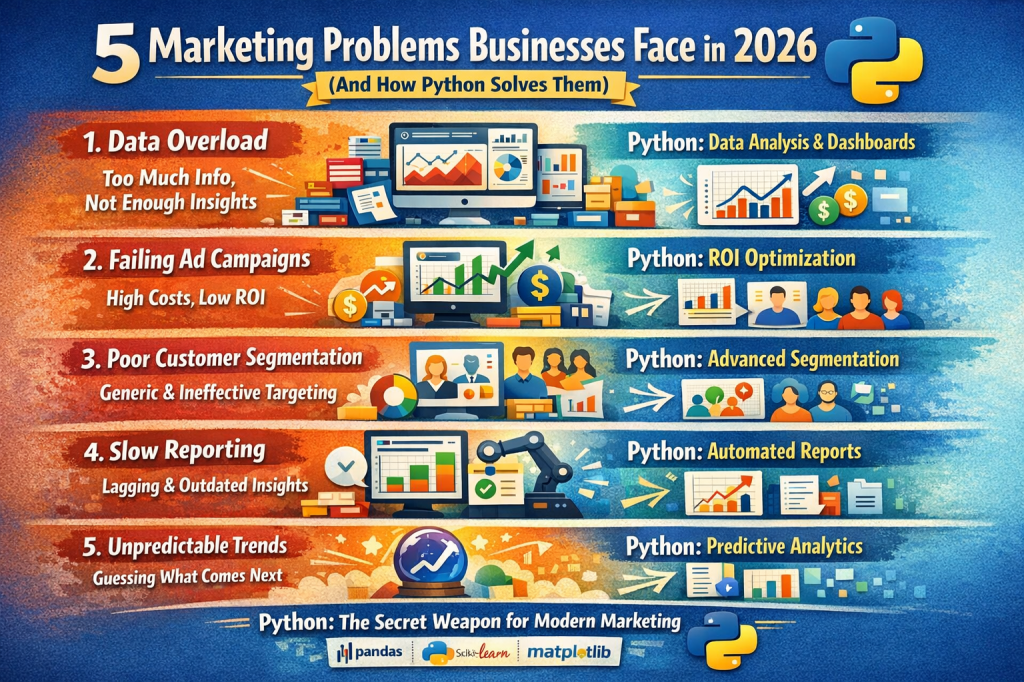
Marketing in 2026 looks very different from just a few years ago. Customers are more informed, platforms are more competitive, and data is exploding from every direction. For many businesses, the challenge is no longer getting data—it’s making sense of it and acting fast enough.
This is where Python quietly becomes one of the most powerful tools in modern marketing. You don’t need to be a hardcore programmer to benefit from it. Even basic Python skills can help solve problems that feel overwhelming today.
Let’s break down five major marketing problems businesses face in 2026 and see how Python offers practical, real-world solutions.
1. Too Much Data, Not Enough Insights
The Problem
Businesses collect data from websites, ads, social media, email campaigns, CRMs, and more. But most teams struggle to turn that data into clear decisions.
The result:
- Conflicting reports
- Slow decision-making
- Guesswork instead of strategy
Data overload often leads to analysis paralysis.
How Python Solves It
Python excels at cleaning, organizing, and analyzing large datasets.
With libraries like:
- Pandas for data cleaning and analysis
- NumPy for numerical calculations
- Matplotlib / Seaborn for visualization
Marketers can:
- Combine data from multiple platforms
- Identify trends in customer behavior
- Create simple dashboards for decision-makers
Instead of staring at spreadsheets, Python helps you see what actually matters.
2. Declining Ad Performance and Rising Costs
The Problem
Paid ads are more expensive than ever. Platforms are crowded, attention is limited, and audiences are harder to target. Many businesses run ads without truly knowing:
- Which campaigns are profitable
- When to stop or scale
- Where money is being wasted
How Python Solves It
Python allows you to analyze ad performance at a deeper level.
Using Python, you can:
- Import ad data from Google, Meta, or TikTok
- Calculate true ROI by campaign, audience, and creative
- Automatically flag underperforming ads
With simple scripts, businesses can even:
- Predict future ad performance
- Optimize budgets based on past trends
This turns advertising from gambling into informed decision-making.
3. Poor Customer Segmentation
The Problem
In 2026, “one-size-fits-all” marketing is dead. Customers expect personalized experiences, but many businesses still treat everyone the same.
This leads to:
- Low engagement
- High unsubscribe rates
- Missed upsell opportunities
How Python Solves It
Python makes advanced customer segmentation accessible.
Using machine learning libraries like:
- Scikit-learn
- SciPy
Businesses can:
- Group customers based on behavior, not assumptions
- Identify high-value vs. low-value segments
- Customize offers for each group
For example, Python can reveal:
- Customers likely to churn
- Customers ready to buy again
- Customers sensitive to discounts
Better segmentation means better messaging—and higher conversions.
4. Slow Marketing Decisions
The Problem
Marketing moves fast. Waiting days or weeks for reports means missing opportunities. Many teams rely on manual reporting, which slows everything down.
By the time insights arrive, it’s already too late to act.
How Python Solves It
Python enables automation.
With scheduled scripts, businesses can:
- Pull fresh data daily or hourly
- Generate performance reports automatically
- Send alerts when key metrics change
For example:
- Get notified when conversions drop suddenly
- Track campaign performance in near real time
- Update dashboards without human effort
Automation frees marketers to focus on strategy instead of repetitive tasks.
5. Predicting What Customers Will Do Next
The Problem
Most businesses react to what already happened. In 2026, that’s not enough. The real advantage comes from predicting:
- What customers will buy
- When they will leave
- Which channels will perform best
How Python Solves It
Python makes predictive marketing possible—even for small teams.
Using machine learning models, Python can:
- Forecast sales trends
- Predict customer churn
- Estimate lifetime value
You don’t need complex AI systems. Even basic models can:
- Improve planning accuracy
- Reduce marketing waste
- Increase customer retention
Prediction turns marketing into a proactive function, not a reactive one.
What This Means for You
Marketing problems in 2026 are less about creativity and more about clarity. The businesses that win are those that understand their data and act on it quickly.
Python is not just a “developer tool” anymore—it’s becoming a marketing skill.
You don’t need to master everything:
- Start with data analysis
- Learn basic automation
- Apply insights step by step
The combination of marketing knowledge and Python gives you a powerful edge that’s hard to replace.
If you’re interested in building skills around business, communication, and personal growth, you may also find value in exploring my books on Apple Books, where I share practical frameworks for growth and income in the modern digital world.

Leave a comment