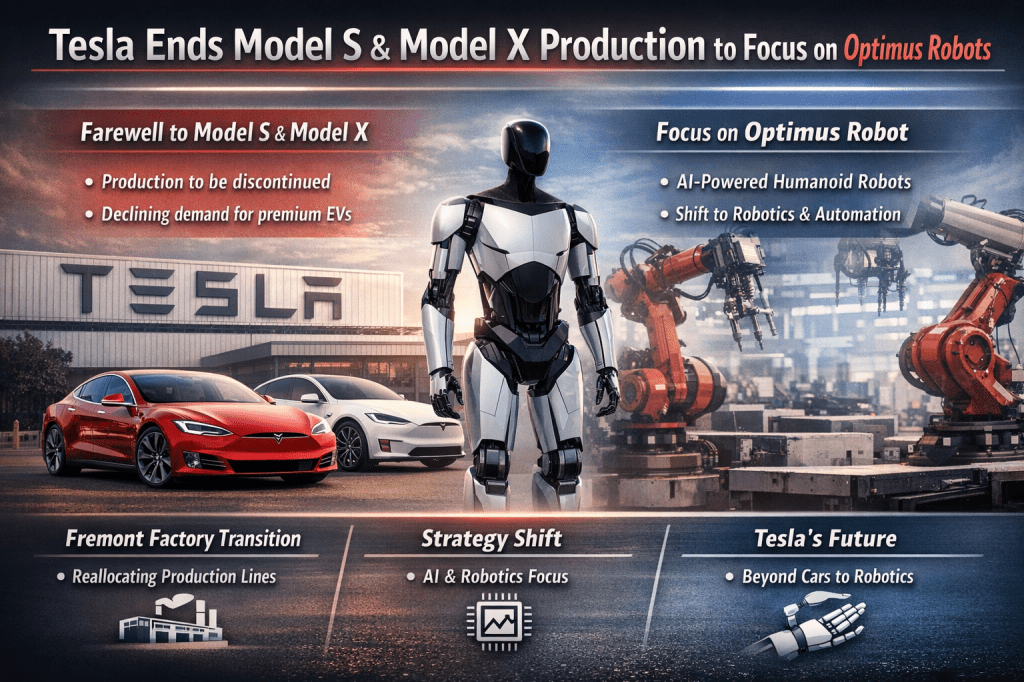
Tesla is making one of the most significant strategic shifts in its history. CEO Elon Musk has stated that Tesla plans to end production of the Model S and Model X, redirecting manufacturing capacity at its Fremont Factory toward the development and production of Optimus humanoid robots.
This move signals a broader transition for Tesla, from a company best known for electric vehicles to one increasingly focused on artificial intelligence, robotics, and automation.
The End of Model S and Model X Production
Tesla’s Model S and Model X were instrumental in establishing the company as a serious player in the global automotive market. The Model S demonstrated that electric cars could compete with premium gasoline vehicles, while the Model X introduced advanced safety features and a distinctive SUV design.
However, over the past several years, demand for these two models has declined relative to Tesla’s lower-priced vehicles. The Model 3 and Model Y now account for the vast majority of Tesla’s vehicle deliveries worldwide, driven by broader affordability and higher production efficiency.
As a result, Tesla plans to gradually phase out Model S and Model X production, freeing up factory space and resources for newer initiatives. The company has indicated that existing owners will continue to receive service, parts, and software updates even after production ends.
Why Tesla Is Reallocating the Fremont Factory
The Fremont factory has long served as a central hub for Tesla’s manufacturing operations. By converting Model S and Model X production lines, Tesla can reuse existing infrastructure, automation systems, and engineering expertise rather than building an entirely new facility.
According to Musk, these lines will be adapted to support large-scale manufacturing of Optimus, Tesla’s humanoid robot designed to perform repetitive, physical, or hazardous tasks. Tesla believes its experience in mass manufacturing, battery systems, and AI software gives it a competitive advantage in robotics production.
What Is Optimus and Why It Matters
Optimus is a general-purpose humanoid robot powered by Tesla’s AI systems, including neural networks originally developed for autonomous driving. The robot is intended to handle tasks such as material handling, factory work, and eventually household assistance.
Musk has repeatedly described Optimus as potentially more important to Tesla’s long-term value than its vehicle business. If Tesla can scale robot production efficiently and reduce costs, Optimus could open new markets far beyond transportation.
However, it is important to note that humanoid robotics remains a technically complex and highly competitive field. Large-scale commercial deployment will depend on continued progress in AI reliability, safety, and real-world usability.
Business and Market Factors Behind the Decision
Several practical considerations help explain Tesla’s shift:
Declining Share of Premium Vehicle Sales
While Model S and X remain technologically advanced, they represent a small and shrinking percentage of Tesla’s overall sales compared to mass-market models.
Pressure on Automotive Margins
Global competition in the electric vehicle market has intensified, leading to pricing pressure and lower margins. Diversifying into robotics may help Tesla reduce dependence on vehicle sales alone.
Long-Term Focus on AI and Automation
Tesla has increasingly positioned itself as an AI and robotics company. Ending low-volume vehicle lines allows the company to concentrate capital and talent on products it believes have greater long-term growth potential.
What This Means for Tesla’s Future
Once Model S and Model X production ends:
- Tesla’s vehicle lineup will focus primarily on Model 3, Model Y, Cybertruck, and future autonomous vehicles.
- The Fremont factory will play a central role in Tesla’s robotics ambitions.
- Tesla’s valuation and investor narrative may increasingly revolve around AI, software, and robotics rather than vehicle delivery numbers alone.
This transition marks a structural change in how Tesla defines itself as a company.
What This Means for the Industry
Tesla’s decision highlights a broader trend in which advanced manufacturing, artificial intelligence, and robotics are converging. Traditional automakers and technology companies alike are investing heavily in automation, suggesting that future competition may extend well beyond cars.
Whether Tesla’s bet on humanoid robots succeeds remains uncertain, but the move underscores how rapidly the definition of a “car company” is evolving.
Key Takeaways
- Tesla plans to end production of Model S and Model X and repurpose Fremont factory lines.
- Manufacturing capacity will be redirected toward Optimus humanoid robots.
- The shift reflects Tesla’s long-term focus on AI, robotics, and automation over low-volume premium vehicles.
Tesla’s strategy represents a calculated risk, but one aligned with Elon Musk’s long-standing belief that artificial intelligence and robotics will shape the next major technological era.

Leave a comment