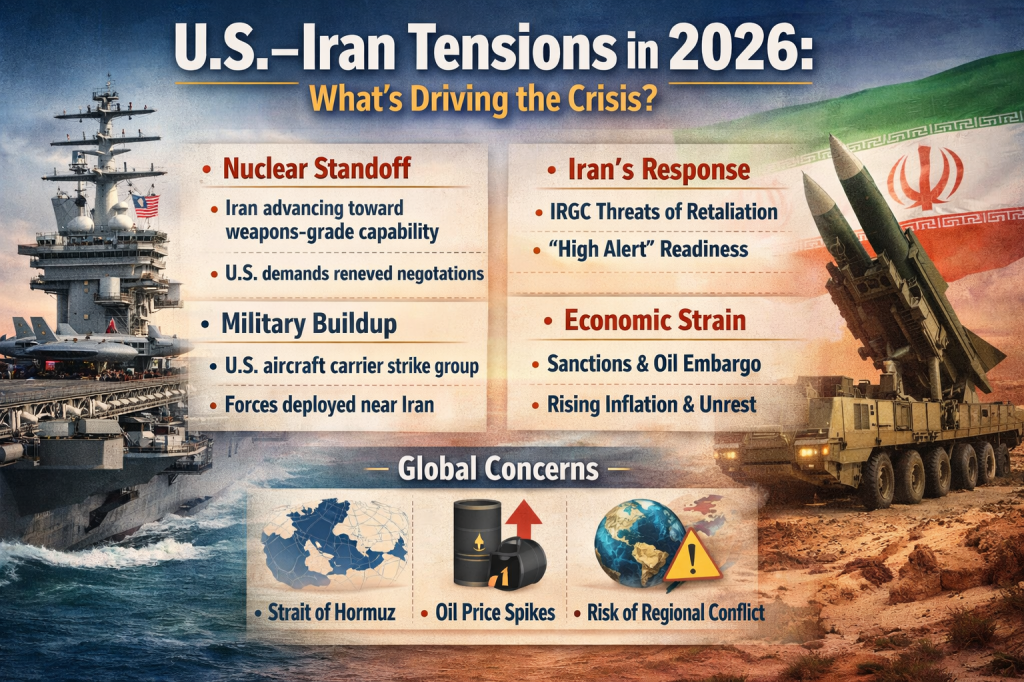
Tensions between the United States and Iran have sharply escalated in early 2026, reviving fears of a direct military confrontation in the Middle East. While hostility between the two countries is nothing new, the current standoff stands out because of its intensity, speed, and global consequences.
At the center of the crisis are renewed nuclear disputes, a visible U.S. military buildup, strong warnings from Tehran, and growing concern among global powers that a single miscalculation could trigger a wider regional conflict.
This article breaks down what’s happening, why it matters, and what could come next—using clear language and real-world context.
Why U.S.–Iran Relations Are Deteriorating
The latest surge in tension is driven by several overlapping issues rather than a single event.
The Nuclear Standoff Explained Simply
Iran’s nuclear program remains the biggest point of friction. A nuclear program refers to a country’s ability to produce nuclear energy, which can be used for electricity or, if weaponized, nuclear bombs.
Washington argues that Iran is moving too close to weapons-grade nuclear capability. Tehran insists its program is peaceful and meant for energy and research.
In response, U.S. President Donald Trump has publicly demanded renewed negotiations and warned that military options are “on the table” if Iran refuses to comply. This hard-line messaging has significantly raised the stakes.
Military Pressure in the Middle East
One of the clearest signs of escalation is the growing U.S. military presence near Iran.
What the Military Buildup Means
The United States has deployed additional naval forces, including an aircraft carrier strike group, to waters near Iran. An aircraft carrier strike group is a floating military base capable of launching airstrikes, defending against missiles, and projecting power across an entire region.
This move serves two purposes:
- Deterrence – warning Iran against aggressive actions
- Leverage – increasing pressure ahead of any potential talks
From Iran’s perspective, however, this buildup is viewed as a direct threat rather than a defensive step.
Iran’s Response: Warnings and Readiness
Iranian leaders have responded forcefully, making it clear they will not negotiate under pressure.
The Role of the Revolutionary Guard
Iran’s powerful Islamic Revolutionary Guard Corps (IRGC) has issued warnings that any U.S. attack would be met with immediate retaliation. The IRGC plays a unique role in Iran—it is both a military force and a political power center, separate from the regular army.
Iran has emphasized that its forces are on high alert, describing the situation as one where “fingers are on the trigger.” This kind of language signals readiness rather than a desire for compromise.
Diplomatic Efforts Behind the Scenes
Despite the aggressive rhetoric, diplomacy has not completely collapsed.
Several countries, including Turkey and Russia, are attempting to mediate between Washington and Tehran. Iran has participated in talks aimed at preventing military escalation, signaling that it still prefers a negotiated outcome—just not one shaped by threats.
Diplomacy here acts like a pressure valve: it doesn’t solve the core problem, but it can prevent the system from exploding.
Economic Pressure and Internal Strain in Iran
Sanctions remain a powerful tool in the U.S. strategy.
What Sanctions Really Do
Sanctions are economic penalties that restrict a country’s ability to trade, sell oil, or access global banking systems. In Iran’s case, sanctions have:
- Reduced oil exports
- Weakened the national currency
- Increased inflation and unemployment
These economic pressures have fueled internal dissatisfaction inside Iran, making the government more sensitive to foreign threats and less willing to appear weak.
Why the World Is Paying Close Attention
The U.S.–Iran standoff isn’t just a bilateral issue—it has global implications.
Oil, Trade, and Global Stability
One major concern is the Strait of Hormuz, a narrow sea passage through which roughly 20% of the world’s oil supply flows. Any military disruption here could:
- Spike global oil prices
- Increase inflation worldwide
- Destabilize already fragile economies
In addition, U.S. allies in the region—and rival powers globally—are watching closely, aware that a conflict could redraw geopolitical lines.
What This Means for the Future
Right now, the situation is balanced between confrontation and containment.
- The United States is using military pressure and sanctions to force negotiations
- Iran is signaling strength to deter attack and protect sovereignty
- Global actors are racing to keep the conflict from escalating
History shows that U.S.–Iran relations often move in cycles: pressure, crisis, negotiation, and uneasy calm. Whether this moment leads to diplomacy or disaster depends on how far each side is willing to push without crossing a point of no return.
Key Takeaways
- U.S.–Iran tensions in 2026 are driven by nuclear concerns, military buildup, and economic sanctions
- Strong rhetoric on both sides has increased the risk of miscalculation
- Diplomatic channels remain open, but fragile
- Any conflict could have serious global economic and security consequences
Understanding these dynamics helps make sense of why this rivalry continues to shape global politics—and why the world is watching so closely.
If you’re interested in how global conflicts affect money, business, communication, and personal decision-making, you may find value in exploring Shafaat Ali’s books on Apple Books, which break down complex world events into practical, easy-to-understand insights for everyday life.

Leave a comment