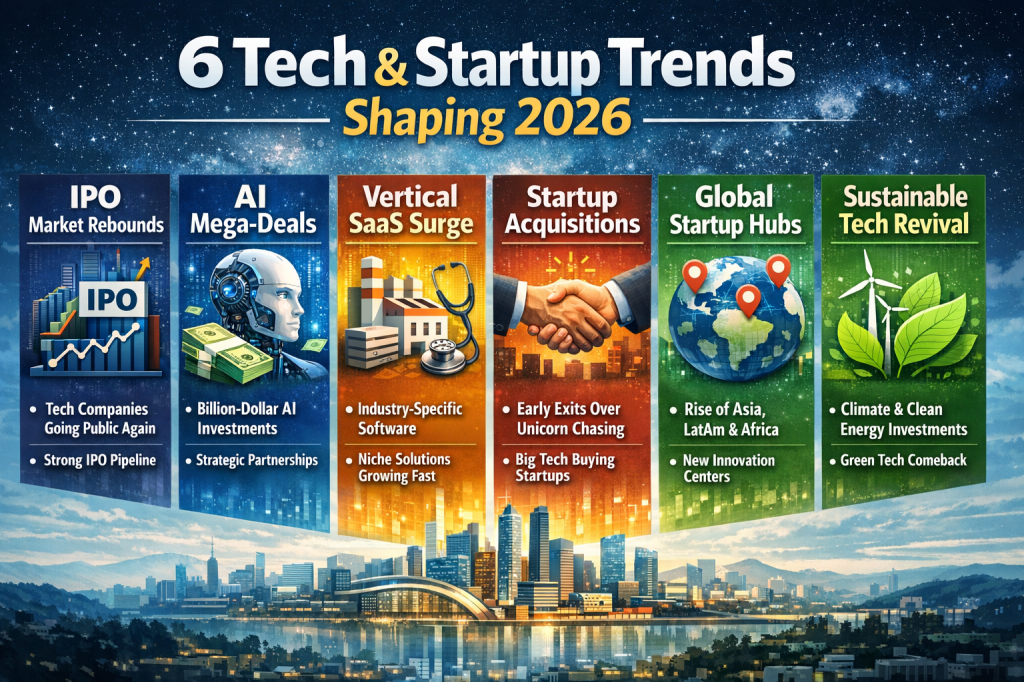
The startup and venture capital world is heading into 2026 with renewed energy. After years of market uncertainty, rising interest rates, and cautious investors, the landscape is shifting again. New data and deal activity suggest we’re entering a phase defined by confidence, consolidation, and big technological bets.
Below are six major tech and startup trends shaping 2026, based on current venture investment patterns, market signals, and emerging business models—explained simply and clearly for anyone following the startup ecosystem.
1. The Return of the IPO Market
For much of the early 2020s, IPOs (Initial Public Offerings) were nearly frozen. An IPO is when a private company sells its shares to the public for the first time. High interest rates and market volatility made public listings risky.
That’s changing.
In 2026, analysts expect a strong IPO rebound, especially from tech startups that delayed going public but continued growing privately. Many of these companies are now:
- Profitable or close to it
- Leaner and more disciplined
- Focused on predictable revenue
Investors are signaling renewed appetite for public tech stocks, particularly in fintech, AI infrastructure, and enterprise software.
Why it matters: IPOs create liquidity, reward early employees, and encourage more venture investment across the ecosystem.
2. AI Mega-Deals Are Redefining Venture Capital
Artificial intelligence is no longer just a buzzword—it’s the center of gravity for tech investment.
In 2026, we’re seeing fewer but much larger AI deals, often involving strategic partnerships rather than traditional funding rounds. Companies like OpenAI and NVIDIA have influenced how capital flows into AI startups.
Key characteristics of this trend include:
- Multi-billion-dollar funding rounds
- Corporate investors partnering with startups
- Long-term infrastructure plays (chips, models, data centers)
Instead of funding dozens of small experiments, investors are backing category-defining AI companies.
Why it matters: AI startups now need scale, defensibility, and real-world use cases—not just clever demos.
3. Vertical SaaS Makes a Strong Comeback
SaaS (Software as a Service) simply means software delivered online via subscriptions. Vertical SaaS focuses on one specific industry, like healthcare, construction, or logistics.
In 2026, vertical SaaS is booming again because:
- Niches are underserved by generic software
- Customers want tools built specifically for their workflows
- AI is making industry-specific automation cheaper
Examples include software for dentists, trucking companies, real estate managers, and manufacturing firms.
Why it matters: These startups may not sound flashy, but they often grow faster, churn less, and become quietly very profitable.
4. Startup Acquisitions Are Replacing Late-Stage Funding
Instead of raising massive late-stage funding rounds, many startups are choosing to sell earlier.
Large tech companies are actively acquiring startups to:
- Absorb AI talent
- Acquire proprietary data
- Speed up product development
This trend is especially strong in AI, cybersecurity, and developer tools.
Why it matters: Founders are rethinking the “unicorn or nothing” mindset. A $200M acquisition can be more attractive than a risky $1B valuation chase.
5. Global Startup Hubs Are Catching Up Fast
Silicon Valley is still important, but it’s no longer the only game in town.
In 2026, startup growth is accelerating in:
- Southeast Asia
- India
- Latin America
- Parts of Africa and Eastern Europe
Lower operating costs, younger populations, and mobile-first markets are driving innovation. Many startups in these regions focus on fintech, logistics, and digital infrastructure.
Why it matters: Venture capital is becoming more global, and founders no longer need to relocate to build billion-dollar companies.
6. Sustainable and Climate Tech Becomes Investable Again
Climate tech struggled during recent market downturns because returns take longer. That’s shifting.
In 2026, climate and sustainability startups are attracting serious capital due to:
- Government incentives
- Corporate net-zero commitments
- Breakthroughs in energy storage and efficiency
These startups focus on practical solutions—like reducing costs, improving supply chains, or increasing energy reliability—rather than idealistic visions alone.
Why it matters: Climate tech is moving from “impact-first” to profit plus impact, which investors prefer.
What This Means for Founders and Investors
The startup world of 2026 is more mature, disciplined, and strategic than before. Easy money is gone—but smarter money is here.
Key takeaways:
- Strong businesses win, not just fast-growing ones
- AI is foundational, not optional
- Smaller exits are respected again
- Global founders have more opportunities than ever
For entrepreneurs, this is a time to focus on real problems, real customers, and real revenue.
If you’re building skills around business, technology, or personal growth, you may find valuable insights in my Apple Books collection on business and personal development, which explores practical strategies for long-term success.

Leave a comment