Artificial Intelligence (AI) is everywhere today—from chatbots and recommendation systems to self-driving cars and medical tools. But behind all this smart technology is something most people never see: AI data centers.
If you’ve ever wondered where AI actually “lives” or how massive AI models are trained, this guide will break it all down in simple terms.
What Is an AI Data Center?
An AI data center is a specialized facility designed to store data and run extremely powerful computers that train and operate artificial intelligence systems.
In simple words:
An AI data center is like a giant digital factory where AI models are built, trained, and run.
Unlike traditional data centers that mainly handle websites or cloud storage, AI data centers are optimized for:
- Heavy calculations
- Massive datasets
- Continuous learning and improvement
How AI Data Centers Are Different from Regular Data Centers
Not all data centers are the same. AI data centers are built for much harder work.
Traditional Data Centers Usually Handle:
- Websites and apps
- Email services
- File storage
- Databases
AI Data Centers Are Built For:
- Training large AI models
- Running real-time AI predictions
- Processing images, videos, and language
- Handling machine learning workloads 24/7
Key Difference in One Line
A regular data center stores and delivers data.
An AI data center thinks with data.
Key Components of an AI Data Center
Let’s look at what makes an AI data center so powerful.
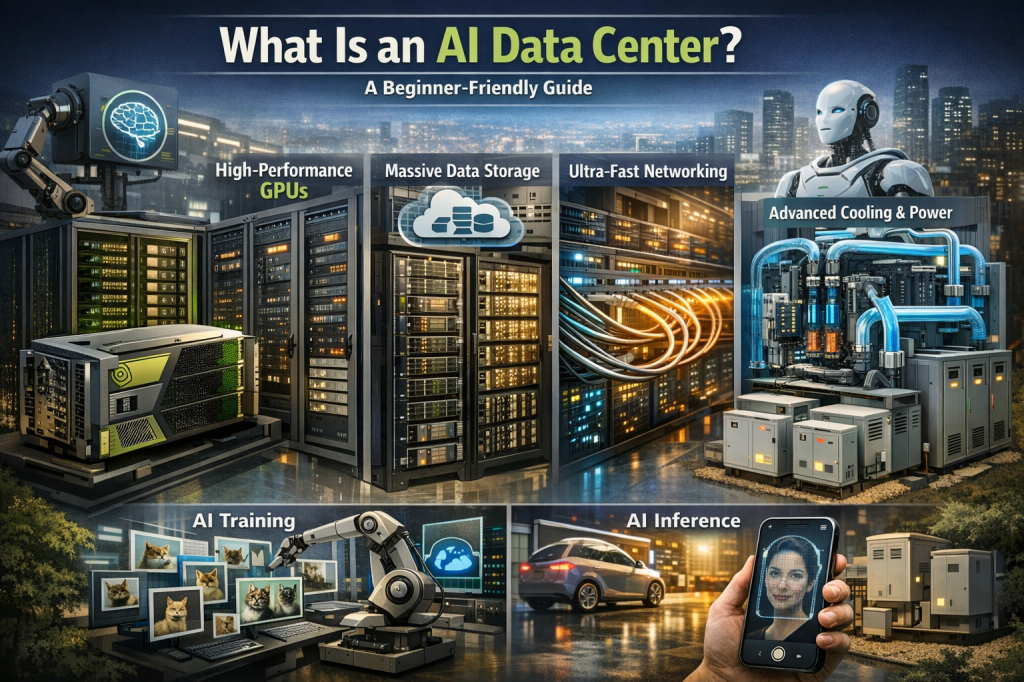
1. High-Performance GPUs and Accelerators
What is a GPU?
A GPU (Graphics Processing Unit) is a chip designed to process many tasks at the same time—perfect for AI calculations.
AI data centers rely heavily on GPUs made by companies like NVIDIA, because AI training involves billions of mathematical operations happening simultaneously.
2. Massive Storage Systems
AI systems learn from huge amounts of data, including:
- Text
- Images
- Videos
- Sensor data
AI data centers use advanced storage systems to quickly read and write this information without slowing down training.
3. Ultra-Fast Networking
AI training often happens across thousands of machines working together.
High-speed networking allows:
- Faster communication between servers
- Distributed AI training
- Real-time AI responses
Without fast networks, AI models would take months instead of days to train.
4. Advanced Cooling and Power Systems
AI hardware consumes enormous amounts of electricity and produces a lot of heat.
AI data centers use:
- Liquid cooling
- Custom airflow designs
- Dedicated power substations
Why this matters:
If machines overheat, performance drops—or systems fail entirely.
What Is AI Training vs AI Inference?
These two terms are essential to understanding AI data centers.
AI Training (What Is It?)
AI training is the process of teaching a model by feeding it large datasets so it can learn patterns.
Example:
Teaching an AI to recognize cats by showing it millions of cat photos.
Training requires:
- Huge computing power
- Long processing times
- Specialized AI hardware
AI Inference (What Is It?)
AI inference is when a trained model uses what it learned to make decisions.
Example:
When your phone unlocks using face recognition.
Inference still needs speed, but far less power than training.
Many AI data centers handle both training and inference.
Who Uses AI Data Centers?
AI data centers are used by organizations that depend on advanced AI capabilities.
Major Users Include:
- Cloud providers like Google and Microsoft
- AI research labs
- Autonomous vehicle companies
- Healthcare and biotech firms
- Financial institutions
- Governments and defense agencies
Even consumer apps like voice assistants and recommendation engines rely on AI data centers behind the scenes.
Why AI Data Centers Are So Important
AI data centers are becoming critical infrastructure for the modern world.
They Enable:
- Faster scientific research
- Smarter medical diagnoses
- Personalized online experiences
- Automation across industries
- New business models powered by AI
Without AI data centers, modern AI systems simply wouldn’t work at scale.
Challenges Facing AI Data Centers
Despite their power, AI data centers come with real challenges.
Major Challenges Include:
- High energy consumption
- Environmental impact
- Rising operational costs
- Limited chip supply
- Security and data privacy concerns
Because of this, companies are investing heavily in:
- Energy-efficient chips
- Renewable power sources
- Smarter cooling technologies
How AI Data Centers Will Evolve
The future of AI data centers is already taking shape.
What’s Coming Next:
- More energy-efficient AI hardware
- Smaller, edge-based AI data centers
- Increased use of renewable energy
- AI systems that manage data centers themselves
In short, AI data centers will become smarter, greener, and more powerful.
What This Means for You
Even if you never visit an AI data center, it affects your daily life.
Every time you:
- Use a chatbot
- Get a video recommendation
- Rely on navigation apps
- Interact with smart devices
You’re benefiting from AI data centers working silently in the background.
Understanding them helps you better understand how the AI-powered world actually runs.
If you’re interested in learning more about how AI, technology, and digital skills connect to personal growth and modern opportunities, you may find some helpful reads on my Apple Books author page.

Leave a comment