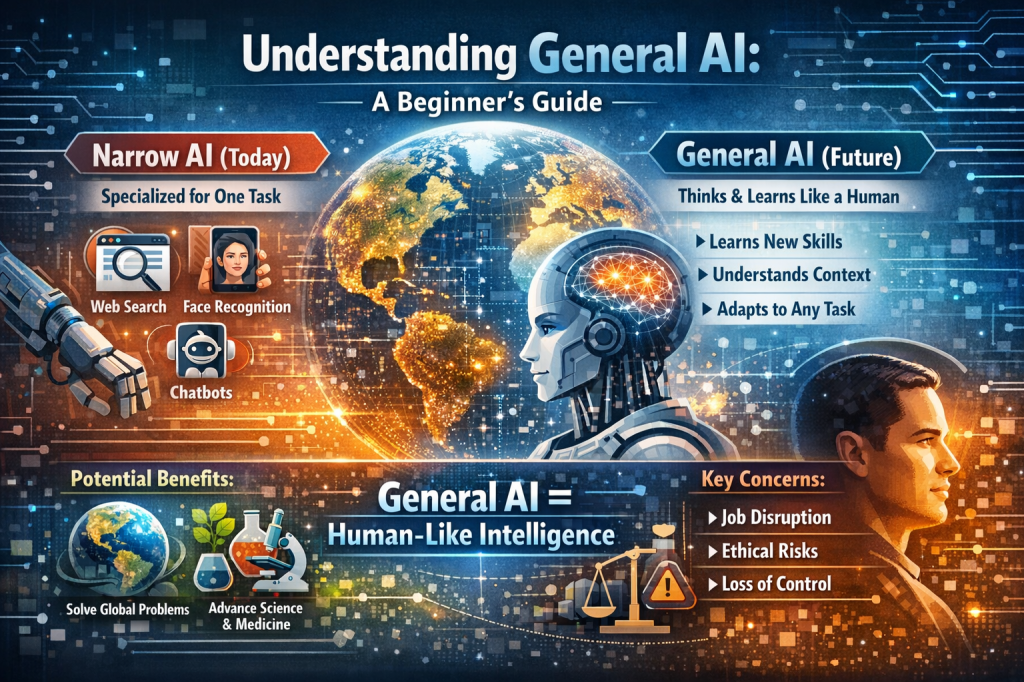
Artificial Intelligence (AI) is everywhere today—from voice assistants on your phone to recommendation systems on Netflix. But when people talk about General AI, they’re referring to something much bigger and more powerful than the AI we use right now.
So what exactly is General AI, and why does it matter? Let’s break it down in a simple, beginner-friendly way.
Understanding AI in Simple Terms
What is AI?
Artificial Intelligence is the ability of a machine or computer system to perform tasks that normally require human intelligence, such as learning, problem-solving, or understanding language.
However, not all AI is the same. There are different levels of AI, and this is where General AI comes in.
What Is General AI?
General AI, also called Artificial General Intelligence (AGI), is a type of AI that can understand, learn, and apply knowledge across many different tasks, just like a human can.
In simple words:
👉 General AI can think and learn like a human, not just do one specific job.
A General AI system would be able to:
- Learn new skills on its own
- Reason and make decisions
- Understand context and emotions
- Switch between tasks without being retrained
This makes General AI very different from the AI systems we use today.
Narrow AI vs. General AI
To understand General AI better, it helps to compare it with what we already have.
Narrow AI (What We Have Today)
What is Narrow AI?
Narrow AI is designed to perform one specific task extremely well.
Examples include:
- Google Search ranking web pages
- Face recognition on smartphones
- Chatbots that answer customer support questions
These systems cannot do anything outside their programmed area.
General AI (What We Don’t Have Yet)
General AI would:
- Learn any task a human can learn
- Adapt to new situations without extra programming
- Combine creativity, logic, and emotional understanding
Think of Narrow AI as a calculator and General AI as a human brain.
Is General AI Real Today?
The short answer: No, General AI does not exist yet.
Even the most advanced systems from organizations like OpenAI or Google DeepMind are still forms of Narrow AI. They may feel intelligent, but they don’t truly understand the world the way humans do.
Current AI:
- Lacks real consciousness
- Doesn’t have true self-awareness
- Cannot independently set goals like humans
General AI remains a long-term research goal.
Why Is General AI So Important?
General AI has the potential to change nearly every part of society.
Possible Benefits
If developed responsibly, General AI could:
- Solve complex global problems like climate change
- Accelerate scientific research and medical discoveries
- Personalize education for every student
- Assist humans in creative fields like writing, art, and design
Imagine a system that can learn medicine, engineering, and economics—and use that knowledge together to solve real-world problems.
Risks and Concerns Around General AI
With great power comes great responsibility.
Key Concerns Include:
- Job disruption: Many roles could change or disappear
- Control issues: Ensuring humans remain in charge
- Ethical risks: Bias, misuse, or harmful decision-making
- Security threats: Advanced AI used for malicious purposes
This is why researchers emphasize AI safety and ethical development alongside innovation.
What Is AI Alignment? (Beginner Definition)
AI alignment means making sure an AI system’s goals and values match human values.
For General AI, alignment is critical. A highly intelligent system that misunderstands human priorities could cause harm—even without bad intentions.
When Might General AI Arrive?
There’s no clear timeline.
Some experts believe General AI could appear within a few decades, while others think it may take much longer—or may never fully happen.
What is certain is that progress in AI is accelerating, and discussions about General AI are becoming more serious every year.
What This Means for You
You don’t need to be a programmer to prepare for a future shaped by AI.
Understanding General AI helps you:
- Make informed career and business decisions
- Adapt to new technologies confidently
- Think critically about ethics and responsibility
Learning how technology works is quickly becoming a core life skill.
If you’re interested in building future-ready skills—especially around business, communication, and personal growth—you may find useful insights in some of my books on personal development and digital skills.
Key Takeaways
- General AI is AI that can think, learn, and adapt like a human
- It is different from today’s Narrow AI, which is task-specific
- General AI does not exist yet but is a major research goal
- It could bring huge benefits—and serious risks
- Understanding it now helps you stay informed and prepared
General AI isn’t science fiction—it’s a future possibility worth understanding today.

Leave a comment