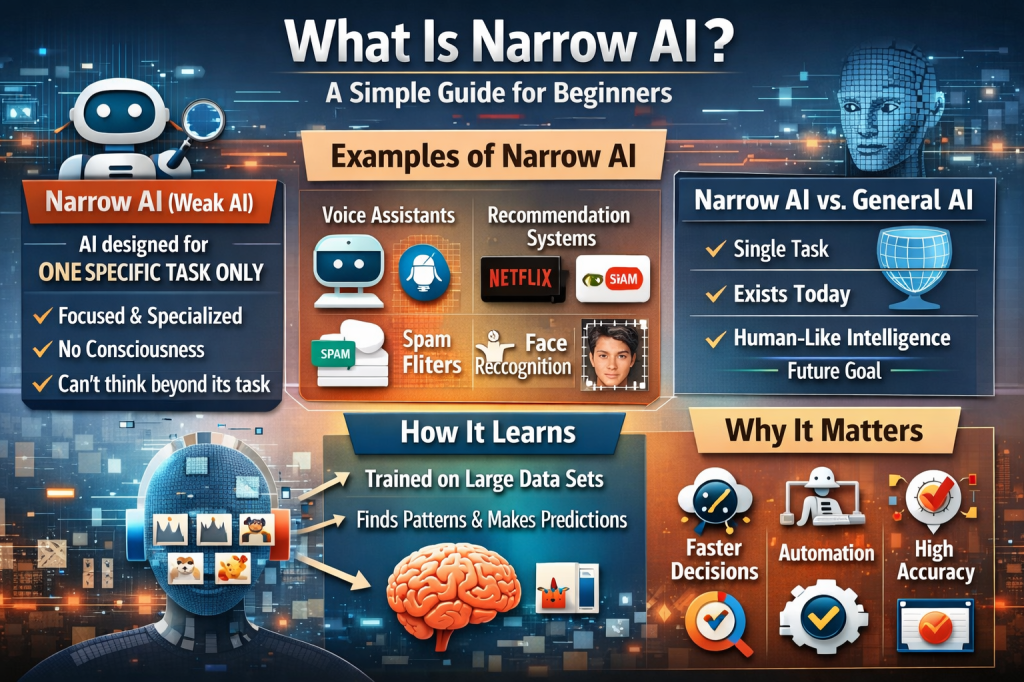
Artificial Intelligence (AI) often sounds like something straight out of a science-fiction movie. But in reality, AI is already part of your everyday life—quietly working behind the scenes. The most common type you interact with today is called Narrow AI.
So, what exactly is Narrow AI, and why does it matter? Let’s break it down in a clear, beginner-friendly way.
What Is Narrow AI?
Narrow AI (also known as Weak AI) is a type of artificial intelligence designed to perform one specific task or a limited range of tasks—and nothing beyond that.
In simple terms:
Narrow AI is very good at one job, but it can’t think, reason, or learn outside that job.
It doesn’t have consciousness, emotions, or general intelligence. It simply follows patterns and rules based on the data it has been trained on.
Everyday Examples of Narrow AI
You probably use Narrow AI many times a day without realizing it. Here are some familiar examples:
- Voice assistants (like Siri or Google Assistant)
They understand voice commands but don’t truly “understand” conversations. - Recommendation systems on platforms like Netflix or YouTube
They suggest movies or videos based on your past behavior. - Email spam filters
They detect unwanted emails but can’t do anything else. - Face recognition systems
They identify faces but don’t know who you are as a person.
Each of these tools does one job extremely well—but only that job.
How Narrow AI Works (Beginner Explanation)
To understand Narrow AI, it helps to know how it learns.
What is Machine Learning?
Machine learning is a method where computers learn from data instead of being manually programmed.
Here’s a simple analogy:
- Imagine teaching a child to recognize cats by showing thousands of cat photos.
- Over time, the child learns patterns like ears, whiskers, and tails.
- Narrow AI works the same way—except much faster and without understanding what a “cat” actually is.
It doesn’t think. It calculates probabilities.
Key Characteristics of Narrow AI
Narrow AI has some clear traits that define it:
- ✅ Designed for one specific task
- ✅ Works with large amounts of data
- ❌ Cannot apply knowledge to new, unrelated problems
- ❌ Has no self-awareness or emotions
- ❌ Cannot “think” like a human
In short, it’s powerful—but limited.
Narrow AI vs General AI: What’s the Difference?
You may hear people talk about General AI (also called Strong AI). Here’s how it compares:
| Feature | Narrow AI | General AI |
|---|---|---|
| Task range | Single or limited | Multiple, human-level |
| Learning ability | Task-specific | Flexible and adaptive |
| Exists today? | ✅ Yes | ❌ No |
| Thinks like humans? | ❌ No | Theoretically yes |
What is General AI?
General AI refers to a hypothetical AI that can understand, learn, and apply knowledge across many tasks—just like a human.
As of now, General AI does not exist. Everything we see today is Narrow AI, including advanced systems built by organizations like OpenAI.
Why Narrow AI Is So Important
Even with its limitations, Narrow AI has changed the world in major ways.
Key benefits include:
- Faster decision-making
- Increased accuracy in specific tasks
- Automation of repetitive work
- Personalized user experiences
For example:
- Doctors use AI to detect diseases earlier
- Businesses use AI to analyze customer behavior
- Creators use AI tools to edit videos, write drafts, or design graphics
Narrow AI boosts productivity—but still needs human oversight.
Common Myths About Narrow AI
Let’s clear up a few misunderstandings:
- “AI is becoming conscious” → ❌ False
- “AI understands emotions” → ❌ False
- “AI can replace humans completely” → ❌ False
Narrow AI doesn’t understand meaning—it only processes data.
The Limits You Should Know About
While useful, Narrow AI has real limitations:
- It can be biased if trained on biased data
- It can fail outside its training environment
- It cannot make moral or ethical judgments
- It depends entirely on human input and goals
That’s why human responsibility remains essential.
What This Means for You
Narrow AI isn’t something to fear—it’s something to understand and use wisely.
Whether you’re a student, professional, or entrepreneur:
- Learning how Narrow AI works gives you an advantage
- Using AI tools can save time and improve results
- Understanding its limits helps you avoid unrealistic expectations
As AI continues to grow, human creativity, judgment, and ethics remain irreplaceable.
If you’re interested in learning how technologies like AI connect with business, personal growth, and smart decision-making, you may find value in my books on personal development and digital skills.

Leave a comment