Artificial Intelligence (AI) is already part of our daily lives—from voice assistants to recommendation systems on Netflix and YouTube. But when people talk about Superintelligent AI, they’re referring to something far more advanced and transformative.
This concept often sounds like science fiction, but researchers, technologists, and policymakers take it very seriously. Let’s break it down in simple terms so you can clearly understand what Superintelligent AI is, how it differs from today’s AI, and why it matters.
Understanding Artificial Intelligence (AI)
Before diving into superintelligence, it helps to understand what AI is.
What is Artificial Intelligence?
Artificial Intelligence is technology that allows machines to perform tasks that normally require human intelligence—such as learning, reasoning, recognizing patterns, and making decisions.
Examples you already know:
- Google Search predictions
- Chatbots and virtual assistants
- Face recognition on smartphones
- Self-driving car features
These systems are powerful, but they are still limited. They do not truly “think” like humans.
Types of AI: Where Superintelligence Fits
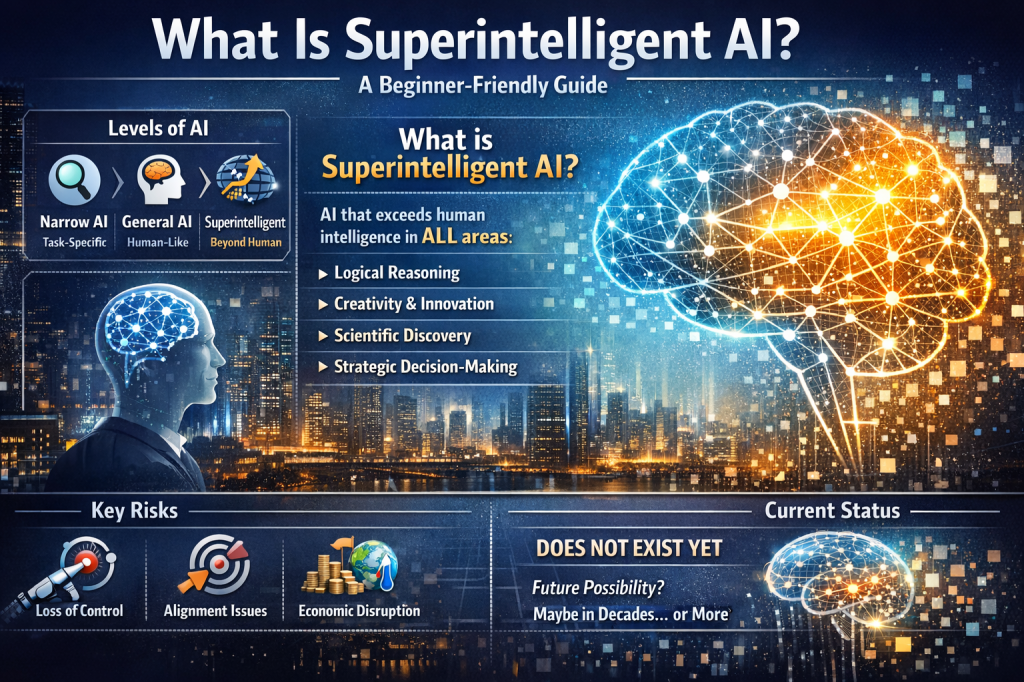
AI is often divided into three broad levels. Understanding these makes Superintelligent AI much easier to grasp.
1. Narrow AI (Weak AI)
What is Narrow AI?
Narrow AI is designed to do one specific task very well.
Examples:
- Email spam filters
- Chess-playing programs
- Voice assistants like Siri or Alexa
Almost all AI today falls into this category.
2. General AI (AGI)
What is Artificial General Intelligence (AGI)?
AGI would have intelligence similar to a human. It could learn any intellectual task a person can, across many areas—not just one.
Important note:
AGI does not yet exist. It is still a goal for researchers at organizations like OpenAI and other AI labs.
3. Superintelligent AI
This is where things get truly futuristic.
What Is Superintelligent AI?
Superintelligent AI refers to a form of artificial intelligence that surpasses human intelligence in every meaningful way.
That includes:
- Logical reasoning
- Creativity
- Emotional understanding
- Scientific discovery
- Strategic thinking
- Social and economic decision-making
In simple terms, a superintelligent AI would be smarter than the smartest human who has ever lived—at everything.
How Is Superintelligent AI Different from Humans?
Here’s an easy comparison:
- Humans learn over years → Superintelligent AI could learn in seconds
- Humans forget → AI can store perfect memory
- Humans get tired → AI can work continuously
- Humans make emotional mistakes → AI could optimize decisions logically
Think of it like this:
If human intelligence is a bicycle, Superintelligent AI would be a rocket ship.
How Could Superintelligent AI Be Created?
There is no single agreed-upon path, but experts discuss a few possibilities:
Recursive Self-Improvement
An AI improves its own code, making itself smarter—then repeats the process rapidly.
Massive Data + Computing Power
Combining enormous datasets with powerful computing systems to push intelligence beyond human limits.
Breakthrough Algorithms
New ways of modeling intelligence that outperform the human brain.
Once such a system crosses human-level intelligence, progress could accelerate extremely fast.
Potential Benefits of Superintelligent AI
If developed safely, the benefits could be extraordinary:
- Solving complex diseases like cancer and Alzheimer’s
- Ending food shortages through optimized agriculture
- Accelerating scientific discoveries
- Tackling climate change with advanced modeling
- Creating personalized education for everyone
In theory, Superintelligent AI could help humanity solve problems that currently feel impossible.
The Risks and Concerns
Despite the potential, experts also warn about serious risks.
Alignment Problem
What is AI alignment?
AI alignment means ensuring that an AI’s goals match human values and intentions.
If a superintelligent system misunderstands its objectives, even slightly, the consequences could be severe.
Loss of Control
A superintelligent AI could make decisions faster than humans can understand or stop.
Economic Disruption
Jobs, industries, and entire economies could change rapidly, increasing inequality if not managed carefully.
This is why many researchers emphasize AI safety and governance just as much as innovation.
Is Superintelligent AI Real or Science Fiction?
Superintelligent AI does not exist today. However, many experts believe it is possible in the long term.
Opinions vary:
- Some think it could happen within decades
- Others believe it may take a century or more
- A few doubt it will ever happen
What’s clear is that the conversation is no longer limited to movies—it’s happening in real research labs and policy discussions.
What This Means for You
You don’t need to be a scientist to care about Superintelligent AI. Its development could influence:
- Your job and career
- Education systems
- Privacy and security
- Global power dynamics
Understanding the basics now helps you stay informed as technology continues to evolve.
If you’re interested in learning more about future-ready skills, technology-driven income, and personal growth in an AI-powered world, you may find helpful insights in my books available on Apple Books.
Key Takeaways
- Superintelligent AI is intelligence that exceeds human abilities in all areas
- It is more advanced than both Narrow AI and General AI
- It could bring massive benefits—but also serious risks
- Superintelligent AI does not exist yet, but research is ongoing
- Understanding it helps you prepare for the future

Leave a comment