Artificial Intelligence (AI) is everywhere today—from chatbots and recommendation systems to self-driving cars. But not all AI works the same way. One of the oldest and most influential approaches is Symbolic AI.
If you’ve ever wondered how early AI systems “thought” or followed rules like a human expert, this guide will walk you through Symbolic AI in clear, beginner-friendly language.
What Is Symbolic AI?
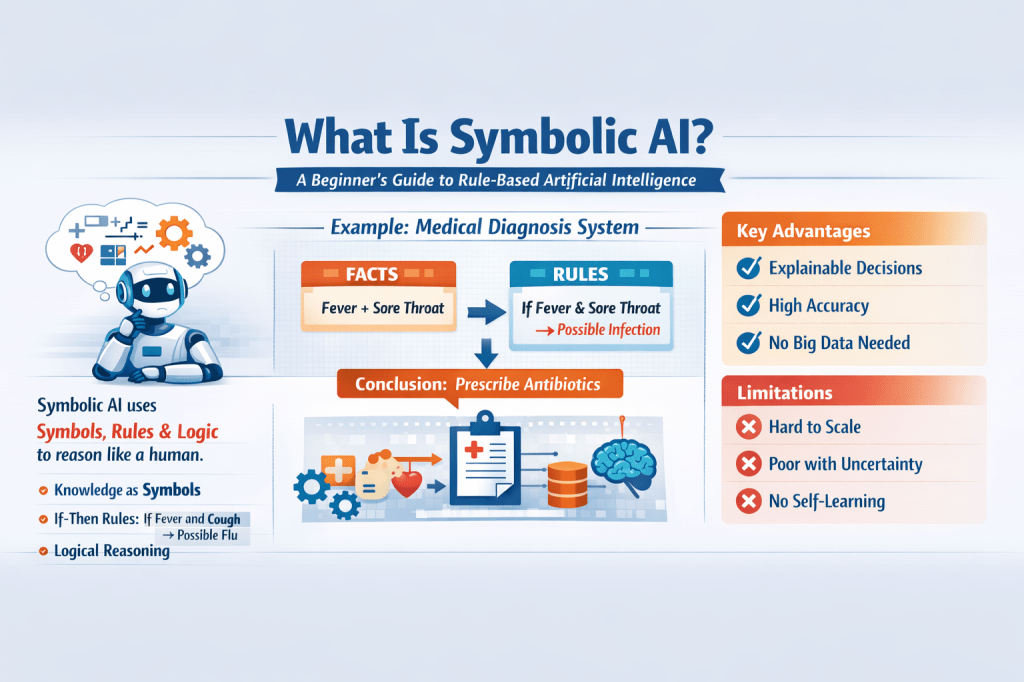
Symbolic AI is an approach to artificial intelligence where machines reason using symbols, rules, and logic, much like humans do when they think step by step.
In simple terms, Symbolic AI works by:
- Representing knowledge as symbols (words, numbers, or logical statements)
- Applying if–then rules to those symbols
- Using logical reasoning to reach conclusions
Instead of learning from large amounts of data, Symbolic AI relies on explicit human knowledge.
What is a symbol?
In AI, a symbol is a clear representation of something in the real world—like the word “fever” representing a medical symptom.
How Symbolic AI Works (Step by Step)
Symbolic AI systems usually follow a structured process:
- Knowledge Representation
Facts about the world are stored as symbols- Example:
Fever = True,Temperature > 38°C
- Example:
- Rules and Logic
Rules explain how symbols relate to each other- Example: If fever and cough, then possible flu
- Inference Engine
This is the “reasoning engine” that applies rules to facts to make decisions.
Think of Symbolic AI like a very organized rule book that a computer follows perfectly—without guessing.
A Simple Real-World Example
Imagine a medical diagnosis system built using Symbolic AI:
- Facts:
- Patient has fever
- Patient has sore throat
- Rules:
- If fever + sore throat → possible infection
- If infection + high temperature → prescribe antibiotics
The system doesn’t learn these rules. A human expert programs them directly.
This is why Symbolic AI is often called rule-based AI.
Common Types of Symbolic AI Systems
1. Expert Systems
Expert systems are programs designed to mimic the decision-making ability of a human expert in a specific field.
What is an expert system?
A computer system that uses rules and knowledge from human experts to solve complex problems.
They are widely used in:
- Medical diagnosis
- Legal advice tools
- Industrial troubleshooting
2. Logic-Based Systems
These systems use formal logic (like mathematical reasoning) to draw conclusions.
They are often used in:
- Automated theorem proving
- Planning and scheduling tasks
3. Knowledge-Based Systems
These focus on storing large sets of structured knowledge and reasoning over it logically.
Key Advantages of Symbolic AI
Symbolic AI has some strong benefits, especially in controlled environments:
✅ Explainable Decisions
Every decision comes from clear rules, making it easy to understand why the system reached a conclusion.
✅ High Accuracy in Rule-Based Domains
When rules are well-defined, Symbolic AI can be extremely reliable.
✅ No Massive Data Needed
Unlike modern AI models, Symbolic AI does not require huge datasets.
Limitations of Symbolic AI
Despite its strengths, Symbolic AI also has important weaknesses:
❌ Hard to Scale
Writing and maintaining thousands of rules becomes difficult as systems grow.
❌ Poor at Handling Uncertainty
Real-world situations are messy, but Symbolic AI prefers clear yes/no logic.
❌ No Learning on Its Own
Symbolic AI cannot improve automatically unless humans update its rules.
Symbolic AI vs Modern AI (Machine Learning)
Here’s a simple comparison:
| Symbolic AI | Machine Learning |
|---|---|
| Rule-based | Data-driven |
| Human-written logic | Learns from examples |
| Highly explainable | Often a “black box” |
| No self-learning | Continuously improves |
What is machine learning?
A type of AI where computers learn patterns from data instead of following fixed rules.
Today’s AI systems often combine both approaches in what’s called hybrid AI.
Is Symbolic AI Still Used Today?
Yes—Symbolic AI is very much alive.
It’s commonly used in:
- Business rule engines
- Compliance and policy systems
- Financial decision models
- Safety-critical systems where explanations matter
Many modern AI solutions blend Symbolic AI + machine learning to get the best of both worlds.
Why Symbolic AI Still Matters
Symbolic AI reminds us that intelligence isn’t just about data—it’s also about reasoning, structure, and clarity.
As AI becomes more powerful, explainability and trust are becoming more important. That’s where Symbolic AI continues to shine.
What This Means for You
If you’re learning AI or exploring tech concepts:
- Symbolic AI helps you understand how machines reason
- It builds a strong foundation in logic and structured thinking
- It’s especially useful in business, law, and decision-based systems
To deepen your understanding of AI, decision-making, and logical thinking in real-world applications, you may also find helpful insights in my books on business and personal development, available on my Apple Books author page.

Leave a comment