Have you ever used a smartphone without knowing how the tiny circuits inside actually work? You tap an app, send a message, or take a photo—and everything just happens. You don’t need to understand electrical engineering to use it.
That’s abstraction.
Now let’s bring that idea into the world of artificial intelligence. AI abstraction is the process of hiding complex details so humans (and even other computer systems) can use AI tools easily without needing to understand how they work internally.
In simple terms, AI abstraction is like using a remote control. You press a button, and something happens. You don’t need to know how the signals travel or how the TV decodes them.
Breaking It Down Simply
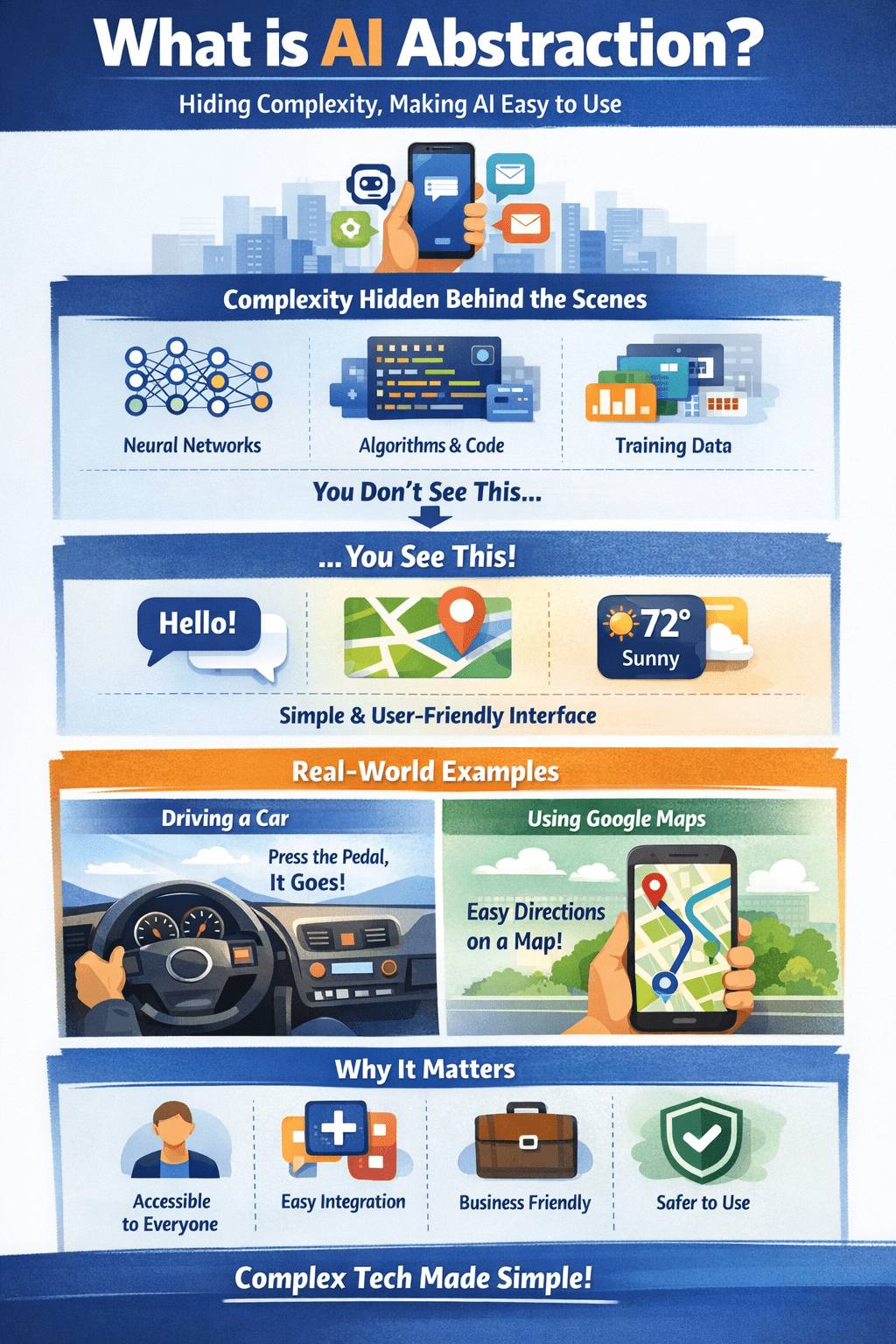
Artificial Intelligence (AI) systems are incredibly complex. Behind the scenes, they use mathematical models, neural networks, training data, and algorithms. These are advanced technical components that can take years to understand.
But here’s the good news: most users never need to learn those details.
AI abstraction acts like a bridge. It hides the complicated processes and presents something simple and usable.
For example, when you use a chatbot like ChatGPT, you type a question and get an answer. You don’t see:
- The millions (or billions) of parameters inside the model
- The training process
- The probability calculations happening in milliseconds
All of that is abstracted away.
You only see the conversation.
A Real-World Example: Driving a Car
Think about driving a car.
When you press the accelerator, the car moves. But do you understand how fuel injection works? Or how the engine converts fuel into motion?
Probably not—and you don’t need to.
The steering wheel, pedals, and dashboard are abstractions. They simplify a highly complex mechanical system into something a regular person can operate safely.
AI works the same way. Developers build complicated systems, then create user-friendly interfaces (like apps or APIs) so everyday people can benefit from them.
Another Example: Google Maps
When you use Google Maps, you type in a destination and instantly get directions.
Behind the scenes, it calculates routes, analyzes traffic data, processes satellite imagery, and runs machine learning models.
But what do you see?
A simple blue line telling you where to drive.
That simplicity is abstraction in action.
Why AI Abstraction Matters
Without abstraction, AI would only be usable by highly trained engineers.
Imagine if every time you wanted a weather update, you had to analyze atmospheric pressure data yourself. That would be exhausting.
Abstraction makes AI:
- Accessible to non-technical users
- Easier to integrate into apps
- Faster to adopt in businesses
- Safer to manage
For businesses, abstraction allows teams to use AI tools without hiring a full research department. For example, companies can use cloud AI services instead of building complex models from scratch.
Layers of Abstraction
AI abstraction often works in layers.
At the lowest level, there’s raw code and mathematical models.
Above that, there are frameworks like TensorFlow or PyTorch, which simplify building AI models.
Then come APIs (Application Programming Interfaces), which let developers use AI features with simple commands.
Finally, there are end-user applications—like voice assistants, recommendation systems, and chatbots—that everyday people interact with.
Each layer hides more complexity.
It’s like building a house:
- You don’t see the wiring inside the walls.
- You don’t see the plumbing under the floor.
- You only see the switch and the faucet.
But everything underneath is still working.
The Trade-Off: Simplicity vs. Control
Abstraction makes life easier—but there’s a trade-off.
When details are hidden, users have less control. Advanced developers sometimes “go deeper” into the system to customize performance.
It’s similar to using a smartphone in basic mode versus developer mode. Most people are happy with the simple interface. Experts sometimes need access to the technical layers underneath.
So abstraction is about balance—making things simple without completely hiding the power beneath.
Key Takeaways
AI abstraction is the art of hiding complexity so people can use powerful systems easily.
It turns complicated math into simple buttons. It transforms lines of code into user-friendly apps. It allows businesses, students, and everyday users to benefit from AI without becoming data scientists.
Next time you ask an AI tool a question or get a movie recommendation online, remember: you’re interacting with a simplified surface built on top of a very complex machine.
That invisible simplification—that’s AI abstraction at work.
If you want to deepen your understanding of AI and other emerging technologies, check out my collection of e-books for deeper insights into these topics: Shafaat Ali on Apple Books.

Leave a comment