If you’ve ever wondered how Netflix seems to “know” what show you’ll binge next, or how Google Maps predicts traffic before you even leave the house, you’ve already experienced AI modeling in action.
But what exactly is AI modeling?
In simple terms, AI modeling is the process of teaching a computer to recognize patterns and make decisions based on data. Think of it like training a very fast, very literal student who learns by studying thousands—or even millions—of examples.
Let’s break it down in a way that actually makes sense.
The Big Idea Behind AI Modeling
At its core, AI modeling is about building a mathematical system (called a model) that can learn from data and then use that learning to make predictions or decisions.
Imagine you’re teaching a child to recognize cats. You show them 100 pictures and say, “This is a cat.” Over time, the child starts noticing patterns—whiskers, fur, pointy ears. Eventually, they can spot a cat on their own.
AI modeling works the same way.
Instead of a child, we have a computer program.
Instead of pictures, we have data.
Instead of intuition, we use mathematics and algorithms (step-by-step rules the computer follows).
The result? A system that can make smart guesses based on what it has learned.
How AI Models Actually Learn
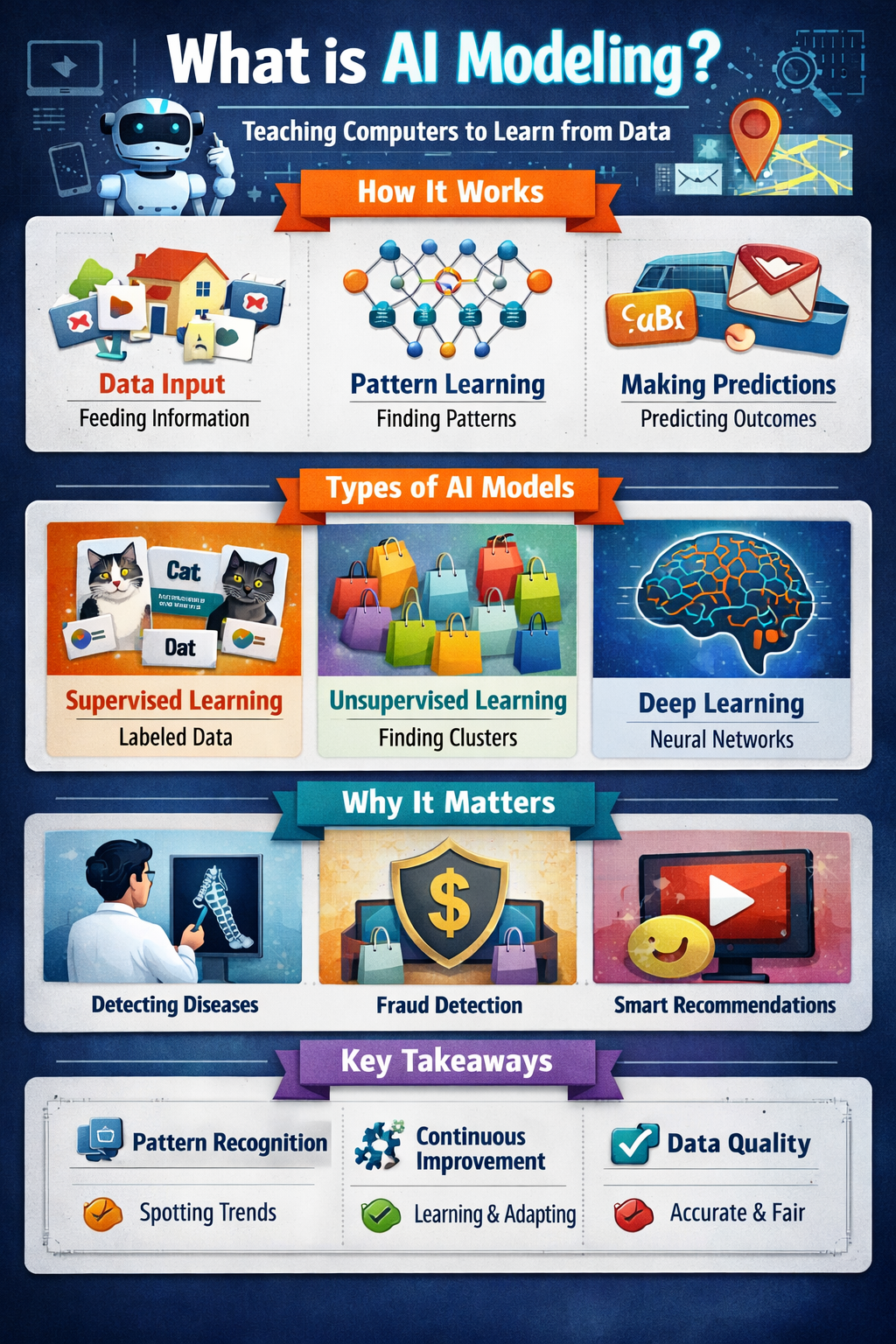
AI models learn through a process called training. Training means feeding the system lots of data and adjusting it until it gets better at making predictions.
Let’s use a relatable example.
Suppose you want to build an AI model that predicts house prices. You would give it data like:
- Size of the house
- Number of bedrooms
- Location
- Age of the property
- Past selling prices
The model studies patterns in this information. Over time, it learns that larger houses in better neighborhoods usually cost more. When you show it a new house, it can estimate the price based on what it learned earlier.
That’s AI modeling in action.
Another everyday example? Email spam filters. Your email service has been trained on millions of spam and non-spam messages. It learns patterns—certain words, suspicious links, unusual formatting. When a new email arrives, the model predicts whether it’s spam. You barely notice it happening, but that’s AI modeling working quietly in the background.
Types of AI Modeling
Not all AI models are built the same way. There are different approaches depending on the problem.
One common type is supervised learning. This is when the model learns from labeled data—meaning the correct answers are already provided. Like showing pictures labeled “cat” and “dog.”
Another type is unsupervised learning. Here, the model looks for patterns without being told the correct answers. For example, a shopping website might group customers based on buying behavior without knowing anything else about them.
Then there’s deep learning, which uses layered systems called neural networks. These are inspired by the human brain and are especially good at handling images, speech, and language.
Each approach is just a different way of building and training an AI model.
Why AI Modeling Matters
AI modeling is powerful because it allows computers to handle tasks that used to require human intelligence.
Healthcare providers use AI models to help detect diseases in medical scans. Banks use them to spot fraudulent transactions. Streaming platforms use them to personalize recommendations.
But here’s something important: AI models are only as good as the data they learn from. If the data is incomplete or biased, the model’s decisions can also be flawed. That’s why responsible AI modeling requires careful design, testing, and monitoring.
Think of it like teaching. If you teach someone incorrect information, they’ll make incorrect decisions later. The same principle applies here.
Key Takeaways
AI modeling is simply the process of teaching computers to learn from data and make predictions. It works by identifying patterns, adjusting through training, and improving over time.
If you strip away the technical buzzwords, it’s really about pattern recognition at scale.
The next time your phone unlocks with your face, your playlist feels perfectly curated, or your navigation reroutes around traffic, you’ll know what’s happening behind the scenes. AI models are quietly analyzing patterns and helping systems make smarter choices.
And this field is only growing. As data becomes more available and computing power increases, AI modeling will continue shaping industries—from education and business to healthcare and entertainment.
If you’re curious about technology, business, or the future of work, understanding AI modeling is a powerful first step.
Check out my collection of e-books for deeper insights into these topics: Shafaat Ali on Apple Books.

Leave a comment