If you’ve ever noticed how your Netflix recommendations seem to get better over time, or how Google Maps suddenly finds a faster route when traffic builds up, you’ve already seen AI optimization in action. But what exactly is it?
At its core, AI optimization is the process of making artificial intelligence systems smarter, faster, more accurate, and more efficient. Think of it like tuning a car engine. The car can run straight from the factory—but with adjustments and fine-tuning, it performs better. AI works the same way.
Let’s break it down in simple terms.
The Simple Idea Behind Optimization
“Optimization” simply means improving something to get the best possible result. In AI, that usually means adjusting a system so it makes better decisions or predictions.
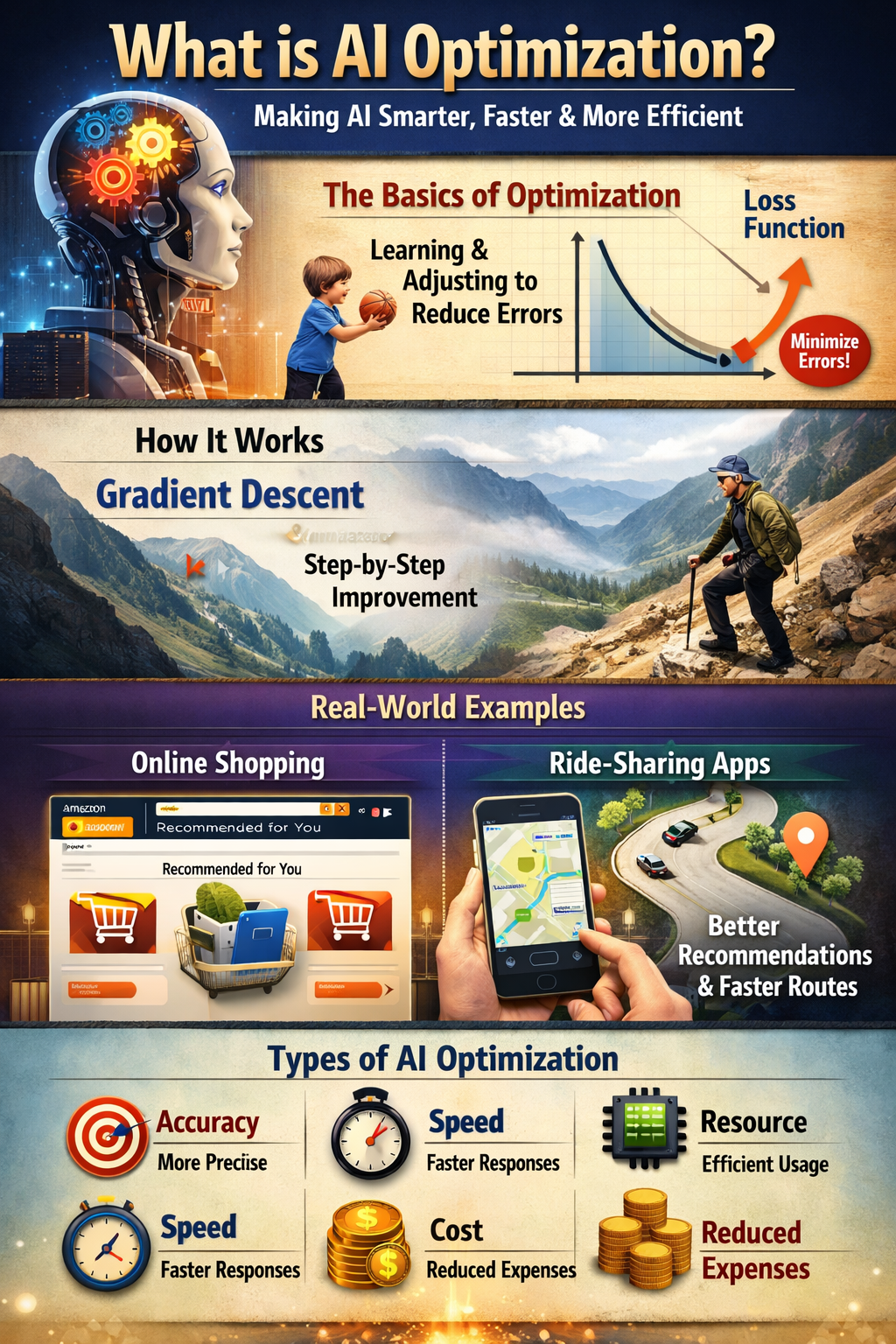
Imagine you’re teaching a child to throw a basketball into a hoop. The first few attempts might miss completely. But with feedback—“Aim higher,” “Use more force”—the child improves. AI systems learn in a similar way. They start with guesses, receive feedback, and then adjust themselves to reduce mistakes.
The mathematical tool often used here is called a “loss function.” Don’t let the term scare you—it’s just a way to measure how wrong the AI is. The goal of optimization is to reduce that “loss” as much as possible.
How AI Optimization Works in Practice
Most AI systems, especially those built using machine learning, rely on optimization algorithms. These are step-by-step procedures that help the system improve.
One of the most common techniques is called “gradient descent.” Picture yourself standing on a foggy mountain trying to reach the lowest point in a valley. You can’t see far ahead, but you can feel the slope under your feet. So you take small steps downhill. Eventually, you reach the bottom. That’s essentially how gradient descent works—it makes small adjustments to reduce error step by step.
Companies like Google and OpenAI rely heavily on optimization to train their large AI models. Without optimization, these systems would remain inaccurate and unreliable.
Real-World Examples You Already Know
Let’s make this even more relatable.
Example 1: Online Shopping
When you browse products on Amazon, the system studies your clicks, purchases, and searches. Over time, it optimizes its recommendation engine so the items it shows you are more likely to interest you. It’s constantly adjusting its internal settings to better predict your behavior.
Example 2: Ride-Sharing Apps
Apps like Uber don’t just match drivers and riders randomly. They optimize routes, pricing, and driver distribution to reduce wait times and maximize efficiency. Behind the scenes, AI models are being fine-tuned continuously to improve performance.
In both cases, optimization is what makes the system “learn” and improve instead of staying static.
Different Types of AI Optimization
AI optimization isn’t just about improving accuracy. It can focus on several goals:
Accuracy Optimization: Making predictions more correct.
Speed Optimization: Reducing how long it takes for the AI to respond.
Resource Optimization: Lowering memory usage or power consumption (especially important for mobile devices).
Cost Optimization: Reducing computational costs when running large AI models.
For example, a smartphone assistant needs to respond quickly without draining your battery. So engineers optimize both performance and efficiency.
Why Optimization Matters More Than You Think
Without optimization, AI would be like a student who never learns from mistakes. It would produce the same errors repeatedly.
Optimization allows AI systems to:
- Adapt to new data
- Improve over time
- Scale to millions (or billions) of users
- Deliver personalized experiences
It’s the invisible engine that powers everything from voice assistants to fraud detection systems.
Common Misconceptions
Some people think AI optimization means the AI becomes conscious or “smarter” in a human sense. That’s not the case. Optimization is mathematical fine-tuning. The system isn’t thinking—it’s adjusting numbers to reduce errors.
Another misconception is that optimization happens once. In reality, it’s often continuous. Models are retrained and refined regularly to keep up with new information.
Key Takeaways
AI optimization is simply the process of improving AI systems so they perform better. It uses mathematical techniques to reduce errors, improve efficiency, and adapt to new data. Whether it’s recommending your next movie, routing your delivery package, or detecting spam emails, optimization is what makes AI practical and powerful.
If you remember one thing, let it be this: AI doesn’t magically get better—it gets optimized.
Check out my collection of e-books for deeper insights into these topics: Shafaat Ali on Apple Books.

Leave a comment