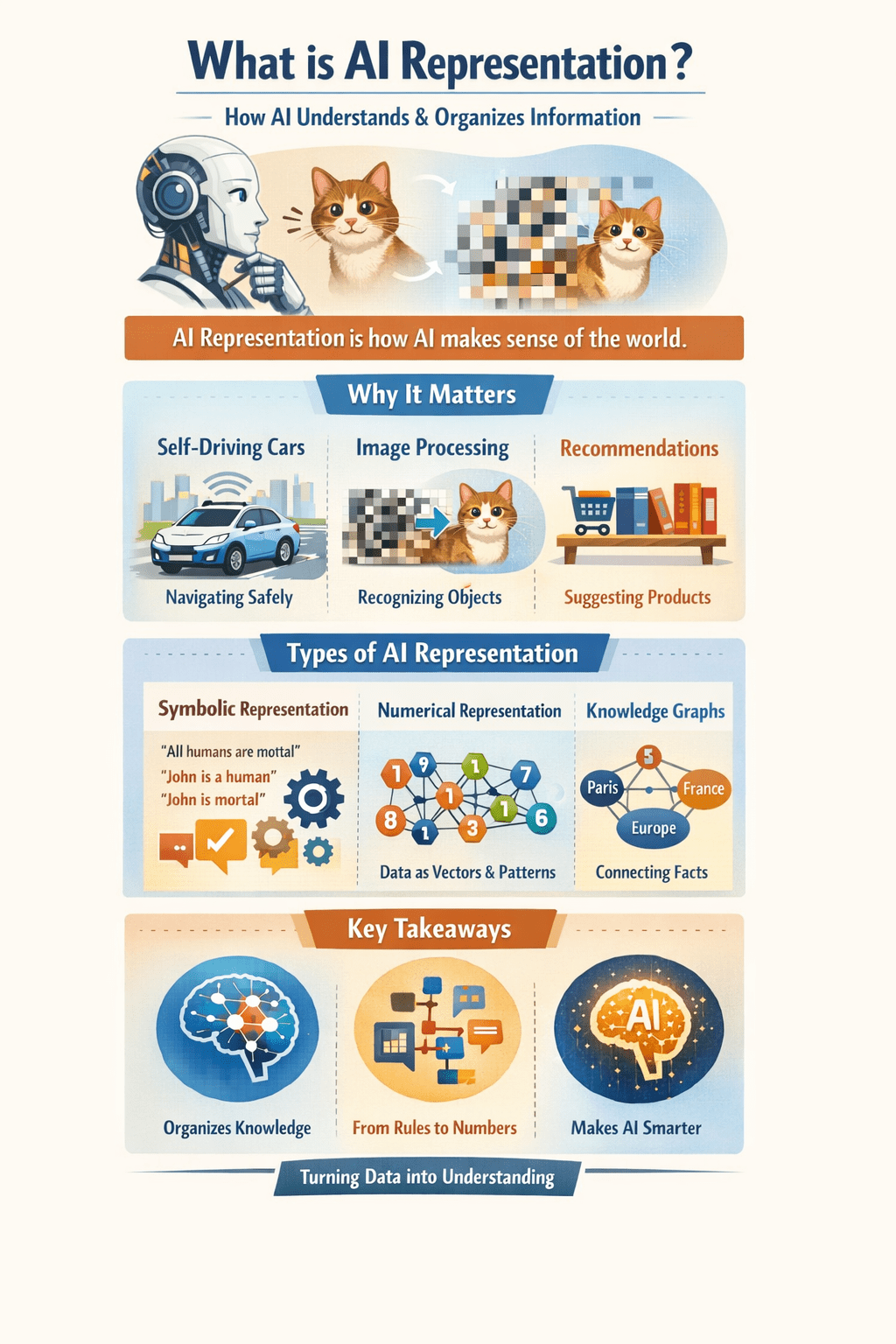
AI representation is about how artificial intelligence (AI) systems understand and store information about the world. Think of it as the way AI “makes sense” of things so it can think, learn, and make decisions.
When you and I look at a cat, we recognize it instantly. We know it has fur, whiskers, and usually says “meow.” But a computer doesn’t naturally understand what a cat is. It needs a structured way to represent that idea in data. That structured way is called AI representation.
Why AI Representation Matters
Imagine you’re building a self-driving car. The car must understand roads, traffic lights, pedestrians, and other vehicles. If it can’t properly represent these things inside its system, it won’t know how to react safely.
AI representation acts like a mental map for machines. Without it, AI would just see random numbers instead of meaningful patterns.
For example:
- A photo becomes a grid of pixel numbers.
- A sentence becomes a sequence of tokens or word vectors.
- A customer profile becomes structured data like age, preferences, and past purchases.
Representation turns messy real-world information into something machines can process.
Types of AI Representation
There are different ways AI systems represent knowledge.
1. Symbolic Representation
This is like writing facts in clear rules. For example:
- “All humans are mortal.”
- “John is a human.”
- Therefore, “John is mortal.”
Early AI systems relied heavily on rules and logic like this.
2. Numerical Representation
Modern AI often uses numbers instead of explicit rules. For example, in image recognition, an object like a dog is represented as patterns of numbers learned from thousands of images.
When you use voice assistants, your speech is converted into numerical features before the system understands your request.
3. Knowledge Graphs
Some AI systems connect information in networks. For example:
- “Paris” → “is capital of” → “France”
- “France” → “located in” → “Europe”
This web-like structure helps AI understand relationships.
Real-Life Example
Think about recommendation systems like those used by online stores. When you buy a book about cooking, the AI represents your interest numerically and compares it with other users. If people who bought cooking books also bought baking tools, you might see baking tools suggested to you.
All of this works because your behavior is represented in a structured, meaningful way.
Key Takeaways
AI representation is simply the method AI uses to organize and understand information. It can use rules, numbers, or connected data structures. The better the representation, the smarter and more accurate the AI system becomes.
As AI continues to grow, representation methods are becoming more advanced, helping machines understand language, images, and even emotions more effectively.
Looking Forward
In the future, AI representation may become more human-like. Systems may better understand context, sarcasm, and complex emotions. This will make interactions with AI feel more natural and intelligent.
If you want to explore more simple explanations about AI and technology, check out my books on Shafaat Ali, Apple Books.

Leave a comment